
For walking the Shokz OpenRun Pro 2 is the best pick, because an open-ear design leaves your canal unblocked so you hear traffic at full volume, with up to 12 rated hours and IP55 water resistance. Choose the Soundcore P40i at $79.99 for a cheap daily pair with 12 hours per charge and 60 with the case, the Beats Powerbeats Pro 2 if earbuds keep working loose, and the Sony WF-1000XM6 if the same pair also has to handle a train or a flight.
The inversion
Why walking is the one case where canceling is wrong
Everywhere else on this site, deeper canceling is better. Walking is the exception, and the reason is simple: on a sidewalk the information you need most is the sound of something approaching from behind you. Removing it is a safety cost, not a feature.
That changes the ranking in three ways.
Awareness moves to the top
Either you do not block the ear at all, which is the open-ear approach, or you rely on a transparency mode that re-injects outside sound through microphones. Transparency is genuinely good now, but it is a processed version of the world with a small delay, and it stops working the moment a battery dies. Transparency mode vs noise canceling covers how the two modes differ in practice.
Battery is measured in weeks, not flights
A walking headphone is used in short, frequent sessions. That makes total battery with the case the number that matters, because the failure mode is not running out mid-walk — it is finding them flat when you want to leave the house.
Retention beats isolation
An earbud that works loose over 40 minutes of movement is a worse product than one that isolates slightly less and stays put. Hooks and wings exist for this, and they work.
On a sidewalk the most useful sound in your environment is the one coming up behind you. Canceling is very good at removing exactly that.
The matrix
The four picks on the figures that matter on foot
| Shokz OpenRun Pro 2 | Soundcore P40i | Beats Powerbeats Pro 2 | Sony WF-1000XM6 | |
|---|---|---|---|---|
| List price | Not quoted here | $79.99 | $249.99 | Not quoted here |
| Battery, buds | up to 12 h | 12 h | up to 8 h (10 h Adaptive EQ) | up to 8 h |
| Total with case | n/a (no case battery) | 60 h | 36 h (45 h Adaptive EQ) | up to 24 h |
| Quick charge | 5 min = 2.5 h | - | - | - |
| Water resistance | IP55 | IPX5 | IPX4 | IPX4 |
| Ear is blocked | No, open-ear | Yes, sealed tips | Yes, sealed tips | Yes, sealed tips |
| Awareness method | Nothing in the canal | Transparency mode | Transparency mode | Ambient sound mode |
| Retention | Wraparound band | Tips | Ear hooks | Tips |
What to look for
Four checks before you buy for walking
- How you will hear traffic. Open-ear is the physics answer, transparency is the software answer. If you walk beside roads daily, prefer the physics.
- Water rating, not just “sweat resistant”. IP55 and IPX5 include water jets; IPX4 is splashes. You will get caught out at some point.
- Retention under movement. Hooks, wings or a wraparound band. Tips alone are the design most likely to loosen over a long walk.
- Total battery with the case. Short frequent sessions make the case the real tank. Sixty hours means charging roughly fortnightly rather than every few days.
Over-ear outdoors
Can you just use over-ear headphones?
You can, and plenty of people do. The problems are heat and awareness: a sealed pad against your head in summer is unpleasant within twenty minutes, and the isolation is passive, so turning canceling off does not give you your hearing back the way removing an earbud does.
Where an over-ear does make sense for walking is cold weather, when the pads are a feature, and in a city where you are mostly on wide sidewalks away from traffic. If that is you, the commuting roundup is the better list, and the comfort ranking is where to check pad heat before you commit.
Adjacent
Walking, running and hiking are not the same purchase
Running adds sweat volume and impact, which pushes the water rating and the retention requirement higher — see best headphones for running. Swimming is a completely different product category, because Bluetooth does not travel through water at all, which is why the swimming page is about on-board storage rather than codecs.
Walking sits between them: lower sweat than running, longer sessions than a commute, and more traffic exposure than either.
In short
Key takeaways
- Shokz OpenRun Pro 2 is the best walking pick: nothing in the canal, up to 12 rated hours, IP55, 5 minutes for 2.5 hours.
- Soundcore P40i at $79.99 gives 12 hours per charge and 60 with the case — the right cheap daily pair.
- Beats Powerbeats Pro 2 at $249.99 solves retention with an ear hook, at up to 8 hours per bud and 36 with the case.
- Sony WF-1000XM6 if the same earbud also has to do a train or a flight: up to 8 hours per bud, 24 with the case.
- Walking is the one use case where you should turn canceling down. Awareness is the priority, not reduction.
- Shop on water rating, retention method and total battery with the case.
At a glance
Quick picks
Scores are our editorial judgment from published specifications and cited third-party measurements, not our own testing. The rubric is published in full. Tap any row for the full write-up.
| # | Product | Best for | Score | Price |
|---|---|---|---|---|
| 1 |  Shokz OpenRun Pro 2An open-ear headphone that leaves your ear canal empty, so you hear the traffic behind you as well as the playlist. The point of it is the opposite of noise canceling. | Best for walking near traffic | 8.58.5 out of 10, our editorial score | |
| 2 | 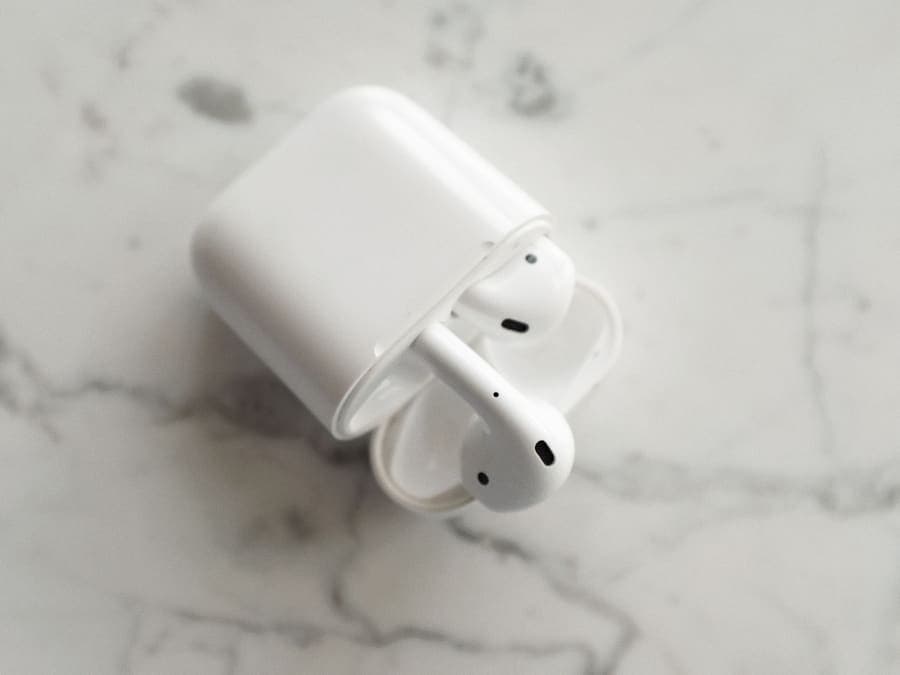 Soundcore P40iA $79.99 earbud rated at 12 hours a charge and 60 with the case, with adaptive canceling and a case that folds out into a phone stand. | Best cheap pair for daily walks | 8.08.0 out of 10, our editorial score | |
| 3 | 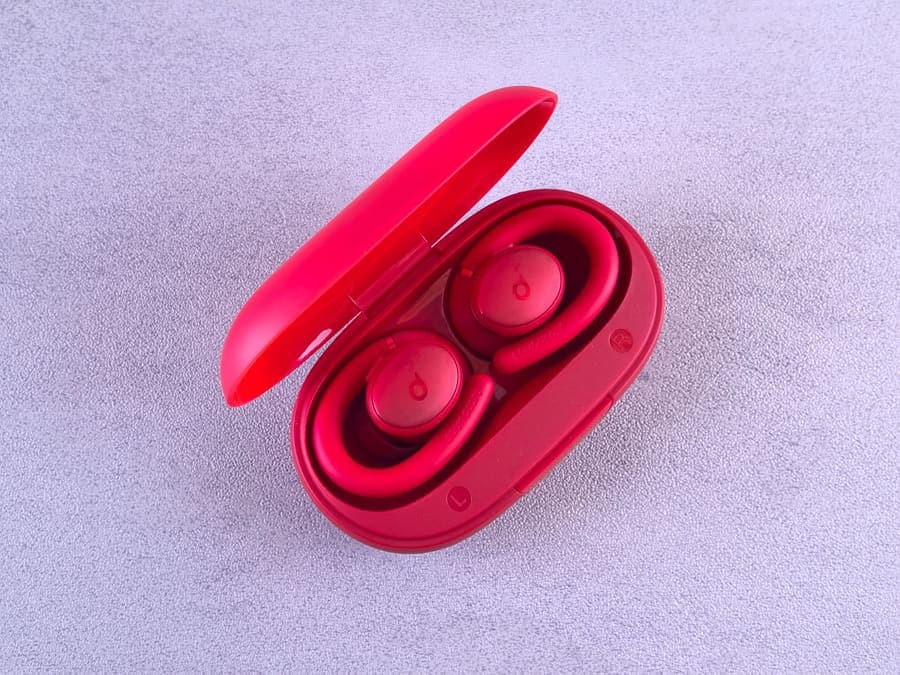 Beats Powerbeats Pro 2The ear hook is the whole argument: a sealed earbud that does not migrate out on a long run, with noise canceling for the treadmill and transparency for the road. | Best if they keep falling out | 8.48.4 out of 10, our editorial score | |
| 4 | 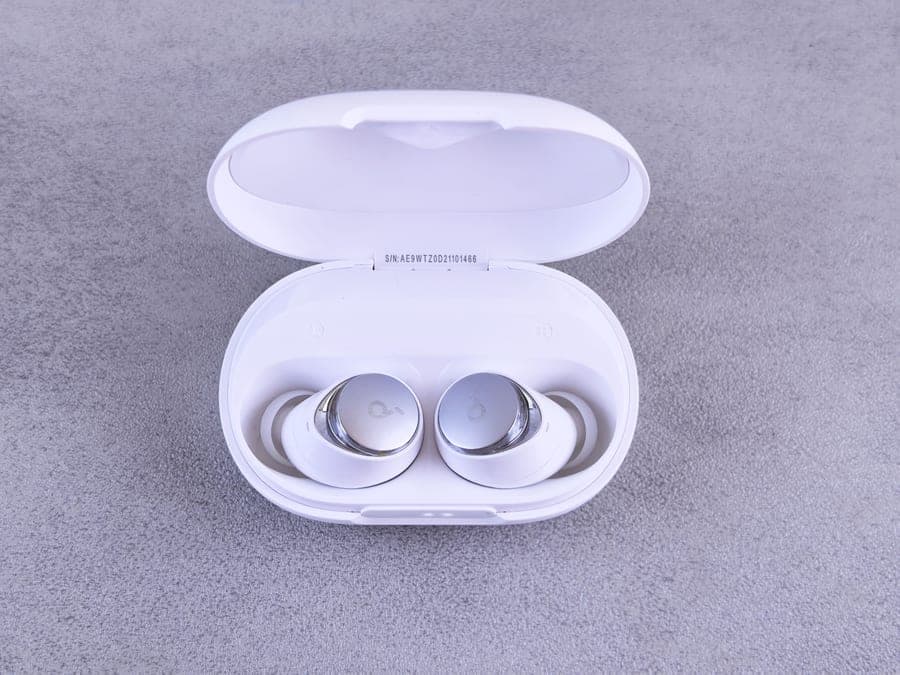 Sony WF-1000XM6Eight rated hours per bud and 24 with the case, at roughly 6.5 g each. The most sensible premium earbud for a flight, because you never have to plan around the battery. | Best if the walk is only half the job | 8.98.9 out of 10, our editorial score |
#ad Amazon links are affiliate links. No live price is shown anywhere on this site, so every button reads “Check price on Amazon”. How this is funded.
The picks in full
Every pick, in detail
1. Best for walking near traffic
Shokz OpenRun Pro 2
An open-ear headphone that leaves your ear canal empty, so you hear the traffic behind you as well as the playlist. The point of it is the opposite of noise canceling.
Our editorial score: 8.5 / 10
#ad Live price not shown. How this is funded
Also sold direct by Shokz — we earn nothing there, so check both.
The right default for walking, because it leaves your ear canal completely open. You hear a car, a bike bell and a person behind you at full volume while still hearing your podcast, and no transparency mode gets close to simply not blocking the ear.
Up to 12 rated hours, five minutes of charge for 2.5 hours, a full charge in one hour, and IP55 so a light shower is a non-event. It pairs bone conduction with an 18 x 11 mm air-conduction low-frequency unit, which is what fixes the thin bass older bone-conduction designs were known for.
Two honest limits. It leaks sound outward, so it is wrong for a quiet office, and because nothing is sealed it cannot reduce road noise at all — in heavy traffic you will reach for the volume.
What works on a plane
- Your ear canal stays open, so road and trail awareness is not a compromise
- 30.3 g on a titanium band means it stops registering as something you are wearing
- IP55 shrugs off sweat, which is the failure mode that kills running earbuds
- 12 rated hours covers a marathon block without a mid-week charge
What does not
- Bone conduction gives up bass depth against a sealed earbud, and no firmware fixes physics
- IP55 is splash resistance, not submersion — this is not a swimming headphone
- Open by design, so it is the wrong tool on a plane or in an open-plan office
How it scores against the five travel axes
Published specifications
| Spec | Figure | Source |
|---|---|---|
| Weight | 30.3 g | Shokz OpenRun Pro 2 specifications |
| Battery | Up to 12 hours | Shokz OpenRun Pro 2 specifications |
| Quick charge | 5 minutes for 2.5 hours | Shokz OpenRun Pro 2 specifications |
| Full charge | 1 hour | Shokz OpenRun Pro 2 specifications |
| Bluetooth | 5.3 | Shokz OpenRun Pro 2 specifications |
| Water resistance | IP55 (sweat and splashes, not swimming) | Shokz OpenRun Pro 2 specifications |
| Drivers | Bone conduction plus an 18 x 11 mm air-conduction low-frequency unit | Shokz OpenRun Pro 2 specifications |
| Multipoint | Yes | Shokz OpenRun Pro 2 specifications |
2. Best cheap pair for daily walks
Soundcore P40i
A $79.99 earbud rated at 12 hours a charge and 60 with the case, with adaptive canceling and a case that folds out into a phone stand.
Our editorial score: 8.0 / 10
#ad Live price not shown. How this is funded
Also sold direct by Soundcore — we earn nothing there, so check both.
$79.99 at the time of writing, 12 hours per charge and 60 hours with the case. For someone walking 45 minutes a day that case figure is close to a fortnight, which is the spec that stops the habit breaking.
IPX5 covers sweat and rain, the 11 mm composite drivers are more than adequate for speech and most music outdoors, and adaptive canceling means you can turn the reduction up on a bus and down on a sidewalk.
It is a sealed in-canal design, so awareness depends on its transparency mode rather than on the physics. That is the trade against the Shokz, and it is the reason this is the second pick rather than the first.
What works on a plane
- 60 rated hours with the case, from an earbud listed at $79.99
- IPX5 means sweat and rain are not a worry on a commute
- The fold-out case stand is a genuinely useful thing on a tray table
- Adaptive canceling at a price where fixed canceling is the norm
What does not
- Canceling depth is a long way behind the premium earbuds, especially in the low band
- No LDAC, so Android listeners do not get the better codec
- The stock tip selection is narrow, and the seal is what decides earbud canceling
How it scores against the five travel axes
Published specifications
| Spec | Figure | Source |
|---|---|---|
| List price | $79.99 at the time of writing | Soundcore |
| Battery | 12 hours per charge, 60 hours with the case | Soundcore |
| Noise canceling | Adaptive ANC | Soundcore |
| Drivers | 11 mm composite | Soundcore |
| Water resistance | IPX5 | Soundcore |
| Microphones | 6, with an AI call algorithm | Soundcore |
| Case | Doubles as a phone stand | Soundcore |
3. Best if they keep falling out
Beats Powerbeats Pro 2
The ear hook is the whole argument: a sealed earbud that does not migrate out on a long run, with noise canceling for the treadmill and transparency for the road.
Our editorial score: 8.4 / 10
#ad Live price not shown. How this is funded
Also sold direct by Beats — we earn nothing there, so check both.
The pick if the actual problem is retention. The ear hook is a mechanical solution to an earbud working loose on a long walk, and it is far more reliable than a different tip size.
Up to 8 hours per bud with canceling or transparency on and 36 hours with the case, or up to 10 and 45 hours in Adaptive EQ. IPX4, active canceling with transparency, built-in heart-rate sensors, and charging over USB-C or Qi. Beats lists it at $249.99 at the time of writing.
The cost is bulk around the ear, which is noticeable under a hat or a hood, and a price well above the Soundcore for a feature set most walkers will not use.
What works on a plane
- Ear hooks solve the one problem that ruins running earbuds, which is drift
- Switchable canceling and transparency, so the same pair works on the treadmill and the road
- Heart-rate sensing on board removes one more strap from the kit
- USB-C and Qi charging, so it uses whatever cable you already carry
What does not
- IPX4 is splash and sweat only — do not take these into a pool
- The hooks make the case noticeably larger than a stem earbud case
- Best features assume an Apple device, so an Android buyer loses part of what they paid for
How it scores against the five travel axes
Published specifications
| Spec | Figure | Source |
|---|---|---|
| Battery, ANC or transparency on | Up to 8 hours per bud, 36 hours with the case | Beats |
| Battery, Adaptive EQ | Up to 10 hours per bud, 45 hours with the case | Beats |
| Water resistance | IPX4 (sweat and splashes) | Beats |
| Chip | Apple H2 | Beats |
| Noise control | Active noise canceling and transparency | Beats |
| Heart rate | Built-in heart-rate sensors | Beats |
| Charging | USB-C and Qi wireless | Beats |
| List price | $249.99 at the time of writing | Beats |
4. Best if the walk is only half the job
Sony WF-1000XM6
Eight rated hours per bud and 24 with the case, at roughly 6.5 g each. The most sensible premium earbud for a flight, because you never have to plan around the battery.
Our editorial score: 8.9 / 10
#ad Live price not shown. How this is funded
Also sold direct by Sony — we earn nothing there, so check both.
The choice when the same earbud has to handle a walk to the station and then the train or the flight. Up to 8 rated hours per bud and 24 with the case, 16 of those from the case.
Approximately 6.5 g per bud with the medium tips, the HD Noise Canceling Processor QN3e with dual processors and eight microphones, SBC, AAC, LDAC and LC3, and IPX4.
For walking specifically it is over-specified: you are paying for canceling depth you should be turning down near a road. Buy it as the one earbud you own for everything, not because walking demands it.
What works on a plane
- Eight rated hours per charge clears most short-haul flights without touching the case
- 24 hours total with the case is the strongest reserve in the premium earbud set
- LDAC means it is not tied to one phone platform
- Roughly 6.5 g per bud effectively disappears when you are trying to sleep on your side
What does not
- Canceling is excellent but the Bose still takes the low-frequency band
- No wired fallback at all, so a seatback screen needs a transmitter
- IPX4 is splash resistance, not weather resistance
How it scores against the five travel axes
Published specifications
| Spec | Figure | Source |
|---|---|---|
| Battery, earbuds | Up to 8 hours | Sony |
| Total with case | Up to 24 hours (16 from the case) | Sony |
| Weight | Approx. 6.5 g per bud with M tips | Sony |
| Driver | 8.4 mm | Sony |
| Bluetooth | 5.3 | Sony |
| Codecs | SBC, AAC, LDAC, LC3 | Sony |
| Water resistance | IPX4 | Sony |
| Processor | HD Noise Canceling Processor QN3e, dual processors, eight microphones | Sony |
How we decide
How these picks were chosen
We do not run a test lab and we do not claim to have flown with these units. Every verdict on this page is one of three things: a measurement published by somebody who does own a test rig and is credited by name, a manufacturer specification we quote and then interpret against what a long flight actually demands, or a plainly-labeled editorial judgment. The five axes we score on — cabin-noise reduction, battery on a long-haul, pack size, comfort past hour three, and wired fallback — are the ones that decide a travel purchase, and the weighting is published in full.
Questions
Common questions
What are the best headphones for walking?
The Shokz OpenRun Pro 2, because an open-ear design leaves your canal unblocked so you hear traffic directly rather than through a microphone. Up to 12 rated hours, IP55, and five minutes of charge buys 2.5 hours. For a cheaper sealed pair, the Soundcore P40i at $79.99 with 12 hours per charge.
Should you use noise canceling while walking?
Not near traffic. Canceling is best at the steady low-frequency sound a car makes approaching, which is the one thing you most want to hear on a sidewalk. Use transparency or ambient mode outdoors and save the deep canceling for a train or a plane.
Are bone conduction headphones good for walking?
Yes, and it is the use case they suit best. Nothing sits in the canal, so your hearing is unaltered rather than processed. The two costs are sound leaking outward, which rules them out for a quiet office, and no ability to reduce road noise at all.
Do I need waterproof headphones for walking?
Water resistant rather than waterproof. IP55 or IPX5 covers rain and sweat, which is what walking produces. Full waterproofing only matters for swimming, and that needs a product with on-board storage because Bluetooth will not reach through water.
Why do my earbuds fall out when I walk?
Usually because the only thing holding them is friction against the canal, and jaw movement plus footfall gradually breaks that grip. A different tip size helps a little; an ear hook or wing is the design that actually fixes it.
Sources
Where these figures come from
- Shokz OpenRun Pro 2 specifications (12 hours, quick charge, IP55, driver arrangement)
- Soundcore P40i product page (list price $79.99, battery, drivers, IPX5)
- Beats Powerbeats Pro 2 product page (battery, IPX4, list price $249.99)
- Sony WF-1000XM6 specifications (battery, weight, processor, codecs, IPX4)
Read next
Related reading
- Best headphones for running
The same outdoor problem with more sweat and more impact.
- Transparency mode vs noise canceling
How well a microphone-fed version of the world really works.
- Best noise-canceling headphones for commuting
If the walk is a short leg of a longer journey.
- Are bone conduction headphones good for flying?
Why the best walking design is the worst plane design.