
For presenters, the SteelSeries Arctis Nova Pro Wireless is the best pick when you present seated: a retractable broadcast-quality boom microphone with 25 dB AI noise cancellation, 2.4 GHz plus Bluetooth, and two hot-swappable batteries rated at up to 22 hours each, so it is never out of action. If you move while presenting, the JBL Tour One M3 is the pick — the only headphone here with both 3.5 mm and USB-C wired paths in the box and up to 40 rated hours with canceling on. The budget pick is the Soundcore P40i with six microphones and an AI call algorithm. Prices come from Amazon’s own data, stamped with the date inside each buy button.
The inversion
Why a presenter should ignore most of this site
Every other page here ranks headphones on what reaches your ears. A presenter is judged on what leaves their mouth, and almost nothing in a headphone review tells you about that. Three consequences follow, and they are uncomfortable ones.
- A boom beats an array, always. Distance from the mouth is the whole game: a capsule two centimeters away needs no processing, and an array in an earcup needs a great deal. Only one pick here has a boom.
- Canceling does nothing for your audience. It helps you hear yourself and the room, which matters, but it changes nothing about how you sound to the people listening.
- A dropout costs more than quality. The worst outcome is not a thin voice, it is silence. That is why a wired path and a hot-swappable battery rank above a decibel on this page.
- Nothing here replaces a lectern or lavalier microphone for a room with a PA system. If you are presenting to a hall through house sound, use the house microphone and treat the headphone as monitoring.
The failure mode a presenter should insure against is not sounding mediocre. It is going silent in front of an audience.
The comparison
What each pick publishes, on presenter axes
| Microphone | Wired path | Battery | Two devices? | |
|---|---|---|---|---|
| SteelSeries Arctis Nova Pro Wireless | Retractable boom, 25 dB AI NC | Yes, plus base station | Two hot-swap, up to 22 h each | Multi-system connect |
| JBL Tour One M3 | Built-in array | 3.5 mm and USB-C in box | Up to 40 h NC on, 70 h BT | Yes |
| Bose QuietComfort Headphones | In-line mic on the cable | Cable listed in box contents | Up to 24 h NC on | Yes |
| Soundcore P40i | Six mics, AI call algorithm | None | 10 h bud, 50 h case | Yes |
The call-quality question in general, rather than for presenting specifically, is at best noise-canceling headphones for office calls and best earbuds for calls, and the two-device question has its own page at best multipoint Bluetooth headphones.
Before the session
Three things that matter more than the headphone you bought
Pick the input explicitly
Conferencing software will happily route your voice through a laptop’s own microphone while playing audio through your headphones, and you will not notice. Set both input and output by name before you start.
Carry the cable
Three of these four picks have a wired path. The one time you will need it is the one time it will matter, and it weighs nothing.
Charge to full, not to enough
The quick-charge figures are the real insurance: five minutes for five hours on the JBL, and a second battery on the SteelSeries. Either removes the only failure that an audience actually sees.
No price is written into this page. Today’s figure sits inside each buy button, read from Amazon’s own data and stamped with the date it was read, per how we choose.
In short
Key takeaways
- SteelSeries Arctis Nova Pro Wireless: a retractable boom microphone with 25 dB AI noise cancellation and two hot-swappable batteries rated up to 22 hours each. Desk-bound, because of the base station.
- JBL Tour One M3 for a presenter who moves: 3.5 mm and USB-C wired paths in the box, up to 40 rated hours with canceling, five minutes of charge for five hours.
- Bose QuietComfort Headphones for an in-line microphone cable, 0.520 lb and removable cushions for a full day of sessions.
- Budget pick: Soundcore P40i, six microphones with an AI call algorithm and 50 hours including the case.
- A boom beats an array because distance to the mouth decides everything. Canceling changes nothing about how you sound to your audience.
At a glance
Quick picks
Scores are our editorial judgment from published specifications and cited third-party measurements, not our own testing. The rubric is published in full. Tap any row for the full write-up.
| # | Product | Best for | Score | Price |
|---|---|---|---|---|
| 1 | 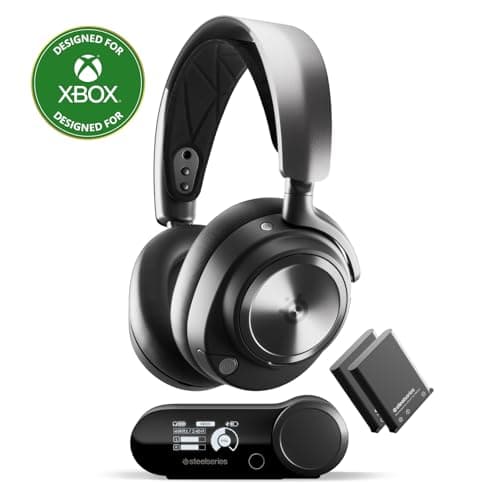 SteelSeries Arctis Nova Pro WirelessThe headset answer rather than the headphone answer: a retractable broadcast microphone, a base station, and two hot-swap batteries so it never has to stop to charge. | Best microphone, for a seated presenter | 8.88.8 out of 10, our editorial score | |
| 2 | 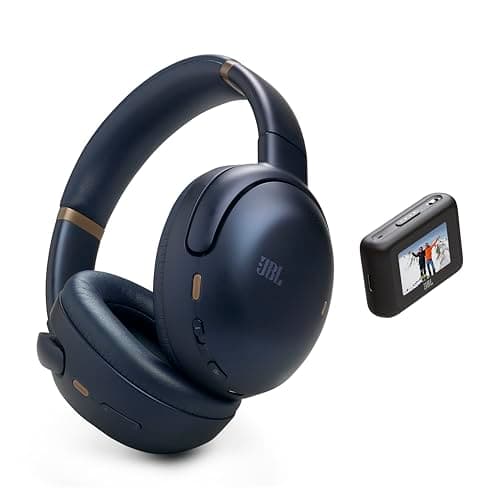 JBL Tour One M3The only headphone here that ships with the answer to the airline-jack problem in the box: the Smart Tx transmitter plugs into the seat and sends the movie to your headphones over Bluetooth. | Best for a presenter who moves | 8.78.7 out of 10, our editorial score | |
| 3 | 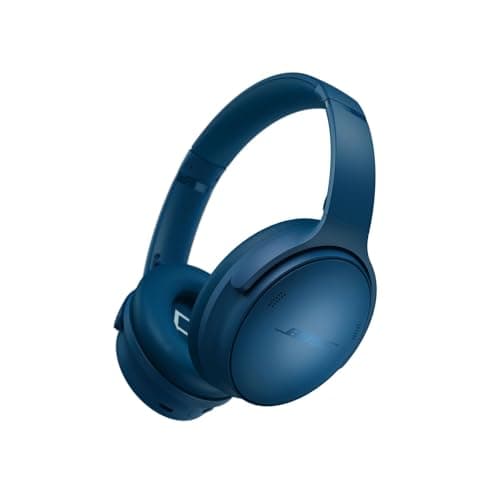 Bose QuietComfort HeadphonesThe non-Ultra Bose: the same brand's canceling philosophy at 24 rated hours, with the audio cable and carry case included and no Immersive Audio to drain the battery. | Best with an in-line microphone cable | 8.58.5 out of 10, our editorial score | |
| 4 | 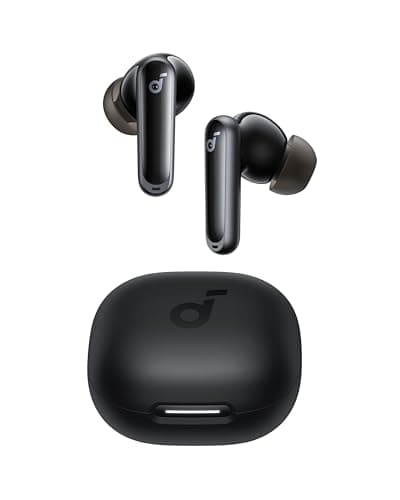 Soundcore P40iA budget earbud rated at 12 hours a charge and 60 with the case, with adaptive canceling and a case that folds out into a phone stand. | Budget pick: the cheapest that does the job | 8.08.0 out of 10, our editorial score |
#ad Amazon links are affiliate links. Prices come from Amazon’s own data on the date stamped under the buttons above; where we have no current figure the button reads “Check price on Amazon” instead of guessing. How this is funded.
The picks in full
Every pick, in detail
1. Best microphone, for a seated presenter
SteelSeries Arctis Nova Pro Wireless
The headset answer rather than the headphone answer: a retractable broadcast microphone, a base station, and two hot-swap batteries so it never has to stop to charge.
Our editorial score: 8.8 / 10
#ad Price as of November 11, 2026. How this is funded
For a webinar, a recorded session or anything you deliver from a desk. It carries a retractable broadcast-quality bidirectional microphone with AI noise cancellation rated at 25 dB — a boom in front of your mouth, which beats every built-in array in our registry by a margin no software closes.
The specification that makes it a presenter’s tool rather than a gamer’s is the pair of hot-swappable batteries, each rated at up to 22 hours: the headset is never out of action, only one battery is. It connects over 2.4 GHz for low latency plus Bluetooth, with multi-system connect, so the laptop running the deck and the phone taking the call are both live.
Be clear about the limit: a base station on the desk makes this the opposite of a portable product. It is heavy and large next to a travel headphone, and it cannot replace one on a plane. If you present standing and roaming, take one of the picks below.
What works on a plane
- Hot-swap batteries mean the headset is never out of action, only one battery is
- 2.4 GHz is the low-latency link that Bluetooth cannot match for games
- A retractable boom microphone beats every travel headphone's built-in array
- Switches between two systems, so the PC and the console share one headset
What does not
- A base station on the desk makes this the opposite of a travel product
- Heavy and large next to anything designed to go in a personal item
- Costs flagship-headphone money and cannot replace one on a plane
How it scores against the five travel axes
Published specifications
| Spec | Figure | Source |
|---|---|---|
| Battery | Up to 22 hours per battery, two hot-swappable batteries | SteelSeries |
| Noise control | Active noise canceling with transparency mode | SteelSeries |
| Wireless | 2.4 GHz plus Bluetooth, with multi-system connect | SteelSeries |
| DAC | GameDAC Gen 2, ESS Sabre quad-DAC, 96 kHz / 24-bit Hi-Res certified | SteelSeries |
| Microphone | Retractable broadcast-quality bidirectional, AI noise cancellation rated at 25 dB | SteelSeries |
| Drivers | Hi-Res capable, frequency range quoted up to 40 kHz | SteelSeries |
| Tuning | 10-band parametric EQ via SteelSeries software | SteelSeries |
2. Best for a presenter who moves
JBL Tour One M3
The only headphone here that ships with the answer to the airline-jack problem in the box: the Smart Tx transmitter plugs into the seat and sends the movie to your headphones over Bluetooth.
Our editorial score: 8.7 / 10
#ad Price as of November 11, 2026. How this is funded
For the presenter who walks, and who cannot afford a dropout. It is the only headphone in our registry with both a 3.5 mm and a USB-C wired path in the box, which means a managed laptop that blocks Bluetooth pairing is still a thirty-second fix rather than a cancelled session.
JBL publishes up to 70 hours on Bluetooth and up to 40 with canceling on, with five minutes of charge buying five hours — which is exactly the margin you want on a conference day. It weighs 278 g, and the Smart Tx transmitter turns any 3.5 mm output, including a lectern mixer or a room system, into a Bluetooth source.
The Smart Tx is one more small object to charge and lose. Canceling is very good rather than class-leading, and there is no boom microphone, so the outbound signal is an array rather than a mouth-level capsule.
What works on a plane
- The Smart Tx transmitter solves in-flight entertainment without a separate purchase
- Up to 40 rated hours with canceling on, comfortably over a long-haul plus layover
- Five minutes of charge buys five hours
- Both a 3.5 mm and a USB-C wired path in the box
What does not
- The Smart Tx is one more small object to lose, and it needs its own charge
- 278 g sits between the Sony and the Sennheiser without beating either at their own game
- Noise canceling is very good rather than class-leading
How it scores against the five travel axes
Published specifications
| Spec | Figure | Source |
|---|---|---|
| Battery, Bluetooth | Up to 70 hours | JBL |
| Battery, ANC on | Up to 40 hours | JBL |
| Quick charge | 5 minutes gives 5 hours | JBL |
| Battery cell | 850 mAh, full charge approx. 2 hours | JBL |
| Weight | 278 g | JBL |
| Smart Tx | Transmitter streams from non-Bluetooth sources including in-flight entertainment | JBL |
| In the box | USB-C-to-3.5 mm and USB-C-to-USB-C cables, USB-C to USB-A adapter | JBL |
3. Best with an in-line microphone cable
Bose QuietComfort Headphones
The non-Ultra Bose: the same brand's canceling philosophy at 24 rated hours, with the audio cable and carry case included and no Immersive Audio to drain the battery.
Our editorial score: 8.5 / 10
#ad Price as of November 11, 2026. How this is funded
For the presenter who wants a wired fallback that still includes a microphone. Bose’s box list for the QuietComfort Headphones includes an audio cable with an in-line mic, so a dead battery or a locked-down laptop does not take your voice away with it.
Bose publishes up to 24 hours with canceling on, a 2.5-hour charge, 0.520 lb (about 236 g) and removable protein-leather cushions, which matter on a headphone worn through a full day of sessions. Canceling is the brand’s strongest suit, which helps in a noisy venue green room.
Twenty-four rated hours is the shortest figure on this page, and Bose contradicts itself on the cable — the specification block says no audio cable is included while the box list on the same page includes one. We report both readings rather than the convenient one, so confirm what is in your box.
What works on a plane
- The audio cable with in-line mic is in the box, so seatback screens work out of the bag
- Bose canceling philosophy without paying the Ultra premium
- No Immersive Audio means no mode that quietly halves your battery
- Carry case included
- Bose publishes 0.520 lb for it — lighter than any canceling flagship here — and publishes no weight at all for the Ultra
What does not
- 24 rated hours is six fewer than the Ultra and half the Sennheiser
- Canceling is a step behind the QuietComfort Ultra
- No USB-C lossless audio input, unlike the Ultra
- Bose's own specification block says no audio cable is included while its box list includes one
How it scores against the five travel axes
Published specifications
| Spec | Figure | Source |
|---|---|---|
| Battery, ANC on | Up to 24 hours | Bose |
| Battery charge time | 2.5 hours via USB | Bose |
| Dimensions | 7.68" H x 6.18" W x 3.15" D | Bose |
| Ear cushions | Removable, protein leather | Bose |
| In the box | Carry case, USB-C cable, audio cable with in-line mic | Bose |
| Immersive Audio | Not supported | Bose |
| Weight | 0.520 lb (approx. 236 g) | Bose |
4. Budget pick: the cheapest that does the job
Soundcore P40i
A budget earbud rated at 12 hours a charge and 60 with the case, with adaptive canceling and a case that folds out into a phone stand.
Our editorial score: 8.0 / 10
#ad Price as of November 11, 2026. How this is funded
The cheapest product on this site with a microphone array built for voice: soundcore publishes six microphones with an AI call algorithm, 10 hours per charge with canceling on and 50 with the case, IPX5, and a case that folds out into a phone stand.
For a presenter who mostly joins calls rather than runs rooms, that is enough, and the earbud form factor is invisible on camera — which is itself a feature nobody lists.
Canceling depth is well behind the premium set, there is no LDAC, the tip selection is narrow, and six microphones in an earbud still cannot match a boom in front of your mouth.
What works on a plane
- 60 rated hours with the case, from an earbud in the budget tier
- IPX5 means sweat and rain are not a worry on a commute
- The fold-out case stand is a genuinely useful thing on a tray table
- Adaptive canceling at a price where fixed canceling is the norm
What does not
- Canceling depth is a long way behind the premium earbuds, especially in the low band
- No LDAC, so Android listeners do not get the better codec
- The stock tip selection is narrow, and the seal is what decides earbud canceling
How it scores against the five travel axes
Published specifications
| Spec | Figure | Source |
|---|---|---|
| Battery, canceling off | 12 hours per charge, 60 hours with the case | Soundcore |
| Battery, canceling on | 10 hours per charge, 50 hours with the case | Soundcore |
| Noise canceling | Adaptive ANC | Soundcore |
| Drivers | 11 mm composite | Soundcore |
| Water resistance | IPX5 | Soundcore |
| Microphones | 6, with an AI call algorithm | Soundcore |
| Case | Doubles as a phone stand | Soundcore |
How we decide
How these picks were chosen
We do not run a test lab and we do not claim to have flown with these units. Every verdict on this page is one of three things: a measurement published by somebody who does own a test rig and is credited by name, a manufacturer specification we quote and then interpret against what a long flight actually demands, or a plainly-labeled editorial judgment. The five axes we score on — cabin-noise reduction, battery on a long-haul, pack size, comfort past hour three, and wired fallback — are the ones that decide a travel purchase, and the weighting is published in full.
Questions
Common questions
What headphones do presenters actually need?
A microphone close to the mouth, a wired fallback, and a battery that cannot strand you. Canceling is useful for hearing yourself in a noisy venue but changes nothing about how you sound to your audience. If you are presenting to a room through a PA system, use the house microphone and treat the headphone as monitoring.
Is a boom microphone really better than a headphone's built-in mics?
Yes, and the reason is distance rather than brand. A capsule a couple of centimeters from your mouth captures a strong, clean signal that needs almost no processing. An array in an earcup is thirty centimeters away and has to separate your voice from the room, which is why only one pick here has a boom and why it tops the page.
Can I use wireless headphones for a live presentation?
Yes, with a fallback. Bluetooth is reliable enough in most rooms, but a managed laptop that blocks pairing, a crowded 2.4 GHz band or a flat battery all end a session the same way. Three of the four picks here have a wired path, and that is the specific reason they are on the page.
Do earbuds work for presenting?
For joining calls and webinars, yes, and they are invisible on camera, which is a genuine advantage. For running a room they are the weakest option here: a microphone in an earbud stem is further from your mouth than a boom and has less hardware behind it. The budget pick on this page publishes six microphones, which is as good as this form factor gets.
Sources
Where these figures come from
Read next
Related reading
- Best noise-canceling headphones for office calls
The same microphone question, for a desk.
- Best headphones for online classes
Presenting to a seminar rather than a conference.
- Best earbuds for calls
If you need to be invisible on camera.
- Best multipoint Bluetooth headphones
Keeping the deck laptop and the phone both live.
- Best noise-canceling headphones for remote work
The rest of the working day.