1. Best cheap earbud with canceling, for a bag that already has too much in it
Soundcore P40i
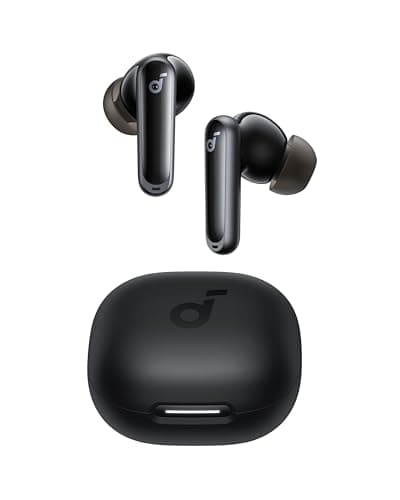
A budget earbud rated at 12 hours a charge and 60 with the case, with adaptive canceling and a case that folds out into a phone stand.
Our editorial score: 8.0 / 10
#ad Price as of November 11, 2026. How this is funded
Budget earbuds almost always save money in the same place, which is the battery. The P40i does not. Soundcore publishes 10 hours a bud with canceling switched on and 50 hours with the case, and 12 and 60 with canceling off — figures most premium earbuds cannot match at five times the price, because a premium earbud spends its internal volume on drivers and processors rather than on cells.
The rest of the specification is sensible rather than exciting: 11 mm composite drivers, IPX5, six microphones with a call-cleanup algorithm, Bluetooth 5.3, wireless charging for the case, and a lid that folds out into a landscape phone stand. That last one sounds like a gimmick and is not, because a tray table has no good way to hold a phone upright.
What you are not buying is canceling depth. Soundcore calls it Adaptive ANC and publishes no decibel figure for it, which is itself informative — the company publishes an “up to 52 dB” number for its P31i and chose not to for this model.
What works on a plane
- 60 rated hours with the case, from an earbud in the budget tier
- IPX5 means sweat and rain are not a worry on a commute
- The fold-out case stand is a genuinely useful thing on a tray table
- Adaptive canceling at a price where fixed canceling is the norm
What does not
- Canceling depth is a long way behind the premium earbuds, especially in the low band
- No LDAC, so Android listeners do not get the better codec
- The stock tip selection is narrow, and the seal is what decides earbud canceling
How it scores against the five travel axes
Published specifications
| Spec | Figure | Source |
|---|---|---|
| Battery, canceling off | 12 hours per charge, 60 hours with the case | Soundcore |
| Battery, canceling on | 10 hours per charge, 50 hours with the case | Soundcore |
| Noise canceling | Adaptive ANC | Soundcore |
| Drivers | 11 mm composite | Soundcore |
| Water resistance | IPX5 | Soundcore |
| Microphones | 6, with an AI call algorithm | Soundcore |
| Case | Doubles as a phone stand | Soundcore |
The Soundcore P40i is the budget earbud to buy when battery life matters more than canceling depth. Soundcore publishes 10 hours a bud with canceling on and 50 hours with the charging case, 12 and 60 hours with canceling off, a 10-minute charge for 5 hours of playback, 11 mm composite drivers, Adaptive ANC with no published decibel figure, IPX5 water resistance, six microphones with an AI call algorithm, and a charging case that doubles as a landscape phone stand. The list price is $79.99 and it is routinely sold well below it. Its weaknesses are low-frequency canceling, the absence of a Hi-Res codec, and a thin stock tip selection.
The short version
Who this is for, and who it is not
Buy it if you commute daily and want the drone taken off the top without carrying an over-ear, if you need a second pair that lives in a jacket pocket, or if you lose earbuds often enough that spending flagship money feels like throwing it away. It is the pick in best budget noise-cancelling earbuds and it appears in best headphones under $100 for the same reason: the specification does not have a hole in it where the battery should be.
Do not buy it as your long-haul headphone. A cabin is a 50 to 300 Hz drone problem, that band is where canceling hardware gets expensive, and this is a sub-$80 list product. If the flight is the thing you are solving, the honest answer is an over-ear — earbuds versus over-ear for flying sets out why, and at the budget end it is not a close call. Do not buy it for critical listening on Android either, because Soundcore publishes no LDAC or Hi-Res support for this model.
In short
Key takeaways
- 50 rated hours with the case and canceling on, which is more than most premium earbuds manage with canceling off.
- Adaptive ANC with no published decibel figure. Soundcore publishes one for the P31i and did not here.
- IPX5, so rain and sweat stop being a decision you make before leaving the house.
- The case lid folds out into a landscape phone stand, which is the most useful thing on a tray table nobody designs for.
- No LDAC or Hi-Res codec listed, so an Android listener with a lossless library gains nothing.
The specification
What Soundcore publishes
| Specification | Figure |
|---|---|
| Battery a bud, canceling off | 12 hours |
| Battery with case, canceling off | 60 hours |
| Battery a bud, canceling on | 10 hours |
| Battery with case, canceling on | 50 hours |
| Quick charge | 10 minutes for 5 hours |
| Full charge, buds | Around 50 minutes |
| Full charge, case | Around 3 hours wired, 4 hours wireless |
| Noise canceling | Adaptive ANC, no decibel figure published |
| Drivers | 11 mm composite |
| Water resistance | IPX5 |
| Microphones | Six, with an AI call algorithm |
| Bluetooth | 5.3 |
| Case | 2-in-1 charging case and landscape phone stand |
| App | HearID sound profile, custom EQ, wind noise reduction, dual connection |
| List price | $79.99 |
Criterion one
Cabin noise: adequate on a bus, outclassed on a plane
Soundcore markets this as Adaptive ANC, meaning the circuit samples the noise around you and adjusts rather than running a fixed curve. What the product page does not do is put a number on it, and that omission matters more than it looks: the same company publishes an “up to 52 dB” reduction claim for the P31i on the same site. When a manufacturer willing to quote a canceling figure declines to quote one for a particular model, the sensible reading is that the figure was not flattering.
In practice this is a mid-band product. Road roar at 40 mph, the hum of a bus floor, the general wash of an open-plan office — it takes the edge off all of them, and the difference is obvious the first time you switch it on. The bottom of the drone band, the part you feel in your sternum on a climbing aircraft, is largely still there. That is less a flaw in this earbud than the price of the category; active canceling versus passive isolation explains where the line sits, and why the seal in your ear does more of the work than the electronics do.
Which leads to the thing that actually decides how quiet these are for you: the tips. An earbud that does not seal has no canceling worth discussing, because the circuit can only work on what the seal lets through. The stock tip range here is narrow, and a six-dollar set of third-party tips is the highest-return accessory purchase in this entire category.
On a budget earbud, the ear tips decide more of the canceling than the canceling circuit does.
Criterion two
Battery: the reason to buy it
Ten hours a bud with canceling on is not a budget-tier figure. It is a figure that embarrasses most of the premium earbud market, where six hours with canceling on is normal and eight is considered good. Fifty hours with the case means a two-week commute between charges for most people, and a 10-minute charge rated for 5 hours of playback covers the case where you find the buds flat on the way out of the door.
The honest framing is that an earbud battery figure is less load-bearing than an over-ear’s, because an earbud carries its own charger in your pocket. Where it matters is a long flight, when the case is in the overhead bin and the buds are not: ten hours a bud covers a transpacific routing without reaching for anything. Most premium earbuds cannot say that. Headphone battery life for long-haul flights works through how rated hours translate onto a real itinerary.
The case also charges wirelessly, which is a specification you only appreciate on a trip where you have one cable and three things that want it.
Criterion three
Pack size: the smallest thing on this site, with a trick
There is nothing to say about an earbud’s packed footprint except that it is the reason people buy earbuds. The case goes in a pocket, there is no hinge to snap and no headband to crush, and at the end of a flight you are not carrying a second bag-shaped object through an airport.
What is worth saying is that the lid folds out into a stand that holds a phone in landscape. An aircraft tray table and a train seat-back table are both surfaces designed for a drink and nothing else, and propping a phone against a cup is the universal travel compromise. This removes it, costs nothing and weighs nothing. Soundcore only claims the landscape orientation, so a portrait video is still your problem.
Criterion four
Comfort past hour three: fit is the whole story
At this weight and size the headline comfort variable is not clamp or pad material, it is whether the tip suits your ear canal. A sealed earbud that fits correctly is comfortable for hours, and a sealed earbud slightly too large is painful inside forty minutes. The difference is three dollars of silicone.
Two things follow. First, if your ears are on the small side, the stock medium tip is likely the wrong starting point — best earbuds for small ears covers which products ship a genuinely wide range. Second, sealed earbuds trap pressure, and a pair that seals well can feel worse during a descent than an over-ear does; noise-canceling headphones and cabin pressure explains what canceling does and does not do about your ears on the way down.
IPX5 adds comfort of a different kind: you stop thinking about the weather. It is rated for sustained low-pressure water jets, which in daily terms means rain on a platform and a hard gym session are both fine. It is not a swimming rating, and nothing with a charging case belongs in a pool.
Criterion five
Wired fallback: there isn’t one
Like every true wireless earbud, the P40i cannot plug into anything. On an aircraft with a seat-back screen that leaves three options: watch the screen with cabin audio you cannot hear, use the airline’s supplied earbuds, or carry a Bluetooth transmitter that converts the headphone jack into a signal these can receive.
That accessory costs roughly as much as these earbuds do, which is a genuine argument against the pairing for a long-haul flyer — airplane headphone jack adapters covers what works, and Bluetooth headphones and in-flight entertainment covers which aircraft have started building Bluetooth into the seat so the problem goes away. For a commuter who never touches a seat-back screen, none of this matters.
Sound and codecs
What it sounds like, and what Android listeners give up
The 11 mm composite driver is tuned for bass, which is the right decision for a product that will mostly be used on a bus. The app ships a HearID profile that plays tones and builds an EQ curve around what you can hear, plus a manual equalizer if you would rather do it yourself. Both are worth ten minutes on the day it arrives.
The omission is codec support. Soundcore lists no LDAC and no Hi-Res Wireless certification for the P40i, while marketing both on its cheaper P31i and its P42i. On an iPhone that changes nothing, because iOS does not support LDAC in the first place. On an Android phone with lossless files it is a real if modest gap — LDAC versus AAC for travel works through how much difference the codec actually makes once you are inside a noisy cabin, and the answer is less than audio forums suggest.
Calls
Calls: six microphones, and an honest limit
Soundcore publishes six microphones with an AI algorithm for call clarity, plus a wind noise reduction setting in the app. For a scheduled call from a quiet room this is fine. For a call taken on a platform with a train arriving, no earbud at this price will make you sound like you are at a desk, and the ones that come closest are built around that single job.
If calls are the thing you need to fix rather than something you occasionally do, best earbuds for calls ranks on microphone behavior rather than on price, and the ordering there is different.
Alternatives
What else to look at
- EarFun Air Pro 4 — the direct rival at the same money, and the one that does publish Hi-Res codec support. The head-to-head is the fastest way to choose between them.
- Soundcore Space One — if the money is similar but the form factor is negotiable, an over-ear at this price cancels more and plugs into a seat-back screen.
- Sony WF-1000XM6 — what several hundred dollars more buys in canceling depth, if the flight really is the problem.
The verdict
Verdict
This is a well-judged budget product rather than a cut-down expensive one. Soundcore spent the money on the battery and the case and took it out of canceling depth and codec support, which is the right trade for a commuter and the wrong one for a long-haul flyer. Bought for what it is, very little at this price is as easy to recommend.
The one thing to do on the day it arrives is try every tip in the box, and then buy better ones. Everything this product does well is downstream of the seal.
How we decide
How these picks were chosen
We do not run a test lab and we do not claim to have flown with these units. Every verdict on this page is one of three things: a measurement published by somebody who does own a test rig and is credited by name, a manufacturer specification we quote and then interpret against what a long flight actually demands, or a plainly-labeled editorial judgment. The five axes we score on — cabin-noise reduction, battery on a long-haul, pack size, comfort past hour three, and wired fallback — are the ones that decide a travel purchase, and the weighting is published in full.
Questions
Common questions
How long does the Soundcore P40i battery last?
Soundcore publishes 12 hours a bud and 60 hours with the charging case in normal mode, falling to 10 hours a bud and 50 hours with the case when noise canceling is on. A 10-minute charge is rated for 5 hours of playback, and a full charge takes around 50 minutes for the buds and about 3 hours for the case over a cable.
Does the Soundcore P40i have good noise cancelling?
It has Adaptive ANC, and Soundcore publishes no decibel figure for it — worth noting, because the company does publish one for its P31i. It reduces mid-band noise such as road roar and office chatter noticeably, and leaves most of the low engine drone on a plane. The ear tip seal decides more of the result than the circuit does.
Is the Soundcore P40i waterproof?
It is rated IPX5, which covers sustained low-pressure water jets — rain, sweat and a splash. That is a weather rating rather than a swimming one, and neither the buds nor the charging case should be submerged.
Does the Soundcore P40i support LDAC?
Soundcore lists no LDAC or Hi-Res Wireless support for the P40i, while marketing both on its cheaper P31i and its P42i. On an iPhone this is irrelevant, since iOS does not support LDAC. On an Android phone with lossless files it is a modest but real gap.
Can you use the Soundcore P40i with an airplane seat-back screen?
Not directly. No true wireless earbud has a headphone plug, so in-flight entertainment needs a Bluetooth transmitter plugged into the aircraft jack, unless the aircraft is one of the newer types with Bluetooth audio built into the seat.
Does the Soundcore P40i case really work as a phone stand?
Yes. Soundcore publishes the case as a 2-in-1 charging case and phone stand that holds a phone in landscape orientation. It is genuinely useful on a tray table or a train table, and Soundcore does not claim portrait support.
Sources
Where these figures come from
- Soundcore P40i product page (12 hours a bud and 60 with the case in normal mode, 10 and 50 hours with ANC on, 10 minutes for 5 hours, around 50 minutes to charge the buds and about 3 hours wired or 4 hours wireless for the case, Adaptive ANC, 11 mm composite drivers, IPX5, six mics with AI, 2-in-1 phone stand in landscape, HearID, custom EQ, wind noise reduction, dual connection, $79.99 list) — read 2026-10-21
- Soundcore P31i product page (the 'up to 52 dB' canceling claim and the Hi-Res LDAC support this model does not carry) — read 2026-10-21
- Amazon listing for the Soundcore P40i (Bluetooth 5.3, wireless charging, in stock) — checked 2026-10-21
Read next
Related reading
- Best budget noise-cancelling earbuds
The roundup this product wins, and what it beat.
- EarFun Air Pro 4 vs Soundcore P40i
The direct head-to-head at the same money.
- Best headphones under $100
Where a budget earbud sits against a budget over-ear.
- LDAC vs AAC for travel
How much the missing codec actually costs you.
- Best earbuds for calls
If the microphone is the thing you are buying for.