1. Best Bose for most travelers
Bose QuietComfort Headphones
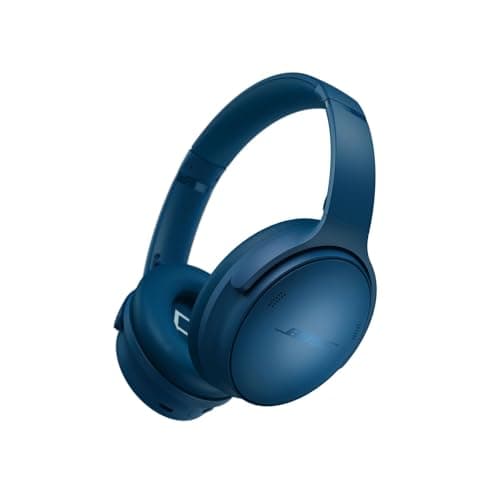
The non-Ultra Bose: the same brand's canceling philosophy at 24 rated hours, with the audio cable and carry case included and no Immersive Audio to drain the battery.
Our editorial score: 8.5 / 10
#ad Price as of November 11, 2026. How this is funded
The case for this model over its own flagship sibling is simpler than Bose would like it to be. You get the brand’s canceling philosophy, a hard carry case, removable ear cushions and a published 0.520 lb — roughly 236 g, which is lighter than every canceling flagship on this site — for meaningfully less money.
What you give up is the Ultra’s deepest canceling, its CustomTune personalization, its USB-C lossless audio input and Immersive Audio. Three of those four matter less on a plane than the brochure suggests; the first one genuinely does.
Bose rates it at 24 hours, which is the real weakness. That covers a long-haul and a layover and does not cover a multi-leg week without a charger.
What works on a plane
- The audio cable with in-line mic is in the box, so seatback screens work out of the bag
- Bose canceling philosophy without paying the Ultra premium
- No Immersive Audio means no mode that quietly halves your battery
- Carry case included
- Bose publishes 0.520 lb for it — lighter than any canceling flagship here — and publishes no weight at all for the Ultra
What does not
- 24 rated hours is six fewer than the Ultra and half the Sennheiser
- Canceling is a step behind the QuietComfort Ultra
- No USB-C lossless audio input, unlike the Ultra
- Bose's own specification block says no audio cable is included while its box list includes one
How it scores against the five travel axes
Published specifications
| Spec | Figure | Source |
|---|---|---|
| Battery, ANC on | Up to 24 hours | Bose |
| Battery charge time | 2.5 hours via USB | Bose |
| Dimensions | 7.68" H x 6.18" W x 3.15" D | Bose |
| Ear cushions | Removable, protein leather | Bose |
| In the box | Carry case, USB-C cable, audio cable with in-line mic | Bose |
| Immersive Audio | Not supported | Bose |
| Weight | 0.520 lb (approx. 236 g) | Bose |
The Bose QuietComfort Headphones are the better-value Bose for most travelers. Bose publishes up to 24 hours of battery life, a 2.5-hour charge time, a circumaural fit with removable protein-leather cushions, dimensions of 7.68 inches high by 6.18 inches wide by 3.15 inches deep and a weight of 0.520 lb, plus Quiet, Aware and Custom modes with adjustable EQ in the Bose app. The box contains a carry case, a 3.5 mm-to-2.5 mm audio cable and a 12-inch USB-C cable. The Ultra premium buys deeper canceling, CustomTune and a USB-C lossless input.
The short version
Who this is for, and who it is not
Buy it if you want Bose canceling on a flight and you do not want to pay flagship money for features you will not use. The combination that matters here — genuinely effective low-frequency reduction, a hard case so it survives a carry-on, cushions you can replace when they harden, and a weight Bose is willing to print — is the whole travel argument, and this model has all of it.
Do not buy it if canceling depth is the specific reason you are shopping. The gap to the QuietComfort Ultra Headphones in the lowest frequencies is the one thing Bose charges for that is real, and the full comparison is in QuietComfort Ultra vs QuietComfort. Do not buy it if you fly multi-leg weeks without a charger, because 24 rated hours is the shortest figure of any over-ear flagship on this site.
The specification
What Bose publishes
| Specification | Figure |
|---|---|
| Battery life | 24 hours |
| Battery charge time | 2.5 hours |
| Charging interface | USB, charging accessory included |
| Dimensions | 7.68" H x 6.18" W x 3.15" D |
| Weight | 0.520 lb (approximately 236 g) |
| Fit | Around-ear, circumaural |
| Ear cushions | Removable, protein leather |
| Product material | Metal, plastic, protein leather |
| Case | Carry and storage, hard leather |
| Noise control | Active noise cancelling, plus passive reduction |
| Modes | Quiet, Aware and Custom, with adjustable EQ in the Bose app |
| Microphones | Built-in |
| Acoustic design | TriPort acoustic headphone structure |
| In the box | Headphones, carry case, 3.5 mm-to-2.5 mm audio cable, USB-C (A to C) cable (12"), safety sheet |
| Immersive Audio | Not supported |
One note on that table, because it is the kind of thing a review exists to catch. Bose’s technical specification block lists “Audio cable included: No”, while the What’s in the box list on the same page includes a 3.5 mm-to-2.5 mm audio cable. Both statements are Bose’s, on the same URL, read the same day. The box list is the more specific of the two and matches the cable Bose ships with its other QuietComfort models, so that is the reading we have gone with — but if a wired path is the reason you are buying, confirm it with the retailer before you order rather than trusting either line.
Criterion one
Cabin noise: very good, and a step behind the Ultra
Bose does not publish a decibel reduction figure for this or any of its canceling headphones, and no consumer canceling product carries a certified rating the way a hearing protector carries an NRR. So there is no number to quote, and anyone quoting you one for a Bose is inventing it.
What Bose does publish is the mechanism, and it is more informative than a number would be. The company states that the QuietComfort Headphones use both active and passive noise reduction, and describes its TriPort acoustic headphone structure as venting the earcups through external ports to enlarge the acoustic volume without enlarging the earcup — which it credits with better audio and better active noise reduction from a smaller, lighter, more comfortable headphone.
Translated into travel terms: against the 50 to 300 Hz engine drone that is the actual problem in a cabin, this does the job. The flight becomes a quiet place you can read in. Where it falls short of the Ultra is in the last few decibels at the bottom of that band, and in what Bose calls CustomTune — the per-ear calibration the Ultra runs and this model does not. If you want to understand why engine noise is the easy case and the person behind you is not, that is do noise-cancelling headphones block voices.
Bose sells the Ultra on canceling depth and sells this one on nothing in particular. The spec sheet says that is backwards for a traveler.
Criterion two
Battery: the honest weak point
24 hours, with a 2.5-hour charge time. That is the shortest rated figure of any flagship over-ear in this registry, and it is the one specification where paying less actually costs you something you will notice.
For context, the same money buys 30 rated hours from the Ultra, 40 from the JBL Tour One M3 with canceling on, and 60 rated hours of playback from the Sennheiser MOMENTUM 4 Wireless. Twenty-four hours is a comfortable long-haul plus a layover; it is not a Monday-out, Thursday-back trip with no charger in the bag. The arithmetic for your own routing is in headphone battery life for long-haul flights.
One small mercy that follows from the feature list: there is no Immersive Audio on this model. On the Ultra that mode cuts the rated figure from 30 hours to 23, which means the gap between the two headphones in practice is smaller than the headline numbers suggest if you are someone who leaves spatial audio switched on.
Criterion three
Pack size: a hard case, and a weight Bose will print
The published dimensions are 7.68 inches high, 6.18 inches wide and 3.15 inches deep, and the case is described as carry and storage in hard leather. Bose does not publish folded dimensions — nobody does, which is the subject of do noise-cancelling headphones fold flat — so the usable figures are the headphone’s own and the fact that a fitted hard case is included rather than sold separately.
The genuinely interesting number is the weight. Bose publishes 0.520 lb, which is approximately 236 g. That is lighter than the 254 g Sony WH-1000XM6, which is the lightest product in the lightest canceling headphones roundup, and it is well under the 386.2 g Apple AirPods Max. Weight is the one comfort figure the industry reliably publishes, and on a four-hour sitting it is the figure that decides whether you keep the headphone on.
Worth being precise about what is new here: Bose publishes no weight for the QuietComfort Ultra Headphones, which is why this site has consistently said so and declined to quote one. It does publish one for this model, in the technical specification block, in pounds.
Criterion four
Comfort past hour three: removable cushions are the real feature
Bose lists the fit as around-ear and circumaural, the cushions as removable protein leather, and the build as metal, plastic and protein leather. Of those, removable is the word that matters most, and it is the one nobody markets.
Ear cushions are a consumable. The foam compresses and the covering stiffens over twelve to twenty-four months of regular use, and when that happens you lose passive isolation and you change the acoustic cavity the canceling circuit was tuned for — so the canceling gets worse too. A headphone with removable cushions can be brought back to new for the price of a pad set. A headphone with bonded cushions cannot. That argument is set out in full in how to improve noise cancelling and how long noise-cancelling headphones last.
Protein leather runs warmer than fabric, which is the standard trade at this price and the reason a long flight in a warm cabin gets sweaty around hour three. Bose publishes no clamping force and no pad depth — no manufacturer does — so the published weight is the only comfort proxy you get, and here it is a good one.
Criterion five
Wired fallback: covered, with an asterisk
The box list includes a 3.5 mm-to-2.5 mm audio cable. That is the right cable for a seatback screen with a single-pin socket, and having it in the box rather than as a purchase is a real advantage over several flagships.
Two caveats. The first is the specification-block contradiction above, which you should resolve with your retailer. The second is that some older and some premium-cabin seats use a twin-pin socket, in which case a small adapter is needed — the options are in airplane headphone jack adapters.
What this model does not have is the Ultra’s USB-C lossless audio input, which takes 16-bit audio at 44.1 or 48 kHz and makes the headphone a wired USB audio device. That matters less on a plane than it does on a managed work laptop with Bluetooth disabled by policy — the case made in best headphones for business travel. The audio cable with in-line mic that Bose lists among this model’s features partially covers the same ground, because an in-line mic makes the wired path a full headset path rather than playback only.
The cons
What is genuinely wrong with it
- 24 rated hours. The shortest flagship figure here, and the clearest reason to look at the JBL or the Sennheiser instead if battery decides your purchase.
- Canceling is a step behind the Ultra. Bose charges for that step and the step is real. If the lowest frequencies on a long-haul are what you are trying to fix, the premium is defensible.
- No USB-C lossless input. An Ultra-only feature, and the one that actually earns its money at a desk rather than in a seat.
- Bose contradicts itself on the audio cable. Specification block says no, box list says yes. Confirm before ordering if the wired path is the point.
- Protein-leather cushions run warm. Normal at this price, still the thing you will notice on hour four of a warm cabin.
- No published clamping force or pad depth. Universal across the category, and it means fit remains something you confirm inside a returns window rather than something you can shop for.
The alternatives
What else to look at, and why
If canceling depth is the point
The Bose QuietComfort Ultra Headphones. 30 rated hours with canceling on, 45 with it off, CustomTune, a 16-bit USB-C lossless input and the deepest canceling in this registry. The direct head-to-head is QuietComfort Ultra vs QuietComfort.
If battery is the point
The Sennheiser MOMENTUM 4 Wireless at up to 60 rated hours of playback, or the JBL Tour One M3 at up to 40 with canceling on and 70 over Bluetooth, which also ships a transmitter that solves the seatback screen outright.
If the budget is the point
The Soundcore Space One gets you a folding, 265 g canceling over-ear with a longer battery rating for a fraction of the money. It does not cancel as deeply and the pads are where the savings went.
If you want the whole field
Best noise-cancelling headphones for flights ranks everything here on cabin noise, battery, pack size, comfort and wired fallback, and JBL vs Bose is the brand-level version of the same argument.
If you are cross-shopping rather than confirming, Bose QuietComfort alternatives starts from what this line is actually known for and matches each substitution to one named strength or a lower price.
In short
Key takeaways
- Bose publishes 24 hours of battery life and a 2.5-hour charge time — the shortest flagship rating here.
- It publishes a weight: 0.520 lb, approximately 236 g, lighter than the 254 g Sony WH-1000XM6.
- Published dimensions are 7.68 in H x 6.18 in W x 3.15 in D, with a hard leather carry case included.
- Ear cushions are removable protein leather, which makes the headphone refurbishable rather than disposable.
- Bose's specification block says no audio cable while its box list includes a 3.5 mm-to-2.5 mm cable — confirm before ordering.
- The Ultra premium buys deeper canceling, CustomTune and a USB-C lossless input; it does not buy a lighter headphone.
How we decide
How these picks were chosen
We do not run a test lab and we do not claim to have flown with these units. Every verdict on this page is one of three things: a measurement published by somebody who does own a test rig and is credited by name, a manufacturer specification we quote and then interpret against what a long flight actually demands, or a plainly-labeled editorial judgment. The five axes we score on — cabin-noise reduction, battery on a long-haul, pack size, comfort past hour three, and wired fallback — are the ones that decide a travel purchase, and the weighting is published in full.
Questions
Common questions
Are the Bose QuietComfort Headphones worth it?
For most travelers, yes — it is the better-value Bose. You get the brand’s canceling, a hard case, removable cushions and a published 0.520 lb for meaningfully less than the Ultra. The reason to pay the Ultra premium is canceling depth at the lowest frequencies, which is real.
How long does the Bose QuietComfort Headphones battery last?
Bose publishes up to 24 hours of battery life, with a 2.5-hour charge time over USB. That is the shortest rated figure of any flagship over-ear on this site; the Ultra is rated 30 hours with canceling on and the Sennheiser MOMENTUM 4 Wireless is rated 60 hours of playback.
How much do the Bose QuietComfort Headphones weigh?
Bose publishes 0.520 lb in its technical specification block, which is approximately 236 g. That is lighter than the 254 g Sony WH-1000XM6. Note that Bose publishes no weight at all for the QuietComfort Ultra Headphones.
What is the difference between QuietComfort Headphones and QuietComfort Ultra?
Bose’s own answer is that the Ultra offers its best headphone noise cancellation, audio personalized with CustomTune and improved voice pickup. The Ultra also adds Immersive Audio, a 16-bit USB-C lossless input and six more rated hours. This model is the successor to the QuietComfort 45.
Do the Bose QuietComfort Headphones come with a cable for airplane entertainment?
Bose’s What’s in the box list includes a 3.5 mm-to-2.5 mm audio cable, which fits a standard single-pin seatback socket. Confusingly, the technical specification block on the same page says no audio cable is included, so confirm with your retailer if that is the deciding feature. Twin-pin sockets need a separate adapter either way.
Can you replace the ear pads on the Bose QuietComfort Headphones?
Yes. Bose lists the cushions as removable protein leather. That matters more than it sounds: cushions are a consumable, and replacing a hardened set restores both the passive isolation and the canceling performance that degraded with it.
Do they support Immersive Audio?
No, Immersive Audio is an Ultra feature. On the Ultra it also cuts the rated battery from 30 hours to 23, so if you would leave it switched on, the practical battery gap between the two models is narrower than the headline figures suggest.
Sources
Where these figures come from
- Bose QuietComfort Headphones product page (24 hours battery life, 2.5-hour charge time, 7.68 x 6.18 x 3.15 inch dimensions, 0.520 lb, circumaural fit, removable protein-leather cushions, hard leather case, Quiet/Aware/Custom modes, adjustable EQ, built-in microphones, active plus passive noise reduction, TriPort acoustic structure, What's in the box list, successor to QuietComfort 45, Ultra feature comparison) — read 2026-10-14
- Bose QuietComfort Ultra Headphones (2nd Gen) product page (30 hours canceling on, 45 off, 23 with Immersive Audio, 16-bit 44.1/48 kHz USB-C lossless input)
- Sony WH-1000XM6 Help Guide specifications (approximately 254 g, for the weight comparison)
- Apple AirPods Max (USB-C) tech specs (386.2 g, for the weight comparison)
Read next
Related reading
- Bose QuietComfort vs Sony WH-1000XM6
The cross-brand cross-shop, and the weight result that surprises people.
- Bose QuietComfort Ultra vs QuietComfort
The head-to-head that decides whether the Ultra premium is worth it.
- Bose QuietComfort Ultra Headphones review
The flagship, and what the extra money actually changes.
- JBL vs Bose noise-cancelling headphones
Endurance against canceling depth, at the brand level.
- Best noise-cancelling headphones for flights
Where this sits against the whole field on travel criteria.
- The comfiest wireless headphones
Why a published weight and removable cushions matter at hour four.