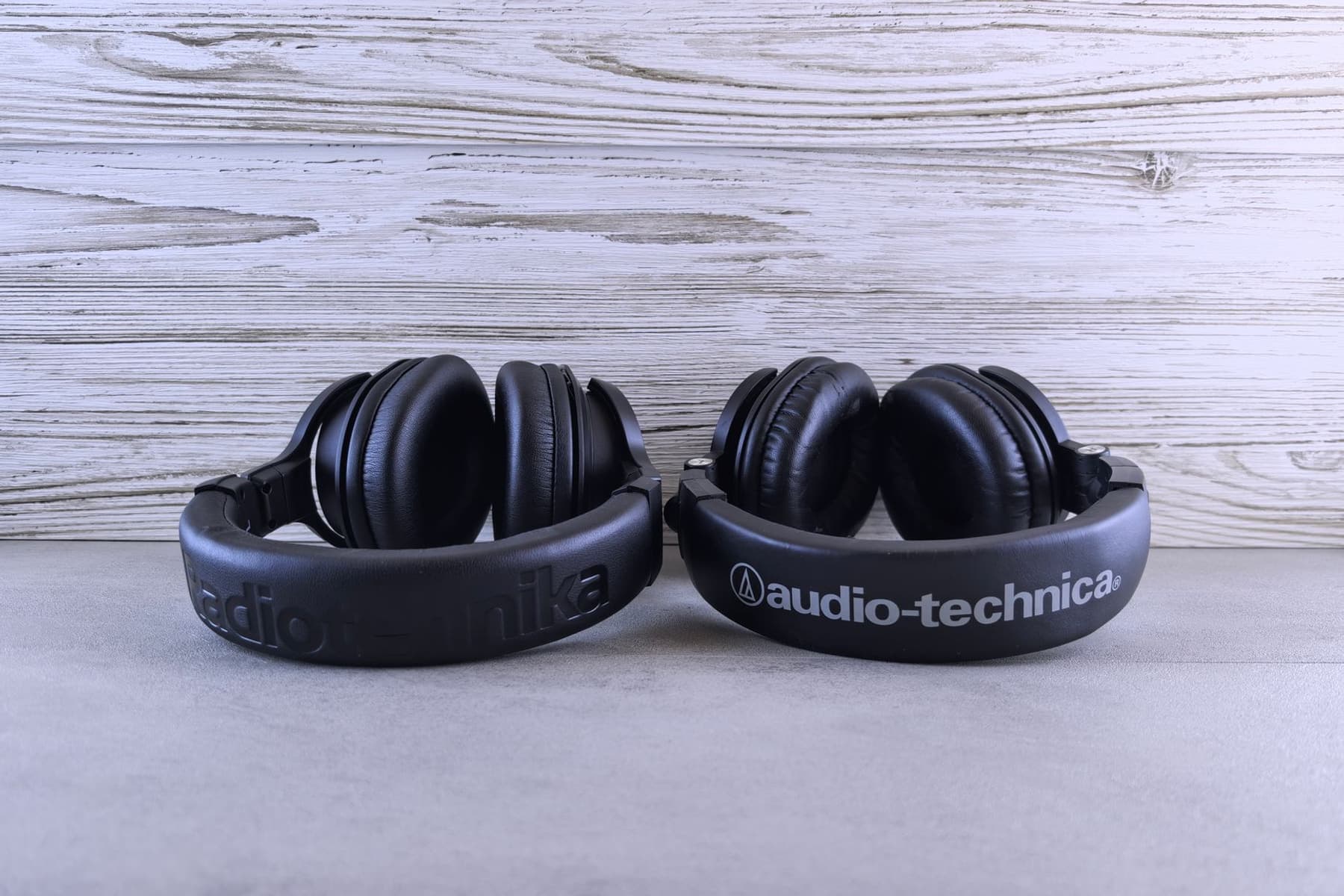
Buy the JBL Tour One M3 if you work at a desk or watch the seatback screen: up to 70 rated Bluetooth hours, five minutes of charge for about five hours, and a Smart Tx transmitter that streams from non-Bluetooth sources including in-flight entertainment. Buy the Sony WH-1000XM6 if you carry it daily or wear it for hours at a stretch: approximately 254 g, it folds into a case, up to 30 rated hours with canceling on, and SBC, AAC, LDAC and LC3.
Side by side
The two headphones on published figures
| JBL Tour One M3 | Sony WH-1000XM6 | |
|---|---|---|
| Battery, Bluetooth | up to 70 h | up to 30 h with canceling on |
| Battery, canceling off | Not published here | up to 40 h |
| Quick charge | 5 min = 5 h | Not published here |
| Full charge | approx. 2 h (850 mAh cell) | approx. 3.5 h |
| Weight | Not published by JBL | approx. 254 g (9 oz) |
| Codecs | Not published here | SBC, AAC, LDAC, LC3 |
| Wired response | Not published here | 4 Hz - 40,000 Hz (IEC) |
| Wired or non-Bluetooth sources | Smart Tx transmitter, plus USB-C-to-3.5 mm cable | 3.5 mm socket present, cable not supplied |
| In the box | USB-C-to-3.5 mm, USB-C-to-USB-C, USB-C-to-USB-A adapter | Case; no audio cable |
| Folds | Yes | Yes, into a case |
For an office
Which is the better office headphone?
If the headphone lives on a desk, the JBL is the stronger pick, and the reason is endurance rather than audio. An office headphone is worn in long stretches five days a week and then forgotten on the desk overnight. Seventy rated hours means that pattern never produces a flat headphone; thirty hours means it sometimes does.
The five-minute quick charge compounds that. Five minutes before a meeting buying about five hours is the difference between a workable headphone and one you resent.
Where the Sony takes the office back
Two situations. First, if you wear it for four hours without a break, 254 g is a genuine advantage and JBL publishes no weight to argue against it. Second, if you move between the office, a train and home, the Sony is the one that folds into a case and gets carried.
What neither of them is
Neither is a call headset. Both have earcup microphone arrays, which are good enough for calls and not good enough for four hours a day of video meetings — a boom microphone in front of your mouth starts with a better signal than any array buried in a cup. Headphones vs headset takes that apart, and the office-calls roundup ranks for the case where how you sound to other people is the priority.
Seventy rated hours is not a bigger number than thirty. It is a different relationship with the charger.
For a flight
Which is the better flight headphone?
This one splits on what you listen to. If you watch the seatback entertainment, the JBL is the clear answer: Smart Tx talks to a non-Bluetooth source so you are not hunting for a cable, and the cables are in the box anyway.
If you listen to your own phone and care about carrying as little as possible, the Sony wins. 254 g and a folding case are what make a premium headphone something you actually bring rather than something you own. Both arguments are laid out against the wider field in best headphones for airplanes, and the in-flight entertainment problem specifically in Bluetooth headphones and in-flight entertainment.
What the specs do not say
Three things to judge for yourself
- Canceling depth. Neither manufacturer publishes a comparable reduction figure, because no canceling product carries a certified rating. Both are strong; neither matches the Bose at the bottom of the frequency range, which is why Bose vs Sony exists as a separate comparison.
- Clamp and pad heat. Unpublished by everyone. Weight is the usable proxy, and here only Sony gives you one — which is itself informative.
- Microphone quality for calls. Specification sheets will not settle this. Record yourself on both and listen back; it takes two minutes and beats any review.
The verdict
One sentence each
Buy the JBL Tour One M3 if the headphone mostly stays in one place and has to talk to whatever source is in front of it — a desk, a seatback screen, a hotel television. Buy the Sony WH-1000XM6 if it moves with you every day and gets worn for hours at a time, and accept that you will order a 3.5 mm cable separately.
If you are choosing between brands rather than these two specific models, the fuller picture is in the JBL Tour One M3 review and the Sony WH-1000XM6 review, which each go deeper than a comparison table can.
In short
Key takeaways
- JBL Tour One M3: up to 70 rated Bluetooth hours, 5 minutes for about 5 hours, full charge in roughly 2 hours from an 850 mAh cell.
- JBL's Smart Tx transmitter streams from non-Bluetooth sources including in-flight entertainment, and the cables are in the box.
- Sony WH-1000XM6: approximately 254 g, folds into a case, up to 30 rated hours with canceling on and 40 with it off.
- Sony supports SBC, AAC, LDAC and LC3, and quotes 4 Hz to 40,000 Hz over the cable — but does not supply a cable.
- JBL publishes no weight, which is the one real gap in this comparison.
- Neither is a call headset. For four hours a day of video meetings, a boom microphone beats both.
At a glance
Quick picks
Scores are our editorial judgment from published specifications and cited third-party measurements, not our own testing. The rubric is published in full. Tap any row for the full write-up.
| # | Product | Best for | Score | Price |
|---|---|---|---|---|
| 1 |  JBL Tour One M3The only headphone here that ships with the answer to the airline-jack problem in the box: the Smart Tx transmitter plugs into the seat and sends the movie to your headphones over Bluetooth. | Best for an office desk and the seatback screen | 8.78.7 out of 10, our editorial score | |
| 2 | 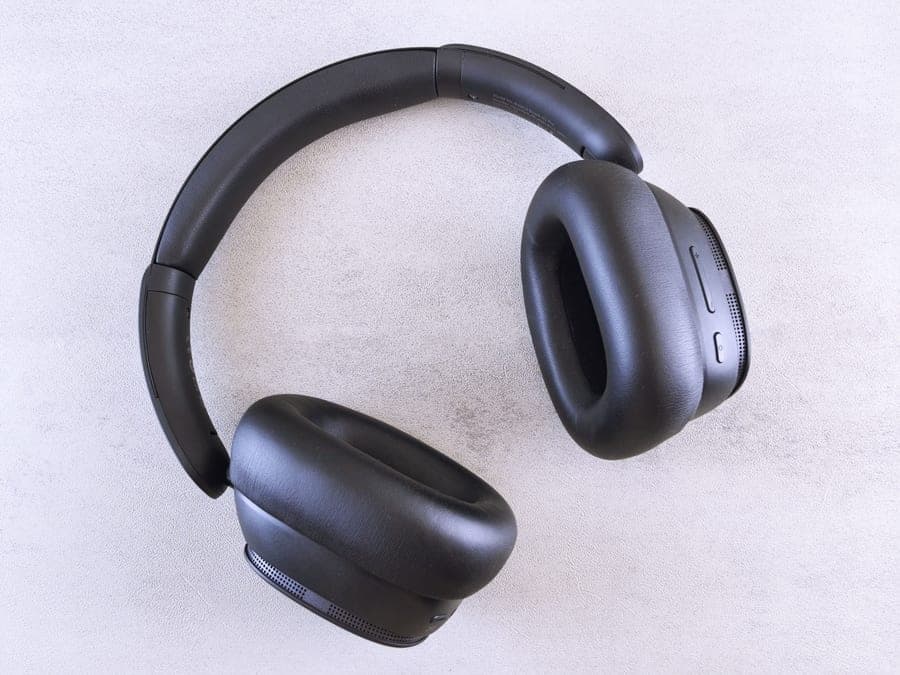 Sony WH-1000XM6The most complete travel headphone on sale: 254 g, 30 rated hours with noise canceling on, and it folds into a case small enough to stop being a decision. | Best for carrying and for long sittings | 9.19.1 out of 10, our editorial score |
#ad Amazon links are affiliate links. No live price is shown anywhere on this site, so every button reads “Check price on Amazon”. How this is funded.
The picks in full
Every pick, in detail
1. Best for an office desk and the seatback screen
JBL Tour One M3
The only headphone here that ships with the answer to the airline-jack problem in the box: the Smart Tx transmitter plugs into the seat and sends the movie to your headphones over Bluetooth.
Our editorial score: 8.7 / 10
#ad Live price not shown. How this is funded
Also sold direct by JBL — we earn nothing there, so check both.
The JBL wins on the two specs nobody puts on a comparison chart. Up to 70 rated hours over Bluetooth, from an 850 mAh cell that fills in roughly two hours, with five minutes of charge buying about five hours.
Seventy hours is the figure that changes how you use a headphone. At a desk it means you never dock it; across a multi-leg trip it means you never think about a charger. Sony’s 30 rated hours with canceling on is good and still requires planning on a long routing.
The second win is Smart Tx: a transmitter that streams from non-Bluetooth sources including in-flight entertainment. That removes the single most common frustration with a premium wireless headphone on a plane. The box also includes USB-C-to-3.5 mm, USB-C-to-USB-C and a USB-C-to-USB-A adapter.
JBL does not publish a weight for it in the specifications we could verify, which is the honest gap in this comparison — and weight is the one comfort figure that is normally available.
What works on a plane
- The Smart Tx transmitter solves in-flight entertainment without a separate purchase
- Up to 40 rated hours with canceling on, comfortably over a long-haul plus layover
- Five minutes of charge buys five hours
- Both a 3.5 mm and a USB-C wired path in the box
What does not
- The Smart Tx is one more small object to lose, and it needs its own charge
- 278 g sits between the Sony and the Sennheiser without beating either at their own game
- Noise canceling is very good rather than class-leading
How it scores against the five travel axes
Published specifications
| Spec | Figure | Source |
|---|---|---|
| Battery, Bluetooth | Up to 70 hours | JBL |
| Battery, ANC on | Up to 40 hours | JBL |
| Quick charge | 5 minutes gives 5 hours | JBL |
| Battery cell | 850 mAh, full charge approx. 2 hours | JBL |
| Weight | 278 g | JBL |
| Smart Tx | Transmitter streams from non-Bluetooth sources including in-flight entertainment | JBL |
| In the box | USB-C-to-3.5 mm and USB-C-to-USB-C cables, USB-C to USB-A adapter | JBL |
2. Best for carrying and for long sittings
Sony WH-1000XM6
The most complete travel headphone on sale: 254 g, 30 rated hours with noise canceling on, and it folds into a case small enough to stop being a decision.
Our editorial score: 9.1 / 10
#ad Live price not shown. How this is funded
Also sold direct by Sony — we earn nothing there, so check both.
The Sony wins on everything to do with carrying it. Approximately 254 g, the lightest canceling over-ear on this site, and the earcups fold into a case small enough that taking it becomes automatic rather than a decision.
Up to 30 rated hours with canceling on and 40 with it off, about 3.5 hours to a full charge, and SBC, AAC, LDAC and LC3 — so it is not tied to one phone platform and it supports the newer low-energy audio standard.
The wired response is quoted at 4 Hz to 40,000 Hz over the cable. Note the asterisk: the socket is there but Sony does not supply the cable, so a seatback screen needs a purchase the JBL does not.
Against the JBL it loses the battery argument outright. What it gets back is the 254 g, and over a four-hour sitting that number is felt rather than read.
What works on a plane
- Folds, which halves the space it takes in a personal item
- 254 g is light for a flagship over-ear, and weight is what you feel at hour four
- LDAC plus LC3 means it is not locked to one phone ecosystem
- 30 rated hours with noise canceling on covers almost any single routing
What does not
- You pay a flagship price for the last increment of noise canceling
- The folding hinge is one more mechanism to eventually wear out
- No airline two-prong adapter in the box
How it scores against the five travel axes
Published specifications
| Spec | Figure | Source |
|---|---|---|
| Weight | Approx. 254 g (9 oz) | Sony Help Guide specifications |
| Battery, NC on | Up to 30 hours | Sony specifications |
| Battery, NC off | Up to 40 hours | Sony specifications |
| Full charge | Approx. 3.5 hours | Sony Help Guide specifications |
| Bluetooth | 5.3 | Sony Help Guide specifications |
| Codecs | SBC, AAC, LDAC, LC3 | Sony Help Guide specifications |
| Wired response | 4 Hz - 40,000 Hz (IEC) | Sony Help Guide specifications |
| Folds | Yes, into a magnetic-closure case | Sony |
How we decide
How these picks were chosen
We do not run a test lab and we do not claim to have flown with these units. Every verdict on this page is one of three things: a measurement published by somebody who does own a test rig and is credited by name, a manufacturer specification we quote and then interpret against what a long flight actually demands, or a plainly-labeled editorial judgment. The five axes we score on — cabin-noise reduction, battery on a long-haul, pack size, comfort past hour three, and wired fallback — are the ones that decide a travel purchase, and the weighting is published in full.
Questions
Common questions
Is JBL or Sony better for headphones?
On these two models it depends on the job. The JBL Tour One M3 wins on endurance (up to 70 rated Bluetooth hours against 30) and on talking to non-Bluetooth sources via its Smart Tx transmitter. The Sony WH-1000XM6 wins on weight at approximately 254 g, on folding into a case, and on codec support.
Which is better for office use, the JBL Tour One M3 or the Sony WH-1000XM6?
The JBL, for most desk setups. Seventy rated hours plus a five-minute charge for about five hours means it is never flat when a meeting starts. Choose the Sony if you wear it for four-hour stretches, where approximately 254 g is the advantage, or if it travels with you daily.
Does the JBL Tour One M3 work with in-flight entertainment?
Yes. JBL supplies a Smart Tx transmitter that streams from non-Bluetooth sources including in-flight entertainment, and a USB-C-to-3.5 mm cable is in the box as the wired fallback. The Sony has a 3.5 mm socket but no supplied cable.
How much does the JBL Tour One M3 weigh?
JBL does not publish a weight in the specifications we could verify, so we are not going to quote one. Sony publishes approximately 254 g for the WH-1000XM6, which is the lightest canceling over-ear on this site.
Which has better noise canceling?
Neither manufacturer publishes a comparable reduction figure, and no canceling product carries a certified rating, so any confident ranking here would be invented. Both are strong; if canceling depth is the deciding factor, the Bose QuietComfort Ultra Headphones are the deepest on this site.
Sources
Where these figures come from
Read next
Related reading
- Bose vs Sony noise-canceling headphones
The brand comparison that settles canceling depth rather than endurance.
- JBL Tour One M3 review
The full read on the 70-hour, Smart Tx side of this comparison.
- Best noise-canceling headphones for office calls
If how you sound to other people is the real requirement.
- Best headphones for airplanes
Both of these against the wider field, judged for a cabin.