1. Best overall for flying
Sony WH-1000XM6
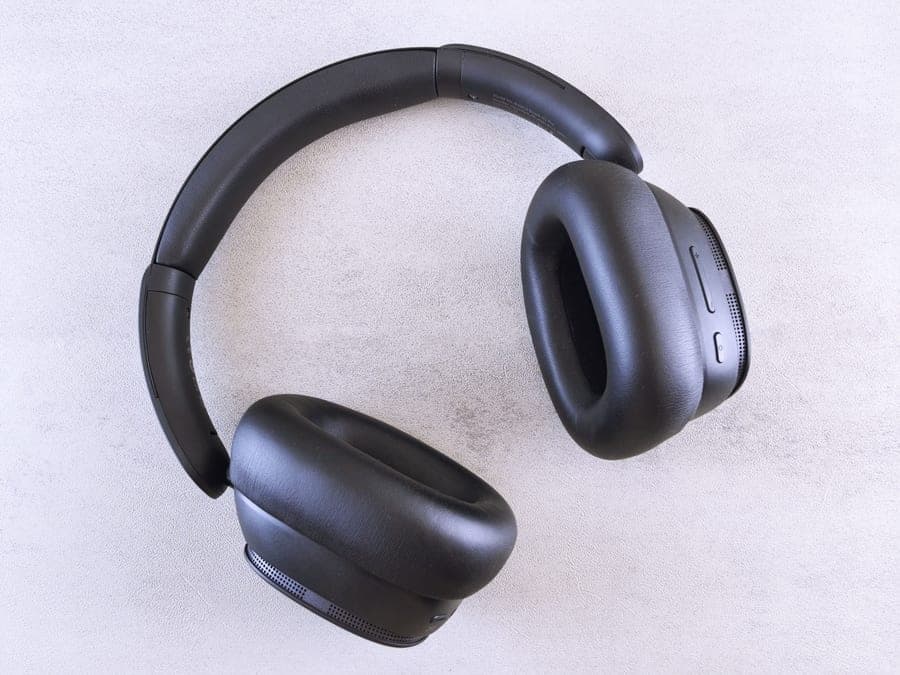
The most complete travel headphone on sale: 254 g, 30 rated hours with noise canceling on, and it folds into a case small enough to stop being a decision.
Our editorial score: 9.1 / 10
#ad Live price not shown. How this is funded
Also sold direct by Sony — we earn nothing there, so check both.
The reason the XM6 keeps winning travel roundups is not that it is the quietest headphone you can buy. It is not — the Bose QuietComfort Ultra takes the deepest part of the low band. The reason is that it is the only flagship that does not ask you to accept a serious compromise somewhere else.
Sony publishes 254 g. It folds. It is rated at 30 hours with canceling on. It supports LDAC and LC3 as well as AAC, so it works properly with an Android phone. It has a 3.5 mm socket. Every other flagship on this site gives up at least one of those, and usually two.
What works on a plane
- Folds, which halves the space it takes in a personal item
- 254 g is light for a flagship over-ear, and weight is what you feel at hour four
- LDAC plus LC3 means it is not locked to one phone ecosystem
- 30 rated hours with noise canceling on covers almost any single routing
What does not
- You pay a flagship price for the last increment of noise canceling
- The folding hinge is one more mechanism to eventually wear out
- No airline two-prong adapter in the box
How it scores against the five travel axes
Published specifications
| Spec | Figure | Source |
|---|---|---|
| Weight | Approx. 254 g (9 oz) | Sony Help Guide specifications |
| Battery, NC on | Up to 30 hours | Sony specifications |
| Battery, NC off | Up to 40 hours | Sony specifications |
| Full charge | Approx. 3.5 hours | Sony Help Guide specifications |
| Bluetooth | 5.3 | Sony Help Guide specifications |
| Codecs | SBC, AAC, LDAC, LC3 | Sony Help Guide specifications |
| Wired response | 4 Hz - 40,000 Hz (IEC) | Sony Help Guide specifications |
| Folds | Yes, into a magnetic-closure case | Sony |
The Sony WH-1000XM6 is the best all-round noise-canceling headphone for flying. At an approximate 254 g it is the lightest flagship over-ear here, it folds into a compact magnetic-closure case, and Sony rates it at up to 30 hours with noise canceling switched on. The Bose QuietComfort Ultra cancels slightly more of the deepest engine drone, and the Sennheiser MOMENTUM 4 lasts twice as long, but neither matches the XM6 across all five travel criteria at once.
The short version
Who this is for, and who it is not
Buy it if you fly regularly, pack tightly, and want to stop thinking about the decision. It is the headphone to recommend to somebody who has not asked a follow-up question, because there is no situation in which it is actively the wrong choice.
Do not buy it if your routings are genuinely brutal — multiple legs across two days without a reliable outlet — because 30 hours is good and 60 is better, and the Sennheiser MOMENTUM 4 publishes 60. Do not buy it if the only thing you care about is the absolute floor of cabin noise, because the Bose QuietComfort Ultra is measurably quieter in the band that matters most. And do not buy it if your budget is the constraint, because the Soundcore Space Q45 gets you a long way for a fraction of the money.
Criterion one
Cabin noise: what it does to engine drone
A cruising narrow-body cabin is dominated by low-frequency energy, most of it in the 50 to 300 Hz range. That is the band active canceling is genuinely good at, because the noise is continuous and predictable enough for the system to model. Sony has been iterating on this specific problem for a decade, and the XM6 is the current end of that line: an updated processor, more microphones, and adaptive behavior that settles rather than hunts when the cabin changes.
In practice what you notice is not silence. It is that the pressure behind the sound disappears. Speech in the row behind you is still audible; the constant background that makes hour six feel like hour ten is mostly gone. That is the correct expectation to set, and it is worth saying plainly because the marketing for every product in this category implies otherwise.
Against the Bose, published measurements consistently put Bose ahead in the deepest frequencies. The gap is real and it is small. If you want the comparison rather than two reviews, read the Bose QuietComfort Ultra versus Sony WH-1000XM6 head-to-head.
Criterion two
Battery across a long-haul
Sony rates the XM6 at up to 30 hours with noise canceling on and up to 40 with it off, with a full charge taking approximately 3.5 hours. The number that matters is the first one, because you did not buy a noise-canceling headphone in order to switch the noise canceling off.
Thirty hours covers essentially any single routing plus its layover plus the gate. A London to Singapore leg is around 13 hours; add a four-hour connection and two hours of terminal and you are at 19. You would finish that trip with a third of the battery left. Two such legs in opposite directions within a week, with a hotel in between, is also fine.
Where it stops being comfortable is a genuinely long multi-leg itinerary with no charging — and the honest answer there is a battery pack rather than a different headphone, because the XM6 charges over USB-C while you wear it. Headphone battery life for long-haul flights works the arithmetic through properly.
Criterion three
Pack size: the hinge is the point
This is where the XM6 earns its position over every other flagship, and it is the criterion most reviews treat as an afterthought.
The XM6 folds. The earcups rotate flat and the headband folds in, and the result goes into a case with a magnetic closure that is genuinely small for a full-size over-ear. Compare that with the Apple AirPods Max, which does not fold at all and whose Smart Case adds 134.5 g while leaving the headband exposed. In a personal item that also contains a laptop, a charger, a water bottle and a book, that difference is not a nicety. It is the difference between the headphones going in the bag and the headphones going round your neck through three terminals.
A headphone that does not fold is not really a travel headphone. It is a home headphone that you are carrying.
The trade is that a hinge is a mechanism, and mechanisms are what eventually fail on headphones. If you are hard on gear, that is a real consideration — though it is also what a decent case is for.
Criterion four
Comfort past hour three
Weight is the most predictive single number for long-session comfort, and 254 g is light for this class. For context, the spread across the flagships on this site runs from 254 g to 386.2 g — more than 50 percent. You do not notice 130 g in a shop. You notice it at hour four, as a specific ache on the crown of your head.
Clamp force on the XM6 is moderate, which is the right answer for a travel headphone: firm enough to hold the seal that the passive isolation depends on, loose enough not to become a vice. Heat is the remaining issue, as it is with every over-ear — if you run warm, the occasional ten-minute break matters more than the pad material does.
If you wear glasses, the arms break the pad seal and cost you canceling performance regardless of which headphone you buy. That is a whole separate problem and it has its own page.
Criterion five
The seatback screen
The XM6 has a 3.5 mm socket, so it can physically connect to an in-flight entertainment system. What it does not have is an airline two-prong adapter in the box, and on older aircraft with twin sockets you will need one.
This is a two-dollar problem with a two-dollar solution, but it is the kind of thing you discover at 35,000 feet rather than at home. Either keep an adapter in the case permanently, or carry a Bluetooth transmitter and use the headphone wirelessly with the seat, which is the more elegant answer and also works with earbuds.
The numbers
Published specifications, in one place
| Spec | XM6 | What it means in a seat |
|---|---|---|
| Weight | approx. 254 g | The lightest flagship here. This is what hour four feels like. |
| Battery, NC on | up to 30 h | Clears any single routing plus layover. |
| Battery, NC off | up to 40 h | Useful on a train where you only want isolation. |
| Full charge | approx. 3.5 h | Charges over USB-C while worn. |
| Bluetooth | 5.3 | Stable multipoint between a phone and a tablet. |
| Codecs | SBC, AAC, LDAC, LC3 | LDAC means it is not an Apple-only proposition. |
| Wired response | 4 Hz - 40,000 Hz (IEC) | It has a socket, which earbuds do not. |
| Folds | Yes | The single most underrated travel spec. |
The alternatives
What else you should look at
- Bose QuietComfort Ultra Headphones (2nd Gen) — quieter in the deepest band and ships the seatback cable in the box. Heavier, and Immersive Audio costs you a third of the battery.
- Sennheiser MOMENTUM 4 Wireless — up to 60 rated hours, and the 1.2 m cable is included. Less quiet, and the case is broader.
- Sony WF-1000XM6 — if pack size is the binding constraint, the earbuds are 6.5 g each and disappear. You lose the wired socket entirely.
- Soundcore Space Q45 — 50 rated hours and a hard case for far less money. The gap in canceling is audible but not disqualifying.
Where it sits in our roundups
The XM6 is the top pick in best noise-canceling headphones for flights and in best travel headphones, and it appears in best foldable noise-canceling headphones and best noise-canceling headphones for commuting.
In short
Key takeaways
- 254 g and a folding hinge are the two specs that make this the default travel flagship, not its canceling.
- Thirty rated hours with canceling on clears any single long-haul routing plus its layover.
- The Bose is quieter in the deepest band; the gap is real and small.
- It has a 3.5 mm socket but no airline two-prong adapter, so keep one in the case.
- If you need sixty hours rather than thirty, the Sennheiser MOMENTUM 4 is the page to read.
How we decide
How these picks were chosen
We do not run a test lab and we do not claim to have flown with these units. Every verdict on this page is one of three things: a measurement published by somebody who does own a test rig and is credited by name, a manufacturer specification we quote and then interpret against what a long flight actually demands, or a plainly-labeled editorial judgment. The five axes we score on — cabin-noise reduction, battery on a long-haul, pack size, comfort past hour three, and wired fallback — are the ones that decide a travel purchase, and the weighting is published in full.
Questions
Common questions
Is the Sony WH-1000XM6 good for long flights?
Yes, and it is the best single choice for most people. Thirty rated hours with canceling on covers any one routing plus its layover, 254 g is the lightest flagship here so hour four is more tolerable, and it folds into a compact case. The only long-haul scenario where something else wins is a multi-day itinerary with no charging, where the Sennheiser MOMENTUM 4 and its 60 rated hours is the better answer.
Does the WH-1000XM6 fold?
Yes. The earcups rotate flat and the headband folds in, and it ships with a carrying case that closes magnetically. This is the single biggest practical advantage it holds over the Apple AirPods Max, which does not fold at all.
Does it come with an airline adapter?
No. It has a 3.5 mm socket so it will work with a single-socket seatback system, but older twin-socket seats need a two-prong adapter that is not in the box. Airplane headphone jack adapters covers what to buy.
Is the XM6 quieter than the Bose QuietComfort Ultra?
No. Published measurements consistently place Bose ahead in the deepest low frequencies, which is the band engine drone occupies. The XM6 wins the overall travel argument on weight, fold size and codec support rather than on raw canceling depth.
Does it work properly with an Android phone?
Yes. Sony lists SBC, AAC, LDAC and LC3, so it is not limited to the lowest-common-denominator codec on Android the way some Apple-ecosystem-first products effectively are.
Sources
Where these figures come from
Read next
Related reading
- Bose QuietComfort Ultra vs Sony WH-1000XM6
The flagship decision most people are actually making.
- Sennheiser MOMENTUM 4 vs Sony WH-1000XM6
Sixty rated hours against thirty, and what you pay for them.
- Best noise-canceling headphones for flights
The full field, with the XM6 at the top of it.
- Best foldable noise-canceling headphones
Why the hinge matters more than the spec sheet suggests.