1. Best budget pick
Soundcore Space 2
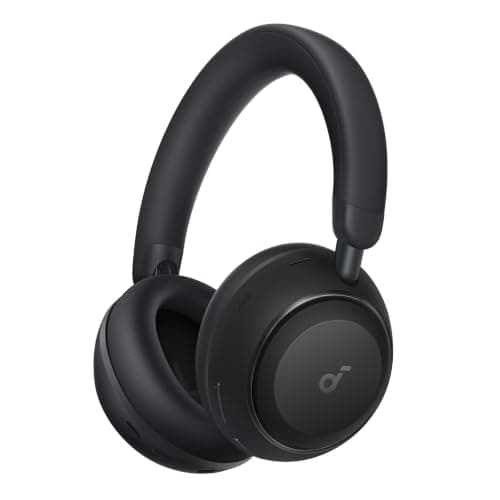
Fifty rated hours with canceling on, a 3.5 mm input and a case in the box, at a fraction of flagship money. The compromise is in the last 10 percent of quiet, not the first 80.
Our editorial score: 8.2 / 10
#ad Price as of November 11, 2026. How this is funded
The interesting thing about the Space 2 is not that it is cheap. It is that on three of the five criteria this site scores on — battery, weight and wired fallback — it matches or beats headphones costing several times more.
Fifty rated hours with canceling on is longer than any flagship here except the Sennheiser. It weighs 264 g, which undercuts most of them. There is a 3.5 mm input and a carrying case in the box. What you give up is concentrated almost entirely in one place: the depth and steadiness of the canceling itself.
What works on a plane
- Up to 50 rated hours with canceling on, which beats every flagship here
- A 3.5 mm input and a case in the box, so nothing else to buy for a seatback screen
- Five minutes of charge buys four hours, which covers a gate-side mistake
- The cheapest way here to get genuinely useful drone reduction on a plane
What does not
- The -37 dB canceling figure is Anker's own laboratory number, not an independent measurement, and the gap to Bose is audible
- Plainer pad materials than the Sennheiser, so hour four is less comfortable
- Plastic build will not survive being crushed in an overhead bin the way the metal Apple would
How it scores against the five travel axes
Published specifications
| Spec | Figure | Source |
|---|---|---|
| Battery, ANC on | Up to 50 hours | soundcore |
| Battery, ANC off | Up to 70 hours | soundcore |
| Quick charge | 5 minutes gives 4 hours | soundcore |
| Full charge | Approx. 2 hours | soundcore support specifications |
| Weight | 264 g (9.31 oz) | soundcore |
| Bluetooth | 6.1 | soundcore |
| Microphones | 3, with AI enhancement for calls | soundcore |
| Codecs | SBC, AAC, LDAC | soundcore support specifications |
| Drivers | 40 mm double-layer diaphragm | soundcore |
| Canceling depth | -37 dB, measured in Anker's own laboratory | soundcore support specifications |
| In the box | Headphones, charging cable, carrying case | soundcore |
| Wired | 3.5 mm input, Hi-Res in wired mode | soundcore |
The Soundcore Space 2 is the best budget noise-canceling headphone for flying. Soundcore rates it at up to 50 hours with ANC on and 70 with it off, five minutes of charge gives four hours, it weighs 264 g, and it runs Bluetooth 6.1 with LDAC and a 3.5 mm input. It is audibly less quiet than the Bose QuietComfort Ultra, and for a few flights a year that is a trade most people should take.
The short version
Who this is for, and who it is not
Buy it if you fly a handful of times a year. The economics are simple: a flagship costs several times as much to remove the last slice of engine drone, and if you are on a plane four times a year you will not accumulate enough hours to justify it. Buy it also if you are buying for someone else and do not know their preferences, or if you are the kind of traveler who loses things.
Do not buy it if you fly constantly, because the fatigue difference compounds and the pads are plainer. Do not buy it if you need the canceling to hold steady while cabin noise changes, because that steadiness is precisely what flagship processing buys. And do not buy it expecting it to survive being crushed in an overhead bin the way the metal AirPods Max would.
Criterion one
Cabin noise: the honest assessment
Soundcore describes a four-stage low-frequency canceling system and puts its depth at -37 dB, measured in Anker’s own laboratory. That is a manufacturer figure rather than an independent or certified measurement, and it should be read as such — an in-house number with no stated test standard is not comparable with anyone else’s.
What is fair to say is that against steady low-frequency drone it does genuinely useful work, and that the difference between it and a flagship is smaller than the price difference. The first eighty percent of the quiet is cheap now. Where the gap shows up is the deepest part of the band, and in how the system behaves when the noise around you changes — a flagship settles, a budget adaptive system hunts a little.
The gap between this and a flagship is audible. It is not the size of the price difference.
Criterion two
Battery: better than most flagships
Soundcore rates it at up to 50 hours with canceling on and up to 70 with it off, and quotes five minutes of charge for four hours of playback and two hours for a full charge.
| Model | Rated hours, ANC on | Quick charge |
|---|---|---|
| Sennheiser MOMENTUM 4 | up to 60 | Yes, fast charging |
| Soundcore Space 2 | up to 50 | 5 min = 4 h |
| JBL Tour One M3 | up to 40 | 5 min = 5 h |
| Sony WH-1000XM6 | up to 30 | - |
| Bose QuietComfort Ultra 2nd Gen | up to 30 (23 immersive) | - |
| Apple AirPods Max | up to 20 | 5 min = approx. 1.5 h |
The four-hours-from-five-minutes figure is the genuinely useful one. It covers the specific failure mode where you realize at the gate that you forgot to charge — ten minutes at a terminal outlet and you have enough for a transatlantic leg.
Criterion three
Pack size: a case, but no published hinge
A carrying case is in the box, and Soundcore describes the body as compact. What it does not publish is a folding specification, which is the one thing that decides how a pair of over-ears behaves inside a full personal item.
That is the gap against its own stablemate rather than against a flagship: the Soundcore Space One states that its earcups rotate and fold, and the Sony folds into a magnetic-closure case. Here we are not going to claim a hinge the manufacturer does not list, so the Space 2 is scored on the case and the compact body alone.
Criterion four
Comfort past hour three: where the money went
264 g (9.31 oz), which is light for an over-ear and a gram under the Space One. Weight is not where this one gives ground. The pad and headband materials are plainer than the flagships’: perfectly fine for two or three hours, but by hour five you will notice more heat and more pressure than in the Sennheiser.
This is the criterion where the price shows most clearly, and it is also the one that is hardest to judge in a shop. Pad comfort at hour five is a material-science problem, and material science is expensive. If your flights are routinely long, this is the argument for spending more.
Criterion five
The seatback screen: an aux input, bring a cable
Soundcore publishes an aux input and says the headphone does Hi-Res in wired mode, so the Space 2 will work with a single-socket seatback system. The box list it publishes is the headphones, a charging cable and a carrying case — no 3.5 mm cable is named, so budget for one. Older twin-socket aircraft still want a two-prong adapter, as with every headphone here.
Worth saying plainly: on the in-flight-entertainment criterion, this sub-flagship headphone still beats the most expensive over-ear on this site, because Apple ships no cable and no aux socket at all. See best wired headphones for flights for the full picture of who includes what.
The alternatives
What else you should look at
- EarFun Air Pro 4 — the budget earbud equivalent, at 11 rated hours per bud and 52 with the case. If pack size matters more than comfort, go here instead.
- Sony WH-1000XM6 — what the extra money actually buys: 40 g less weight, deeper canceling, better pads, LDAC.
- JBL Tour One M3 — the mid-to-upper option with the Smart Tx transmitter for in-flight entertainment.
Where it sits in our roundups
The Space 2 leads best budget noise-canceling headphones for flights and best noise-canceling headphones under $200, and appears in best headphones for long-haul flights on the strength of its battery alone.
The decision most people face here is against its own stablemate rather than against a flagship. Soundcore Space One vs Space 2 weighs this one’s extra ten rated hours and Bluetooth 6.1 against the Space One’s published folding earcups.
In short
Key takeaways
- Up to 50 rated hours with canceling on beats every flagship here except the Sennheiser.
- 264 g, Bluetooth 6.1, SBC / AAC / LDAC and a 3.5 mm input for a seatback screen.
- Soundcore's -37 dB canceling depth is its own laboratory figure, not an independent measurement.
- Five minutes of charge buys four hours, which covers forgetting to charge before a flight.
- Pad comfort at hour five is where the price shows. For routinely long flights, spend more.
How we decide
How these picks were chosen
We do not run a test lab and we do not claim to have flown with these units. Every verdict on this page is one of three things: a measurement published by somebody who does own a test rig and is credited by name, a manufacturer specification we quote and then interpret against what a long flight actually demands, or a plainly-labeled editorial judgment. The five axes we score on — cabin-noise reduction, battery on a long-haul, pack size, comfort past hour three, and wired fallback — are the ones that decide a travel purchase, and the weighting is published in full.
Questions
Common questions
Is the Soundcore Space 2 good enough for flying?
Yes, for most people who fly a few times a year. It does genuinely useful work against steady engine drone, is rated at up to 50 hours with canceling on, weighs 264 g and has a 3.5 mm input for the seatback screen. The gap to a flagship is audible but far smaller than the price difference.
How deep is the Space 2's noise cancelling?
Soundcore quotes -37 dB from a four-stage low-frequency system, tested in Anker’s own laboratory. That is a manufacturer figure, not an independent or certified measurement, and an in-house number with no stated test standard is not comparable with anyone else’s. Treat it as a claim rather than data.
How long does the Space 2 battery last?
Soundcore rates it at up to 50 hours with ANC on and up to 70 hours with ANC off. Five minutes of charging is quoted as giving four hours of playback, and a full charge takes about two hours.
Does it come with a case and a cable?
A carrying case and a charging cable are the box contents Soundcore publishes. A 3.5 mm audio cable is not named, so budget for one — but the headphone does have an aux input, which is more than the Apple AirPods Max offers.
Space 2 or spend more on a Sony WH-1000XM6?
Count your flights. A handful a year and the Space 2 is the rational buy. Forty a year and the Sony’s 40 g weight saving, deeper canceling and better pads pay for themselves in fatigue you will not feel.
Sources
Where these figures come from
Read next
Related reading
- Best budget noise-canceling headphones for flights
Where the Space 2 leads the field.
- Best noise-canceling headphones under $200
What the price ceiling actually costs you.
- EarFun Air Pro 4 review
The budget earbud equivalent, at 52 hours with the case.
- Sony WH-1000XM6 review
What the extra money buys, item by item.