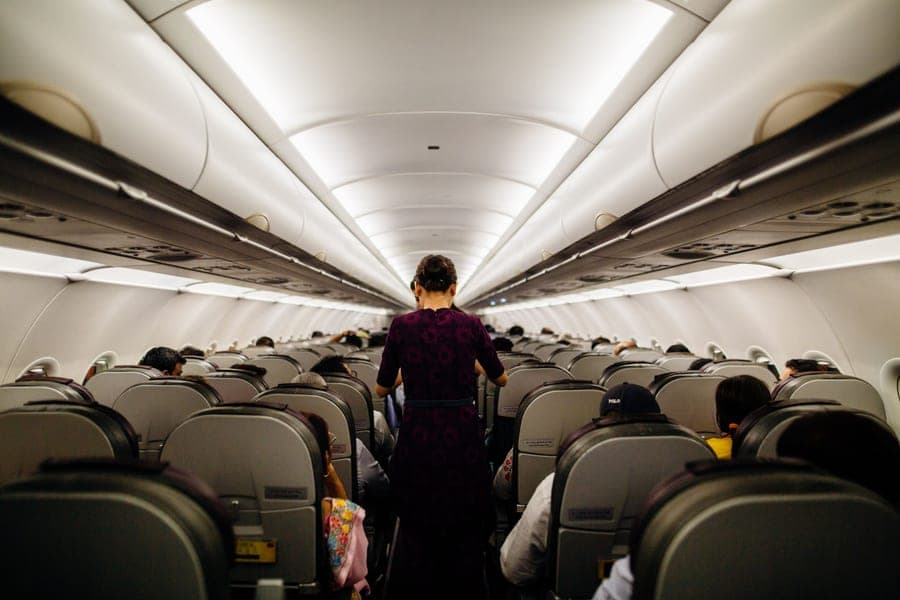
Yes. Bluetooth noise-canceling headphones are permitted on essentially every airline throughout the flight, including taxi, takeoff and landing. The restriction that used to exist applied to cellular radios and larger electronic devices, not to short-range Bluetooth accessories. The one reasonable exception is that cabin crew may ask you to remove them during the safety briefing so you can hear it — that is about hearing the briefing, not about the device.
Where the confusion came from
The rule that used to exist, and what it was about
For years passengers were told to switch off all electronic devices for takeoff and landing. That rule was real, and the reason people are still uncertain is that it was never clearly explained when it changed.
Two separate concerns were bundled together. One was potential radio interference with aircraft systems, which applied primarily to cellular transmitters — devices deliberately broadcasting at comparatively high power to reach a distant tower. The other was loose objects and distraction during the phases of flight where something going wrong matters most.
Aviation regulators have since separated the two. Small personal electronic devices, and short-range Bluetooth accessories in particular, are permitted through all phases of flight, while cellular service remains off. A pair of headphones broadcasting a few meters to your phone is a categorically different thing from a phone reaching for a cell tower.
Airplane mode disables the cellular radio. It does not disable Bluetooth, and that is deliberate.
Airplane mode
What airplane mode actually does
A common source of doubt. Turning on airplane mode disables the cellular radio. On every modern phone it leaves Bluetooth available, and you can re-enable Wi-Fi separately for the aircraft’s own network.
That is not a loophole, it is the intended design. If Bluetooth were the concern, airplane mode would switch it off and not offer a toggle. Your headphones will pair normally with your phone in airplane mode, which is exactly what you want.
The exception
The safety briefing
Cabin crew may ask you to remove your headphones during the safety demonstration, and this is the one time you should expect it.
The reason is not about the device. It is that you need to actually hear the briefing, and someone with active canceling on and music playing is not going to. Take them off, put them back on, and everyone is satisfied.
You may also be asked to remove them when a crew member is speaking to you directly — a meal question, an exit-row briefing. That is ordinary courtesy rather than a rule.
A summary
Where you stand at each phase of flight
| Phase of flight | Bluetooth headphones | Note |
|---|---|---|
| Boarding | Fine | - |
| Safety briefing | Take them off | So you can hear it |
| Taxi | Fine | - |
| Takeoff | Fine | This is the change people are unsure about |
| Cruise | Fine | - |
| Descent and landing | Fine | - |
| When crew speak to you | Take them off | Courtesy rather than a rule |
Wired headphones are permitted throughout with no caveats at all, since they broadcast nothing. Worth knowing if you ever encounter a crew member who is stricter than the airline’s own policy — and another reason a headphone with a socket is useful.
The real restriction
The thing that will actually stop you
In practice the rule is rarely what prevents people using their own headphones on a flight. What prevents it is that the seatback entertainment system has a wired audio output and no Bluetooth transmitter, so your wireless headphones have nothing to pair with.
There is no setting you missed and no permission to request. The fix is either a cable, if your headphone has a socket, or a small transmitter plugged into the seat jack. That is covered properly in Bluetooth headphones and in-flight entertainment and best headphones for in-flight entertainment.
Two related questions
Things people ask alongside this
Can I take them in hand luggage?
Yes, and you should — headphones belong in your personal item rather than a checked bag, both because you want them on the flight and because lithium batteries are generally expected to travel in the cabin. They are not a restricted item in any sense that affects a passenger.
Do they help with ear pressure?
No, and this is a common misconception worth correcting separately. Noise canceling works on sound, not air pressure, and ear discomfort on descent is your Eustachian tubes equalizing. Do noise-canceling headphones help with cabin pressure explains the physiology.
In short
Key takeaways
- Yes — Bluetooth noise-canceling headphones are permitted throughout the flight on essentially every airline.
- The old restriction was about cellular transmitters and loose objects, not short-range Bluetooth.
- Airplane mode disables the cellular radio and leaves Bluetooth available. That is by design.
- Crew may ask you to remove them for the safety briefing. That is about hearing the briefing.
- Wired headphones are permitted throughout with no caveats at all.
- What actually stops people is that the seatback screen has no Bluetooth to pair with.
At a glance
Quick picks
Scores are our editorial judgment from published specifications and cited third-party measurements, not our own testing. The rubric is published in full. Tap any row for the full write-up.
| # | Product | Best for | Score | Price |
|---|---|---|---|---|
| 1 | 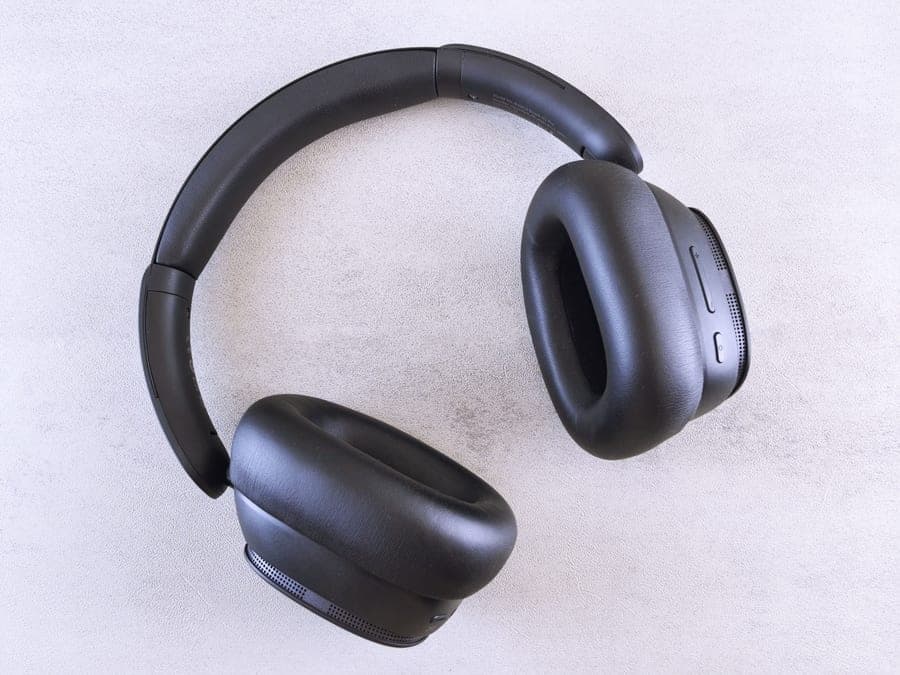 Sony WH-1000XM6The most complete travel headphone on sale: 254 g, 30 rated hours with noise canceling on, and it folds into a case small enough to stop being a decision. | The straightforward answer | 9.19.1 out of 10, our editorial score | |
| 2 | 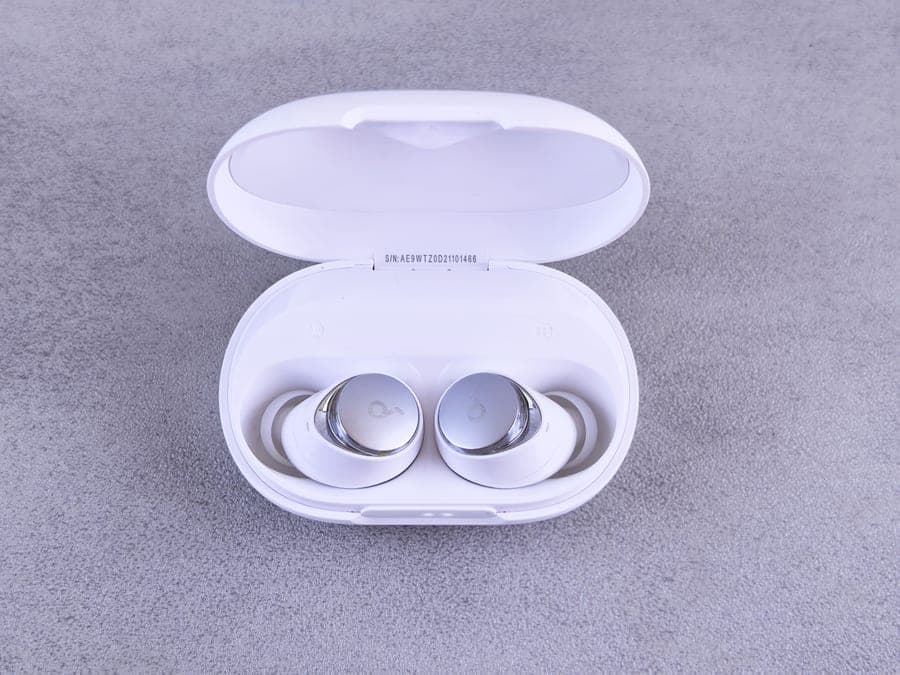 Sony WF-1000XM6Eight rated hours per bud and 24 with the case, at roughly 6.5 g each. The most sensible premium earbud for a flight, because you never have to plan around the battery. | If you want to sleep through the flight | 8.98.9 out of 10, our editorial score | |
| 3 | 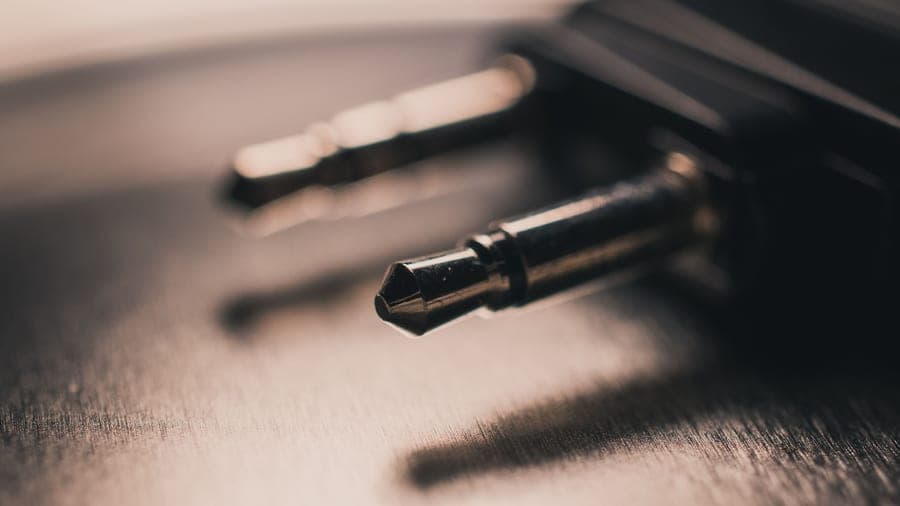 Twelve South AirFly Pro 2The single accessory that makes any wireless headphone work with a seatback screen: plug it into the airline jack and it sends the audio to your headphones over Bluetooth. | The other restriction people hit | 9.09.0 out of 10, our editorial score |
#ad Amazon links are affiliate links. No live price is shown anywhere on this site, so every button reads “Check price on Amazon”. How this is funded.
The picks in full
Every pick, in detail
1. The straightforward answer
Sony WH-1000XM6
The most complete travel headphone on sale: 254 g, 30 rated hours with noise canceling on, and it folds into a case small enough to stop being a decision.
Our editorial score: 9.1 / 10
#ad Live price not shown. How this is funded
Also sold direct by Sony — we earn nothing there, so check both.
If this page has settled your question and the next one is what to actually buy, this is the default recommendation: approximately 254 g, folds into a compact case, 30 rated hours with canceling on, and a 3.5 mm socket for the seatback screen.
Bluetooth 5.3 with SBC, AAC, LDAC and LC3, so it pairs reliably with whatever you are carrying.
What works on a plane
- Folds, which halves the space it takes in a personal item
- 254 g is light for a flagship over-ear, and weight is what you feel at hour four
- LDAC plus LC3 means it is not locked to one phone ecosystem
- 30 rated hours with noise canceling on covers almost any single routing
What does not
- You pay a flagship price for the last increment of noise canceling
- The folding hinge is one more mechanism to eventually wear out
- No airline two-prong adapter in the box
How it scores against the five travel axes
Published specifications
| Spec | Figure | Source |
|---|---|---|
| Weight | Approx. 254 g (9 oz) | Sony Help Guide specifications |
| Battery, NC on | Up to 30 hours | Sony specifications |
| Battery, NC off | Up to 40 hours | Sony specifications |
| Full charge | Approx. 3.5 hours | Sony Help Guide specifications |
| Bluetooth | 5.3 | Sony Help Guide specifications |
| Codecs | SBC, AAC, LDAC, LC3 | Sony Help Guide specifications |
| Wired response | 4 Hz - 40,000 Hz (IEC) | Sony Help Guide specifications |
| Folds | Yes, into a magnetic-closure case | Sony |
2. If you want to sleep through the flight
Sony WF-1000XM6
Eight rated hours per bud and 24 with the case, at roughly 6.5 g each. The most sensible premium earbud for a flight, because you never have to plan around the battery.
Our editorial score: 8.9 / 10
#ad Live price not shown. How this is funded
Also sold direct by Sony — we earn nothing there, so check both.
Worth mentioning on a rules page because one genuine restriction does apply to over-ears and not to earbuds: you cannot sleep against a window in an earcup, and the crew will not stop you trying.
Roughly 6.5 g a bud, eight rated hours and 24 with the case. Canceling works with no audio playing, so these function as pure ear protection for a nap.
What works on a plane
- Eight rated hours per charge clears most short-haul flights without touching the case
- 24 hours total with the case is the strongest reserve in the premium earbud set
- LDAC means it is not tied to one phone platform
- Roughly 6.5 g per bud effectively disappears when you are trying to sleep on your side
What does not
- Canceling is excellent but the Bose still takes the low-frequency band
- No wired fallback at all, so a seatback screen needs a transmitter
- IPX4 is splash resistance, not weather resistance
How it scores against the five travel axes
Published specifications
| Spec | Figure | Source |
|---|---|---|
| Battery, earbuds | Up to 8 hours | Sony |
| Total with case | Up to 24 hours (16 from the case) | Sony |
| Weight | Approx. 6.5 g per bud with M tips | Sony |
| Driver | 8.4 mm | Sony |
| Bluetooth | 5.3 | Sony |
| Codecs | SBC, AAC, LDAC, LC3 | Sony |
| Water resistance | IPX4 | Sony |
| Processor | HD Noise Canceling Processor QN3e, dual processors, eight microphones | Sony |
3. The other restriction people hit
Twelve South AirFly Pro 2
The single accessory that makes any wireless headphone work with a seatback screen: plug it into the airline jack and it sends the audio to your headphones over Bluetooth.
Our editorial score: 9.0 / 10
#ad Live price not shown. How this is funded
Also sold direct by Twelve South — we earn nothing there, so check both.
The rule that actually stops people using their headphones on a plane is not a regulation, it is that the seatback screen has a wired output and no Bluetooth transmitter, so there is nothing to pair with.
This plugs into the seat jack and solves it for any Bluetooth headphone. 25+ rated hours, and it pairs two sets so you can share a screen. Nothing about it is restricted on board.
What works on a plane
- 25+ rated hours outlasts any single flight you will ever take
- Pairs two sets of headphones, so two people can watch one screen
- Receiver mode makes it useful in a rental car with only an aux input
- Works with any Bluetooth headphone, so it outlives whatever you own now
What does not
- One more small object to charge and not lose
- Adds a small amount of latency, which shows on lip sync for some people
- A single 3.5 mm plug, so older twin-socket seats still want a two-prong adapter
How it scores against the five travel axes
Published specifications
| Spec | Figure | Source |
|---|---|---|
| Battery | 25+ hours | Twelve South |
| Full charge | About 2 hours via USB-C | Twelve South |
| Bluetooth | 5.3, aptX HD Adaptive | Twelve South |
| Modes | Transmitter and receiver | Twelve South |
| Pairing | Two sets of headphones at once | Twelve South |
| Connection | 3.5 mm AUX | Twelve South |
Questions
Common questions
Are noise-canceling headphones allowed on planes?
Yes, on essentially every airline and throughout the flight, including taxi, takeoff and landing. The restriction that used to exist applied to cellular radios and larger devices rather than short-range Bluetooth accessories.
Can I use Bluetooth headphones during takeoff and landing?
Yes. Regulators separated short-range Bluetooth accessories from cellular transmitters some years ago, and Bluetooth headphones are permitted through all phases of flight. Cabin crew may still ask you to remove them for the safety briefing.
Does airplane mode turn off Bluetooth?
No. Airplane mode disables the cellular radio; Bluetooth stays available on every modern phone, and Wi-Fi can be re-enabled separately for the aircraft’s network. That is the intended design rather than a loophole.
Will cabin crew ask me to take my headphones off?
Possibly, during the safety briefing, so that you can hear it — and when they are speaking to you directly. That is about hearing instructions rather than about the device. Outside those moments you are fine.
Can I put noise-canceling headphones in my carry-on?
Yes, and you should. Headphones belong in your personal item both because you want them during the flight and because lithium batteries are generally expected to travel in the cabin rather than the hold.
Why won't my headphones connect to the airplane screen then?
Because the seat has a wired audio output and no Bluetooth transmitter, so there is nothing to pair with. It is not a rule or a permission problem. You need either a 3.5 mm cable, if your headphone has a socket, or a small Bluetooth transmitter plugged into the seat jack.
Sources
Where these figures come from
Read next
Related reading
- Bluetooth headphones and in-flight entertainment
The restriction that actually affects you.
- How noise-canceling headphones work on a plane
Why a cabin is the ideal environment for the technology.
- Do noise-canceling headphones help with cabin pressure?
The other common misconception, corrected.
- Best noise-canceling headphones for flights
If the next question is what to buy.
- Best wired headphones for flights
Wired headphones are permitted with no caveats at all.