
To compare noise-canceling headphones, rewrite both spec sheets into the same units before reading either: find each battery figure for the same mode, separate manufacturer-measured claims from published specifications, convert weight and fold size into carried bulk, check what cable is actually in the box, confirm the wired fallback, and then ignore driver diameter and frequency response entirely.
The six steps
A comparison that works
- Normalise the battery mode. Find the canceling-on figure for every product on your list. It is usually further down the page than the headline number, and it is the only one that describes how you will listen.
- Separate claims from specifications. “-37 dB in our own laboratory” and “rated up to 50 dB” are vendor claims. A published weight in grams is a specification. Keep them in different columns.
- Convert size into carried bulk. Weight is published; fold geometry and case size usually are not. A heavier headphone in a flat hard case can take less room than a lighter one that does not fold.
- Read the box contents. A wired fallback that requires a cable the manufacturer does not supply is an errand, not a feature.
- Confirm the wired and in-flight path. 3.5 mm, 2.5 mm-to-3.5 mm, USB-C audio or a transmitter: these are not interchangeable, and one of them will be what your seat offers.
- Delete the specs that do not discriminate. Driver diameter and quoted frequency response tell you almost nothing about how a headphone performs in a cabin. Cut them from the table and the table gets clearer.
Step one in practice
Why battery figures are the worst offender
Canceling is the largest discretionary power draw in the product, so switching it off produces the biggest number available for the box. Across these three products the gap between the headline figure and the canceling-on figure is 30 hours, 20 hours and nothing respectively — which means the ranking changes depending on which column you read.
Spatial audio modes make it worse again: Bose publishes a separate up-to-23-hour figure for Immersive Audio. If you intend to use that feature, 23 is your number, not 30 and certainly not 45. The battery rankings apply this normalisation across the whole registry.
You are not comparing products. You are comparing two marketing departments’ choices about which measurement to print largest.
Worked example
The same three products, normalised
| Bose QC Ultra | JBL Tour One M3 | Soundcore Space 2 | |
|---|---|---|---|
| Battery, canceling ON | up to 30 h | up to 40 h | up to 50 h |
| Battery, canceling OFF | up to 45 h | up to 70 h | up to 70 h |
| Battery, spatial mode | up to 23 h | Not published | Not published |
| Weight | approx. 264 g as reported | 278 g | 264 g (9.31 oz) |
| Quick charge | Not published | 5 min = 5 h | 5 min = 4 h |
| Vendor canceling claim | No figure published | No figure published | -37 dB, Anker's own lab |
| Cable in the box | 2.5 mm-to-3.5 mm | USB-C to 3.5 mm | 3.5 mm input, cable supplied |
| In-flight path | Analogue cable | Smart Tx transmitter | Analogue cable |
Read the canceling-on row and the order is Soundcore, JBL, Bose. Read the headline row and it is JBL and Soundcore tied, with Bose last. Neither ordering is the buying answer, because the thing the Bose wins is in no row of this table — which is the final lesson of the method.
The unmeasurable part
Three things that decide it and never appear on a spec sheet
Canceling depth
Almost nobody publishes an attenuation curve, and the vendors who publish a single decibel figure measured it themselves. You are left with independent measurement sites and careful reading. This site’s own position is published at /methodology: editorial scores derived from specifications and named third-party measurement, never from a lab we do not have.
Clamping force
Not published by anyone. Weight is the usable proxy and it is imperfect, because a light headphone with a firm clamp hurts sooner than a heavy one with a gentle one. The comfort rankings treat this as the judgment call it is.
Pad heat
Also unpublished, and the reason a specification-perfect headphone can still be unbearable at hour four. Pad material and depth are the clues, and neither is quantified.
Specs to ignore
Four numbers that look decisive and are not
- Driver diameter. A 40 mm driver is not better than a 42 mm one, or worse than a 10 mm one in a different form factor. It describes geometry, not performance.
- Quoted frequency response. A 4 Hz to 40,000 Hz figure describes a wired measurement at an unstated tolerance. It does not tell you what you will hear.
- Microphone count. Eight microphones is an architecture, not an outcome. What matters is what the processing does with them.
- Bluetooth version. 5.3 against 6.1 changes nothing you will notice. The codec list matters far more — LDAC versus AAC for travel covers which.
In short
Key takeaways
- Rewrite every spec sheet into the same units before you compare anything.
- Always find the canceling-on battery figure. The headline number is usually canceling-off.
- Keep vendor-measured claims such as -37 dB in a separate column from published specifications.
- Fold geometry and case size decide carried bulk more than weight does.
- Clamping force, pad heat and real canceling depth are unpublished. Expect to rely on judgment for those three.
- Driver diameter, quoted frequency response, microphone count and Bluetooth version do not discriminate between good products.
At a glance
Quick picks
Scores are our editorial judgment from published specifications and cited third-party measurements, not our own testing. The rubric is published in full. Tap any row for the full write-up.
| # | Product | Best for | Score | Price |
|---|---|---|---|---|
| 1 | 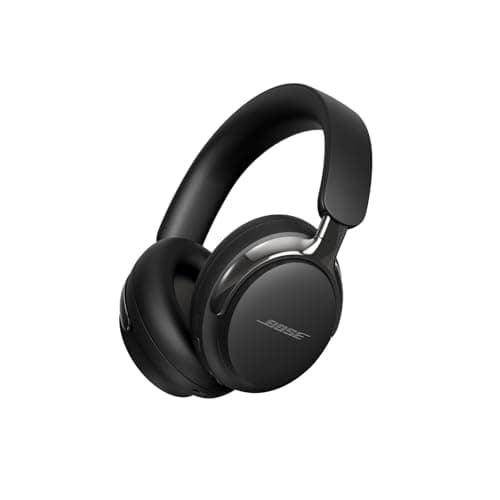 Bose QuietComfort Ultra Headphones (2nd Gen)The quietest cabin of anything here, and the only over-ear in this group whose box already contains the audio cable a seatback screen needs. | What the method picks on canceling depth | 9.09.0 out of 10, our editorial score | |
| 2 | 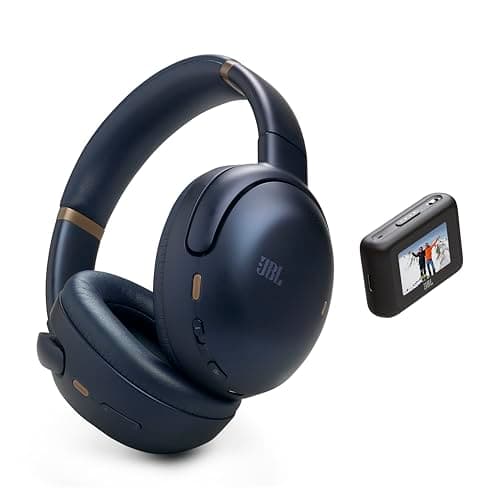 JBL Tour One M3The only headphone here that ships with the answer to the airline-jack problem in the box: the Smart Tx transmitter plugs into the seat and sends the movie to your headphones over Bluetooth. | The spec sheet that needs normalising most | 8.78.7 out of 10, our editorial score | |
| 3 | 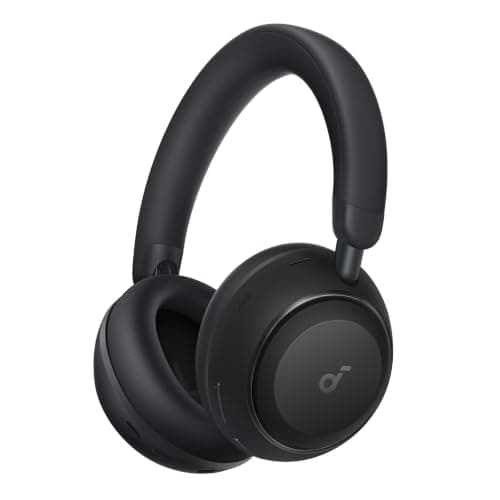 Soundcore Space 2Fifty rated hours with canceling on, a 3.5 mm input and a case in the box, at a fraction of flagship money. The compromise is in the last 10 percent of quiet, not the first 80. | Where a vendor claim needs reading carefully | 8.28.2 out of 10, our editorial score |
#ad Amazon links are affiliate links. Prices come from Amazon’s own data on the date stamped under the buttons above; where we have no current figure the button reads “Check price on Amazon” instead of guessing. How this is funded.
The picks in full
Every pick, in detail
1. What the method picks on canceling depth
Bose QuietComfort Ultra Headphones (2nd Gen)
The quietest cabin of anything here, and the only over-ear in this group whose box already contains the audio cable a seatback screen needs.
Our editorial score: 9.0 / 10
#ad Price as of November 11, 2026. How this is funded
Run the comparison properly and this is the product that wins the single criterion most buyers say they care about. Low-frequency reduction is the deepest in this registry, which is the band engine drone and train rumble occupy.
Its spec sheet is also the clearest illustration of step one. Bose publishes three battery figures — up to 30 hours with canceling on, up to 45 with it off and up to 23 with Immersive Audio — and only one of them describes how you will use it.
Approximately 264 g as reported, earcups that rotate flat into a hard case, USB-C audio at 16-bit 44.1 or 48 kHz lossless input, and a hard case, USB-C cable and 2.5 mm-to-3.5 mm audio cable in the box.
What works on a plane
- The best low-frequency canceling in this group, which is exactly the band engine drone lives in
- The 2.5 mm-to-3.5 mm cable is in the box, so a seatback screen needs nothing extra
- Compact hard case for a full-size over-ear
- Up to 45 hours with canceling off, if you only want isolation on a train
What does not
- Immersive Audio costs you a third of the battery, dropping to 23 rated hours
- Heavier than the Sony by roughly 10 g, and clamp is firmer out of the box
- The hard case is compact but still rigid, so it will not squash into a full bag
How it scores against the five travel axes
Published specifications
| Spec | Figure | Source |
|---|---|---|
| Battery, ANC on | Up to 30 hours | Bose |
| Battery, ANC off | Up to 45 hours | Bose |
| Battery, Immersive Audio on | Up to 23 hours | Bose |
| Weight | Approx. 264 g (9.3 oz) as reported | Published reviews |
| USB-C audio | 16-bit, 44.1 or 48 kHz lossless input | Bose support |
| In the box | Hard case, USB-C cable, 2.5 mm-to-3.5 mm audio cable | Bose |
| Folds | Earcups rotate flat into a compact hard case | Bose |
Read the full Bose QuietComfort Ultra Headphones (2nd Gen) review
2. The spec sheet that needs normalising most
JBL Tour One M3
The only headphone here that ships with the answer to the airline-jack problem in the box: the Smart Tx transmitter plugs into the seat and sends the movie to your headphones over Bluetooth.
Our editorial score: 8.7 / 10
#ad Price as of November 11, 2026. How this is funded
Up to 70 rated hours over Bluetooth, falling to up to 40 hours with canceling on. Both numbers are true and only the second is comparable with a rival’s canceling-on figure, which is exactly the trap step one is for.
It also shows why a feature list beats a number sometimes: the Smart Tx transmitter streams from non-Bluetooth sources including in-flight entertainment, which is a specific problem solved rather than a specification won.
278 g, an 850 mAh cell with a full charge in approximately two hours, five minutes of charge for five hours, and USB-C-to-3.5 mm and USB-C-to-USB-C cables plus a USB-C to USB-A adapter supplied.
What works on a plane
- The Smart Tx transmitter solves in-flight entertainment without a separate purchase
- Up to 40 rated hours with canceling on, comfortably over a long-haul plus layover
- Five minutes of charge buys five hours
- Both a 3.5 mm and a USB-C wired path in the box
What does not
- The Smart Tx is one more small object to lose, and it needs its own charge
- 278 g sits between the Sony and the Sennheiser without beating either at their own game
- Noise canceling is very good rather than class-leading
How it scores against the five travel axes
Published specifications
| Spec | Figure | Source |
|---|---|---|
| Battery, Bluetooth | Up to 70 hours | JBL |
| Battery, ANC on | Up to 40 hours | JBL |
| Quick charge | 5 minutes gives 5 hours | JBL |
| Battery cell | 850 mAh, full charge approx. 2 hours | JBL |
| Weight | 278 g | JBL |
| Smart Tx | Transmitter streams from non-Bluetooth sources including in-flight entertainment | JBL |
| In the box | USB-C-to-3.5 mm and USB-C-to-USB-C cables, USB-C to USB-A adapter | JBL |
3. Where a vendor claim needs reading carefully
Soundcore Space 2
Fifty rated hours with canceling on, a 3.5 mm input and a case in the box, at a fraction of flagship money. The compromise is in the last 10 percent of quiet, not the first 80.
Our editorial score: 8.2 / 10
#ad Price as of November 11, 2026. How this is funded
Anker publishes a canceling figure of -37 dB measured in its own laboratory. That is a real published number, it is not independently verified, and it cannot be compared with a rival who publishes no figure at all. Step three exists because of claims like this.
The rest of the sheet is strong and straightforwardly comparable: up to 50 rated hours with canceling on and 70 with it off, 264 g, 40 mm double-layer diaphragm drivers, Bluetooth 6.1, SBC, AAC and LDAC, and a 3.5 mm wired input with Hi-Res in wired mode.
Compared on normalised terms it beats both products above on rated hours and loses to both on canceling depth and pad comfort — which is a clear, usable result rather than a confusing one.
What works on a plane
- Up to 50 rated hours with canceling on, which beats every flagship here
- A 3.5 mm input and a case in the box, so nothing else to buy for a seatback screen
- Five minutes of charge buys four hours, which covers a gate-side mistake
- The cheapest way here to get genuinely useful drone reduction on a plane
What does not
- The -37 dB canceling figure is Anker's own laboratory number, not an independent measurement, and the gap to Bose is audible
- Plainer pad materials than the Sennheiser, so hour four is less comfortable
- Plastic build will not survive being crushed in an overhead bin the way the metal Apple would
How it scores against the five travel axes
Published specifications
| Spec | Figure | Source |
|---|---|---|
| Battery, ANC on | Up to 50 hours | soundcore |
| Battery, ANC off | Up to 70 hours | soundcore |
| Quick charge | 5 minutes gives 4 hours | soundcore |
| Full charge | Approx. 2 hours | soundcore support specifications |
| Weight | 264 g (9.31 oz) | soundcore |
| Bluetooth | 6.1 | soundcore |
| Microphones | 3, with AI enhancement for calls | soundcore |
| Codecs | SBC, AAC, LDAC | soundcore support specifications |
| Drivers | 40 mm double-layer diaphragm | soundcore |
| Canceling depth | -37 dB, measured in Anker's own laboratory | soundcore support specifications |
| In the box | Headphones, charging cable, carrying case | soundcore |
| Wired | 3.5 mm input, Hi-Res in wired mode | soundcore |
Questions
Common questions
How do you compare noise cancelling headphones properly?
Normalise the spec sheets first. Find the canceling-on battery figure for every product, separate vendor-measured claims from published specifications, convert weight and fold into carried bulk, check what cable is in the box, and confirm the wired or in-flight path. Then ignore driver diameter and frequency response.
Which specification matters most for noise cancelling headphones?
Low-frequency attenuation, which almost nobody publishes. Of the figures that are published, the canceling-on battery rating, weight and the fold geometry are the three that reliably change how a headphone performs on a trip.
Can you trust a manufacturer's decibel reduction claim?
Treat it as a claim, not a measurement. Anker’s -37 dB figure for the Space 2 is explicitly measured in its own laboratory, and EarFun’s up-to-50-dB rating is its own as well. Those numbers cannot be compared with each other or with a rival who publishes nothing.
Is a bigger driver better in headphones?
No. Driver diameter describes the geometry of the transducer, not the quality of the tuning, the housing or the canceling system. A 40 mm driver in a well-designed closed earcup will beat a larger one in a poor housing every time.
How do I compare comfort between two headphones I cannot try?
Use weight as the starting proxy, then look for pad depth and material, and for reports of clamping force specifically. No manufacturer publishes clamp, so this is the part of a comparison where editorial judgment legitimately replaces a number.
Sources
Where these figures come from
Read next
Related reading
- How to choose noise-canceling headphones
The decision itself, once the specifications are comparable.
- The longest battery life headphones
The same normalisation applied across every product here.
- Our methodology
What this site scores, how, and what it refuses to claim.
- Active canceling vs passive isolation
Why one unpublished specification explains most of the difference.