A closed-back earcup seals the driver behind a solid shell, so sound does not leak out and outside noise does not leak in — and that seal is what makes active noise canceling possible. An open-back earcup has a vented or grilled rear, which produces a wider, more natural soundstage but leaks sound in both directions. For travel, commuting or any shared space, closed-back is the only workable choice.
The mechanism
What the back of an earcup actually does
A driver is a diaphragm pushing air. Air moves off both faces, not just the one pointing at your ear. What sits behind the driver decides what happens to the rear wave, and that single design choice produces almost every difference people attribute to open and closed headphones.
Seal the rear and that wave is trapped in a small volume. It pressurises, which is how you get deep, controlled bass, and it reflects, which is what produces the slightly enclosed character people complain about. Vent the rear and the wave escapes. The result sounds wider and less congested, and the bass loses the pressure that a sealed cavity provides.
Closed-back is a prerequisite for canceling
Active canceling works by generating an inverted copy of the noise inside a known acoustic volume. Open the volume up and the system has nothing predictable to control — which is why no serious canceling headphone has ever been open-back. How canceling works on a plane covers that mechanism properly.
Leakage goes both ways
An open-back pair lets the aircraft in and lets your music out. Both halves matter: you will hear the engines, and the passenger beside you will hear your film. Active canceling versus passive isolation explains why physical isolation is the part you cannot substitute with processing.
Open-back headphones are not worse headphones. They are headphones designed for a room you will not be in.
The comparison
Open-back against closed-back, by what it changes
| Open-back | Closed-back | |
|---|---|---|
| Soundstage | Wider, more natural | Narrower, more enclosed |
| Bass pressure | Less; the rear wave escapes | More; a sealed cavity pressurises |
| Isolation from outside noise | Almost none | Significant, before any processing |
| Sound leaking out | Audible to people nearby | Minimal at normal volume |
| Active noise canceling | Not viable | Required design for it |
| Heat against the ear | Runs cool | Warms up over hours |
| Right environment | A quiet room you are alone in | Planes, trains, offices, anywhere shared |
Where each belongs
Three rooms, three answers
A plane, a train or a bus
Closed-back, with canceling. This is not a preference, it is the only configuration that addresses the noise — the flights roundup ranks that field.
An open-plan office
Closed-back again, and for a second reason: leakage. An open-back pair in a shared office broadcasts your music to the desk next to you, which is the opposite of what you bought headphones for. The open-plan roundup covers the rest.
A quiet room at home
Here open-back genuinely wins, and it is worth saying so rather than pretending otherwise. Nothing is leaking in, nothing you leak out matters, and the wider presentation is a real pleasure over long sessions. The unsealed Koss pairs above get you most of the way there for very little. Are audiophile headphones good for travel is the page for anyone trying to make one pair do both jobs.
Semi-open
A note on “semi-open”
Some manufacturers describe a partially vented earcup as semi-open. There is no standard behind the term and no published measurement that defines it, so treat it as marketing language rather than a specification. The question to ask is the practical one: can the person next to you hear it, and can you hear them?
What to look for
Four checks before you choose a design
- Name the room first. If the honest answer includes any shared or noisy space, the decision is already closed-back.
- If you want canceling, the question is closed. Active canceling and an open earcup are incompatible, not a trade-off.
- Judge heat as a real specification. A sealed earcup warms up; an unsealed one does not. Past hour three that decides comfort as much as clamp does.
- Try an unsealed on-ear before buying open-back. A Koss on-ear costs a fraction of an open-back headphone and answers most of the same want.
In short
Key takeaways
- Closed-back seals the rear of the driver: more bass pressure, real isolation, and the only design active canceling can work in.
- Open-back vents the rear: wider soundstage, cooler against the ear, and leakage in both directions.
- Sony WH-1000XM6 is the closed-back travel answer, at approximately 254 g with up to 30 rated hours of canceling.
- Sennheiser MOMENTUM 4 is the closed-back pick for anyone who finds sealed earcups claustrophobic.
- Koss Porta Pro and KSC75 are unsealed on-ears: the open experience, with no isolation at all.
- 'Semi-open' has no standard definition. Ask whether the person next to you can hear it instead.
At a glance
Quick picks
Scores are our editorial judgment from published specifications and cited third-party measurements, not our own testing. The rubric is published in full. Tap any row for the full write-up.
| # | Product | Best for | Score | Price |
|---|---|---|---|---|
| 1 | 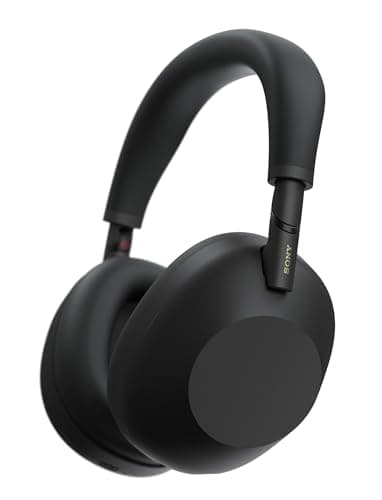 Sony WH-1000XM6The most complete travel headphone on sale: 254 g, 30 rated hours with noise canceling on, and it folds into a case small enough to stop being a decision. | Best closed-back for travel | 9.19.1 out of 10, our editorial score | |
| 2 | 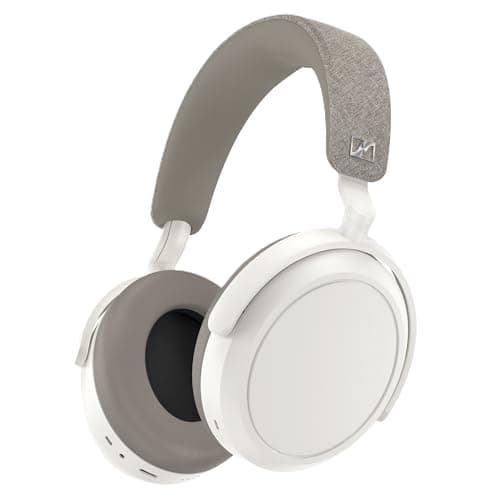 Sennheiser MOMENTUM 4 WirelessSennheiser publishes up to 60 hours. That is the difference between charging at the gate and not thinking about a charger for an entire two-week trip. | Closed-back with the most relaxed presentation | 8.88.8 out of 10, our editorial score | |
| 3 | 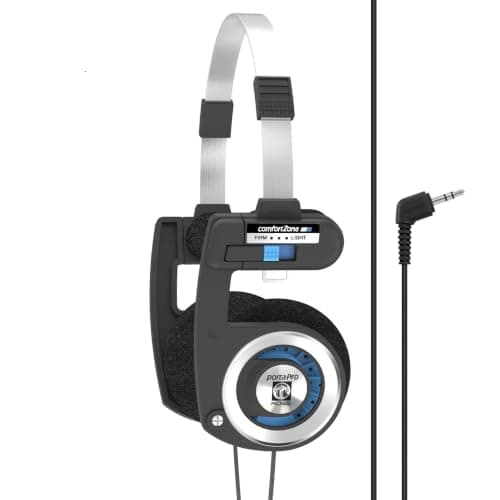 Koss Porta ProA limited lifetime warranty on the cheapest over-ear here, which means the least expensive headphone on this site is also the one least likely to need replacing. | If you want unsealed, and nothing else | 7.47.4 out of 10, our editorial score | |
| 4 | 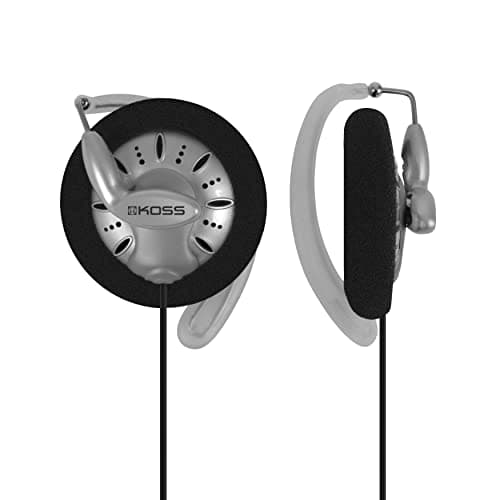 Koss KSC75A clip-on with titanium-coated diaphragms, a published distortion figure and the same limited lifetime warranty. Nothing at this price is more honest. | The cheapest unsealed option | 7.27.2 out of 10, our editorial score |
#ad Amazon links are affiliate links. Prices come from Amazon’s own data on the date stamped under the buttons above; where we have no current figure the button reads “Check price on Amazon” instead of guessing. How this is funded.
The picks in full
Every pick, in detail
1. Best closed-back for travel
Sony WH-1000XM6
The most complete travel headphone on sale: 254 g, 30 rated hours with noise canceling on, and it folds into a case small enough to stop being a decision.
Our editorial score: 9.1 / 10
#ad Price as of November 11, 2026. How this is funded
If you came here deciding between the two designs and you travel, this is the end of the decision. A sealed closed-back earcup is the prerequisite for active canceling working at all, because the system has to control the air inside a closed volume.
Approximately 254 g, up to 30 rated hours with canceling on and 40 with it off, SBC, AAC, LDAC and LC3 over Bluetooth 5.3, and a wired response quoted at 4 Hz to 40,000 Hz. It folds into a magnetic-closure case.
The 4 Hz lower figure is a closed-back fact as much as a driver fact: you cannot pressurise the ear like that through an open grille. No cable is supplied, which is the one thing to buy alongside it.
What works on a plane
- Folds, which halves the space it takes in a personal item
- 254 g is light for a flagship over-ear, and weight is what you feel at hour four
- LDAC plus LC3 means it is not locked to one phone ecosystem
- 30 rated hours with noise canceling on covers almost any single routing
What does not
- You pay a flagship price for the last increment of noise canceling
- The folding hinge is one more mechanism to eventually wear out
- No airline two-prong adapter in the box
How it scores against the five travel axes
Published specifications
| Spec | Figure | Source |
|---|---|---|
| Weight | Approx. 254 g (9 oz) | Sony Help Guide specifications |
| Battery, NC on | Up to 30 hours | Sony specifications |
| Battery, NC off | Up to 40 hours | Sony specifications |
| Full charge | Approx. 3.5 hours | Sony Help Guide specifications |
| Bluetooth | 5.3 | Sony Help Guide specifications |
| Codecs | SBC, AAC, LDAC, LC3 | Sony Help Guide specifications |
| Wired response | 4 Hz - 40,000 Hz (IEC) | Sony Help Guide specifications |
| Folds | Yes, into a magnetic-closure case | Sony |
| In the box | Headset, headphone cable, USB-C cable, carrying case, documents | Sony Help Guide, Included items |
2. Closed-back with the most relaxed presentation
Sennheiser MOMENTUM 4 Wireless
Sennheiser publishes up to 60 hours. That is the difference between charging at the gate and not thinking about a charger for an entire two-week trip.
Our editorial score: 8.8 / 10
#ad Price as of November 11, 2026. How this is funded
The pick for someone whose real objection to closed-back is that it sounds boxed in. Of the sealed over-ears in this registry, this has the most open and least forward presentation, from a 42 mm transducer.
It also has the gentlest clamp here, and clamp is the other half of what makes a closed earcup feel claustrophobic. Up to 60 rated hours, approximately 293-295 g, fold-flat earcups, a carry case and a 1.2 m 3.5 mm cable in the box.
It is still a closed-back design and it will not give you the soundstage of a genuine open-back pair in a quiet room. What it does is remove most of the reasons people give for wanting one.
What works on a plane
- Up to 60 rated hours, roughly double the flagship norm
- The 1.2 m 3.5 mm cable is in the box, so seatback screens work straight out of the bag
- Fold-flat earcups make the carry case slim rather than deep
- The 42 mm transducer is the most relaxed listen here over a very long session
What does not
- Published measurements consistently place its noise canceling a step behind the Bose
- The case is broad, so it eats width in a personal item even though it is slim
- Fold-flat is not fold-up, so the footprint is larger than the Sony's
How it scores against the five travel axes
Published specifications
| Spec | Figure | Source |
|---|---|---|
| Battery | Up to 60 hours playback | Sennheiser |
| Weight | Approx. 293-295 g | Sennheiser / published reviews |
| Transducer | 42 mm | Sennheiser |
| In the box | Carry case, USB-C cable, 1.2 m 3.5 mm auxiliary cable | Sennheiser |
| Folds | Fold-flat earcups | Sennheiser |
3. If you want unsealed, and nothing else
Koss Porta Pro
A limited lifetime warranty on the cheapest over-ear here, which means the least expensive headphone on this site is also the one least likely to need replacing.
Our editorial score: 7.4 / 10
#ad Price as of November 11, 2026. How this is funded
The closest thing on this site to the open-back experience, and deliberately so. Koss categorises it as an on-ear: foam cushions rest against the ear rather than sealing around it, so air passes freely and the sound does not feel enclosed.
15 Hz to 25,000 Hz, 60 ohms, 101 dB SPL/1mW, a straight 4 ft dual-entry cable with a 3.5 mm plug, and a limited lifetime warranty. There is no battery, no canceling and nothing to charge.
It also demonstrates the whole problem with the design on the move: it provides almost no isolation, everyone near you hears what you are playing, and on a train it is unusable. In a quiet room at a desk it is one of the best things you can buy for the money.
What works on a plane
- A limited lifetime warranty at this price, which is not a normal thing to find
- Wired, so there is no battery to degrade and nothing to charge
- Collapses flat into a bag with no case and no hinge to snap
- The 3.5 mm plug works with a seatback screen directly, no transmitter required
What does not
- Open-backed on-ear, so it blocks very little and leaks sound to your neighbor
- No noise canceling whatsoever — this is the wrong purchase for engine drone
- Foam pads wear out, though replacements are cheap and easy to fit
How it scores against the five travel axes
4. The cheapest unsealed option
Koss KSC75
A clip-on with titanium-coated diaphragms, a published distortion figure and the same limited lifetime warranty. Nothing at this price is more honest.
Our editorial score: 7.2 / 10
#ad Price as of November 11, 2026. How this is funded
The same acoustic argument, in a clip-on form factor and for less money again. 15 Hz to 25,000 Hz, 60 ohms, 101 dB SPL/1mW, total harmonic distortion below 0.2 percent, a 4 ft dual-entry cable and the same limited lifetime warranty.
It is worth knowing this exists before spending money on a “budget open-back” headphone, because it answers most of the same want. It runs cool, weighs almost nothing, and needs no power.
As with the Porta Pro, you are buying airiness and giving up isolation entirely. Treat both as home or office-at-a-quiet-desk products, never as travel headphones.
What works on a plane
- A limited lifetime warranty at the lowest price on this site, which is a genuinely unusual combination
- Publishes a distortion figure, which almost nothing at this price does
- Clip-on and tiny, so it disappears into a jacket pocket
- Wired and battery-free, so it is always ready and never degrades
What does not
- Open-backed by design, so it blocks essentially nothing
- The ear clips are an acquired taste and do not suit every ear
- No microphone, no controls, no canceling — it is a driver on a wire
How it scores against the five travel axes
How we decide
How these picks were chosen
We do not run a test lab and we do not claim to have flown with these units. Every verdict on this page is one of three things: a measurement published by somebody who does own a test rig and is credited by name, a manufacturer specification we quote and then interpret against what a long flight actually demands, or a plainly-labeled editorial judgment. The five axes we score on — cabin-noise reduction, battery on a long-haul, pack size, comfort past hour three, and wired fallback — are the ones that decide a travel purchase, and the weighting is published in full.
Questions
Common questions
What is the difference between open-back and closed-back headphones?
The rear of the earcup. Closed-back seals the driver behind a solid shell, which traps the rear wave, raises bass pressure and blocks outside noise. Open-back vents it through a grille, which produces a wider soundstage but lets sound pass freely in both directions.
Can you use open-back headphones on a plane?
You can, but you should not. They provide almost no isolation, so you hear the engines clearly and end up raising the volume, and everyone within a seat or two hears what you are playing. Closed-back with active canceling is the right configuration for a cabin.
Are open-back headphones better quality?
They are not better, they are better suited to a quiet room. The wider, less enclosed presentation is a genuine advantage with nothing to isolate against. In any shared or noisy environment the same design is a straightforward disadvantage.
Do noise cancelling headphones have to be closed-back?
Effectively yes. Active canceling generates an inverted copy of the noise inside a sealed acoustic volume, and an open earcup does not provide one. Open-ear bone-conduction designs take the opposite approach and do not attempt canceling at all.
Which should I buy if I only want one pair?
Closed-back. One pair has to work in the worst room you use it in, and that room is a plane, a train or an office rather than a quiet study. If you later want the open-back experience at a desk, an unsealed on-ear costs very little.
Sources
Where these figures come from
- Sony WH-1000XM6 specifications (weight, battery, codecs, wired response)
- Sennheiser MOMENTUM 4 Wireless product page (60 hours, weight, transducer, box contents)
- Koss Porta Pro product page (on-ear categorisation, frequency response, impedance, cable, warranty)
- Koss KSC75 product page (frequency response, impedance, distortion, cable, warranty)
Read next
Related reading
- Over-ear vs on-ear headphones
The other earcup decision, and the one that affects isolation most.
- Active canceling vs passive isolation
Why physical sealing is the part processing cannot replace.
- Are audiophile headphones good for travel?
For anyone trying to make one pair serve a quiet room and a cabin.
- Wired vs wireless headphones
The connection decision that usually comes next.