1. Best under $50, and the one that outlives everything else here
Koss Porta Pro
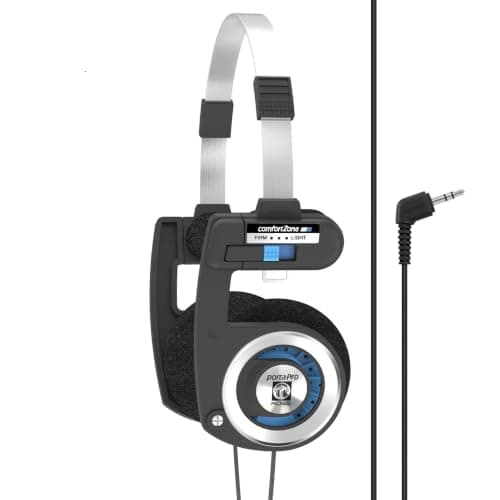
A limited lifetime warranty on the cheapest over-ear here, which means the least expensive headphone on this site is also the one least likely to need replacing.
Our editorial score: 7.4 / 10
#ad Price as of November 11, 2026. How this is funded
Every other product on this site is on a clock. A lithium cell loses capacity whether you use it or not, firmware support ends, a hinge gets one crush too many. The Porta Pro has no cell, no firmware and a limited lifetime warranty from Koss, which is an unusual thing to find at this price and a genuinely unusual thing to find at any price.
The published specification is a wired headphone from 1984 and reads like one: 15 to 25,000 Hz, 60 ohms, 101 dB SPL/1mW, a straight dual-entry 4-foot cable with a 3.5 mm plug. It folds flat without a hinge mechanism to fail and it plugs straight into a seat-back screen with no adapter, no pairing and no battery anxiety.
It is also open-backed and on-ear, which means it blocks almost nothing and leaks audibly to the person beside you. On a plane that is close to the worst possible set of properties. Everywhere else it is a bargain.
What works on a plane
- A limited lifetime warranty at this price, which is not a normal thing to find
- Wired, so there is no battery to degrade and nothing to charge
- Collapses flat into a bag with no case and no hinge to snap
- The 3.5 mm plug works with a seatback screen directly, no transmitter required
What does not
- Open-backed on-ear, so it blocks very little and leaks sound to your neighbor
- No noise canceling whatsoever — this is the wrong purchase for engine drone
- Foam pads wear out, though replacements are cheap and easy to fit
How it scores against the five travel axes
The Koss Porta Pro is the headphone to buy when you want something cheap that will not die. Koss publishes a 15 to 25,000 Hz frequency response, 60 ohms impedance, 101 dB SPL/1mW sensitivity, a straight dual-entry 4-foot 3.5 mm cable, a collapsible lightweight design with foam ear cushions, an original 1984 introduction date and a limited lifetime warranty, at a $49.99 list price. It has no battery, no Bluetooth and no noise canceling of any kind, and its open-backed on-ear design blocks very little and leaks sound to the people near you.
The short version
Who this is for, and who it is not
Buy it as the cheap pair that lives in a bag and never needs charging, as a backup for the day your main headphone is flat, as a wired path into a seat-back screen, or as a first real headphone for someone who keeps losing cheap ones. It wins the under-$50 slot in best headphones under $50 and is the recommendation in best headphones for audiobooks, where blocking the world out matters far less than a comfortable fit and spoken-word clarity.
Do not buy it to make a plane quieter. Open-backed means there is deliberately a path between the driver and the outside world, so the engine drone arrives essentially unreduced, and your neighbor hears your audiobook. If that is your problem, the cheapest product on this site that genuinely solves it is an over-ear with canceling — best budget noise-cancelling headphones for flights is the right list, and it starts about twice as high.
In short
Key takeaways
- Limited lifetime warranty from Koss on a headphone with a $49.99 list price.
- No battery, no firmware and no pairing. Nothing in it degrades on a shelf.
- A 3.5 mm plug works directly with an airplane seat-back screen, with no transmitter and no adapter.
- Open-backed on-ear: it blocks very little and leaks sound to the seat beside you.
- Koss publishes no weight and no driver diameter for this model on its US product page.
The specification
What Koss publishes
| Specification | Figure |
|---|---|
| Frequency response | 15 - 25,000 Hz |
| Impedance | 60 ohms |
| Sensitivity | 101 dB SPL/1mW |
| Cable | Straight, dual entry, 4 ft, 3.5 mm plug |
| Driver | Described only as "dynamic elements"; no diameter published |
| Weight | Not published by Koss |
| Design | Collapsible, adjustable headband, foam ear cushions |
| Noise canceling | None |
| Battery | None. It is a passive wired headphone |
| Introduced | 1984 |
| Warranty | Limited Lifetime Warranty |
| List price | $49.99 |
| In the box | Soft case, per the current Amazon listing |
Two absences are worth naming rather than filling in. Koss does not publish a weight for the Porta Pro on its US product page, and it does not publish a driver diameter — the description says “dynamic elements” and stops there. Third-party databases carry numbers for both, and we are not going to repeat them as though Koss had said them.
Criterion one
Cabin noise: it does almost nothing, by design
This is the criterion this site exists for, and the Porta Pro fails it completely. An open-backed on-ear headphone sits on the outside of your ear with a deliberate acoustic path to the outside world, so there is no seal and no barrier. Engine drone comes through. Conversation comes through. The only reduction you get is whatever your music masks, and masking is not reduction.
It also works in the other direction. Everything you play is audible to the person next to you at normal listening volume, which on a quiet train carriage is a social problem rather than an audio one. Open-back versus closed-back headphones covers the trade in full, and active canceling versus passive isolation explains why a seal does more of the work than the electronics in the first place.
There is one honest upside. Because nothing is sealed and nothing is being actively canceled, there is no pressure sensation and no ANC hiss — the two complaints that send some people back to wired headphones permanently. If canceling makes your ears feel odd, this is the product category that cannot do that to you.
Nothing in this headphone degrades on a shelf. That is the entire argument, and at this price it is a strong one.
Criterion two
Battery: not applicable, which is the point
A passive wired headphone has no battery, so it has no runtime to quote and no capacity to lose. It is identical on the first day and the two-thousandth, and it works in the state every wireless headphone fails in: flat, forgotten on a charger at home, dead at hour nine of a twelve-hour flight.
That matters more than it sounds. The single most common way a traveler ends up with silence is not a defect, it is a charger left in a hotel room. A $40 wired pair in the bottom of a bag is the cheapest insurance against that, which is the role it plays in how long noise-cancelling headphones last — the lithium cell is the part that decides the lifespan of everything else on this site, and this product does not have one.
Criterion three
Pack size: folds flat, no case needed
The headband collapses and the earpieces fold inward, so the packed object is roughly the size of a sandwich and has no rigid hinge to snap under a bag. The current Amazon listing includes a soft case; Koss’s own page does not list box contents, so treat the case as a retail-listing detail rather than a guaranteed one.
There is nothing precious about it in transit. A flagship over-ear that gets crushed in an overhead bin is a several-hundred-dollar problem, and this is not — which is precisely why it works as the pair you are willing to treat carelessly. How to pack headphones for travel covers the general case, most of which you can ignore here.
Criterion four
Comfort past hour three: light, warm-free, but it presses
On-ear is the divisive part. The pads sit on your ear rather than around it, with foam cushions and an adjustable headband, and because the design is open the cups do not trap heat the way a sealed over-ear does — so there is no sweat problem at hour three. What there can be is pressure, since the clamp is carried by the ear itself rather than by the side of your head.
People divide sharply on this and the split is anatomical rather than a matter of taste. If on-ear pressure bothers you, no amount of adjustment fixes it; over-ear versus on-ear headphones sets out which problem each form factor solves. Because it is light and the headband adjusts widely, it is also one of the few pairs that fits a smaller head properly, which is why it appears in best headphones for small heads.
The foam cushions are the wear part. They flatten and eventually crumble over a few years, and replacements are cheap and push on by hand — the warranty is on the headphone, not on consumables.
Criterion five
Wired fallback: it is the whole product
A 4-foot 3.5 mm cable plugs directly into an aircraft seat-back screen, a hotel TV, an airline’s adapter, a laptop with a jack and anything else with a headphone socket. No pairing screen, no latency, no transmitter, nothing to charge. On a modern single-jack aircraft it simply works; the older twin-pin seats need the two-prong adapter that airplane headphone jack adapters covers.
Latency is zero, which makes it a better movie headphone than any Bluetooth pair without a transmitter — Bluetooth audio latency on a plane explains the lip-sync problem this design does not have. At 60 ohms it is also easy enough to drive that a phone dongle or a seat-back jack produces sensible volume.
Security and durability
The warranty, and what it actually covers
Koss states a Limited Lifetime Warranty on the Porta Pro product page. “Limited” is doing real work in that phrase — it is a manufacturer warranty against defects, with terms and a handling cost, not an unconditional promise to replace a pair you sat on. Read Koss’s terms before relying on it.
Even read conservatively, it changes the arithmetic. A headphone that can be serviced indefinitely against defects, with no battery to become unserviceable, has an expected life measured in decades rather than in charge cycles. That is a strange thing to be able to write about a product that costs less than a month of most streaming bundles.
Alternatives
What else to look at
- Soundcore Space One — roughly twice the price, with real canceling, a battery and a wired input. The obvious upgrade if the plane is the problem.
- Best wired headphones for flights — the full list of plug-in options, including closed-back designs that do isolate.
- Soundcore P40i — similar money, opposite philosophy: a battery, canceling and a case, and none of the permanence.
The verdict
Verdict
Judged against this site’s own criteria, the Porta Pro scores badly on the one that matters most on a plane and extremely well on the two nobody thinks about until they are stranded: wired fallback and lifespan. That is not a contradiction, it is a product doing exactly what it was designed to do in 1984 and refusing to pretend otherwise.
Buy it as a second pair, a backup, a wired path to a seat-back screen, or a cheap headphone for someone who will not look after it. Do not buy it as a canceling headphone, because it has never claimed to be one.
How we decide
How these picks were chosen
We do not run a test lab and we do not claim to have flown with these units. Every verdict on this page is one of three things: a measurement published by somebody who does own a test rig and is credited by name, a manufacturer specification we quote and then interpret against what a long flight actually demands, or a plainly-labeled editorial judgment. The five axes we score on — cabin-noise reduction, battery on a long-haul, pack size, comfort past hour three, and wired fallback — are the ones that decide a travel purchase, and the weighting is published in full.
Questions
Common questions
Does the Koss Porta Pro have noise cancelling?
No. It is a passive, open-backed on-ear headphone with no battery and no canceling circuit of any kind. It blocks very little external noise and leaks audibly to the people around you.
Is the Koss Porta Pro good for flights?
Only as a wired backup. Its 3.5 mm plug works directly with a seat-back screen and it never runs out of charge, but it does nothing about engine drone. If reducing cabin noise is your goal, buy a closed-back headphone with active canceling instead.
What warranty does the Koss Porta Pro come with?
Koss lists a Limited Lifetime Warranty on the Porta Pro product page. It is a limited manufacturer warranty against defects with its own terms, not an unconditional replacement promise, so read Koss’s conditions before relying on it.
How much does the Koss Porta Pro weigh?
Koss does not publish a weight for the Porta Pro on its US product page, and it does not publish a driver diameter either. The page describes it only as lightweight with dynamic elements, so any specific gram figure you see elsewhere is a third-party measurement rather than a manufacturer specification.
Can you replace the Koss Porta Pro ear pads?
Yes. The foam cushions push on and off by hand and replacements are inexpensive, which is useful because the foam is the part that wears out first. Consumables of this kind are not what a manufacturer warranty covers.
Is the Koss Porta Pro still made?
Yes. Koss still lists it as a current product at a $49.99 list price, and it was in stock at Amazon when this page was checked on 2026-10-21. The design dates from 1984 and has been sold continuously since.
Sources
Where these figures come from
- Koss Porta Pro product page (15 - 25,000 Hz frequency response, 60 ohms impedance, 101 dB SPL/1mW sensitivity, straight dual-entry 4 ft 3.5 mm cable, lightweight collapsible design with adjustable headband and foam ear cushions, 'dynamic elements', originally introduced in 1984, Limited Lifetime Warranty, $49.99) — read 2026-10-21
- Amazon listing for the Koss Porta Pro (wired 3.5 mm plug, collapsible design, soft case included, in stock) — checked 2026-10-21
Read next
Related reading
- Best headphones under $50
The roundup this product wins, and what it beat.
- Over-ear vs on-ear headphones
Whether the pressure on your ear is going to bother you.
- Wired vs wireless headphones
What a cable still buys you on a plane.
- Best wired headphones for flights
Plug-in options that do isolate, unlike this one.
- Best headphones for audiobooks
Where an open design stops being a disadvantage.