
For cycling the Shokz OpenRun Pro 2 is the best pick: an open-ear bone-conduction design at 30.3 g that leaves the ear canal clear so traffic stays audible, with IP55, up to 12 rated hours and a band that clears a helmet strap. The Beats Powerbeats Pro 2 is the secure sealed option for traffic-free riding, the Shokz OpenSwim Pro is IP68 for wet weather, and the Soundcore P40i is the cheap pick for short rides.
The inversion
Cycling is the one case where noise canceling is a defect
Everything else on this site is built around removing sound. On a bike, the sound you are removing is a van closing from behind, a car door opening into the lane, and another rider calling a pass. Active canceling works hardest at exactly the low frequencies a diesel engine lives in, which is the single most useful warning you get.
That is why three of the four picks above are open-ear or must run with canceling off. It is the same reasoning as the walking roundup, but with speed and a road position making the stakes higher.
Transparency mode is not the same as an open ear
Transparency re-creates the outside world through microphones and plays it back to you. It is genuinely good now, and it is still a processed copy with latency, a frequency response of its own, and a complete dependency on battery. Transparency mode versus canceling covers where each one belongs. An open-ear design has none of those dependencies because nothing is blocking the ear in the first place.
Wind is the spec nobody publishes
Above roughly 25 to 30 km/h, airflow across a microphone port generates broadband noise that no canceling system removes, and some systems amplify. How canceling behaves in wind goes through the mechanism. For a cyclist it means two things: calls at speed will be bad, and a canceling system may hiss rather than help.
A sealed earbud is a better headphone and a worse cycling headphone. Those are not in conflict.
The matrix
The four picks on the figures that matter on a bike
| Shokz OpenRun Pro 2 | Beats Powerbeats Pro 2 | Shokz OpenSwim Pro | Soundcore P40i | |
|---|---|---|---|---|
| Design | Open-ear, bone conduction | Sealed, over-ear hook | Open-ear, bone conduction | Sealed in-ear |
| Water rating | IP55 | IPX4 | IP68, 2 m fresh water | IPX5 |
| Battery | up to 12 h | up to 8 h per bud | 9 h Bluetooth, 6 h MP3 | 12 h per charge |
| Total with case | n/a, no case | 36 h | n/a, no case | 60 h |
| Weight | 30.3 g total | Not published | 27.3 g total | Not published |
| Quick charge | 5 min = 2.5 h | Not published | Not published | Not published |
| Phone-free playback | No | No | Yes, 32 GB on board | No |
Fit on a bike
Three fit problems a spec sheet will not warn you about
The helmet strap
A helmet retention strap passes directly under and in front of the ear. That is the same space an over-ear hook occupies, and the same space a behind-the-head band crosses. The OpenRun Pro 2 band sits low on the occipital bone and generally clears it; a hook design needs a genuine check with your own helmet before a three-hour ride.
Sunglasses arms
Add cycling glasses and three things now compete for one small area. Glasses arms are the reason many riders end up with an open-ear band rather than hooks — the same clash the glasses roundup deals with for over-ears.
Vibration
Road buzz through a rigid frame will slowly walk a loose in-ear tip out of position, and you will not notice until the seal breaks. Hooks and bands do not have this problem. If you ride a sealed bud, carry the next tip size up.
What to look for
Four checks before you buy for cycling
- Open-ear unless you ride away from cars. Bone conduction and open-fit designs leave your hearing intact instead of simulating it.
- Read the IP digits, not the word “waterproof”. IPX4 is a splash, IPX5 is a jet, IP68 is submersion. Only one of those is a winter commute.
- Test it with your actual helmet. Hook, band and strap all want the same few millimetres, and no specification sheet mentions it.
- Expect calls at speed to be poor. Wind across a microphone port is unsolved at any price. Plan to stop if you need to be understood.
If the budget is the constraint rather than the awareness, best workout earbuds under $200 lists only the products under that ceiling with a published ingress rating.
In short
Key takeaways
- Shokz OpenRun Pro 2: open-ear, 30.3 g, IP55, up to 12 rated hours, and it clears a helmet strap.
- Beats Powerbeats Pro 2: the most secure sealed fit, up to 8 h per bud and 36 with the case, for riding away from traffic.
- Shokz OpenSwim Pro: IP68 and 32 GB on board, so wet-weather riding without a phone works.
- Soundcore P40i: IPX5, 12 h per charge and 60 with the case, for short rides on quiet roads.
- Noise canceling removes the low-frequency engine sound that warns you a vehicle is there. Leave it off.
- Wind noise above roughly 25 to 30 km/h defeats microphones, so expect bad calls at speed.
At a glance
Quick picks
Scores are our editorial judgment from published specifications and cited third-party measurements, not our own testing. The rubric is published in full. Tap any row for the full write-up.
| # | Product | Best for | Score | Price |
|---|---|---|---|---|
| 1 | 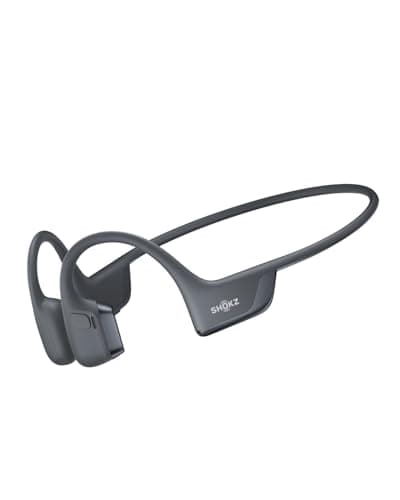 Shokz OpenRun Pro 2An open-ear headphone that leaves your ear canal empty, so you hear the traffic behind you as well as the playlist. The point of it is the opposite of noise canceling. | Best overall for cycling | 8.58.5 out of 10, our editorial score | |
| 2 | 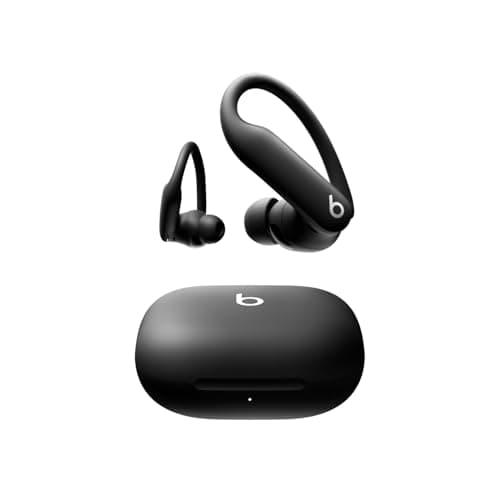 Beats Powerbeats Pro 2The ear hook is the whole argument: a sealed earbud that does not migrate out on a long run, with noise canceling for the treadmill and transparency for the road. | Best sealed option, if you ride away from traffic | 8.48.4 out of 10, our editorial score | |
| 3 | 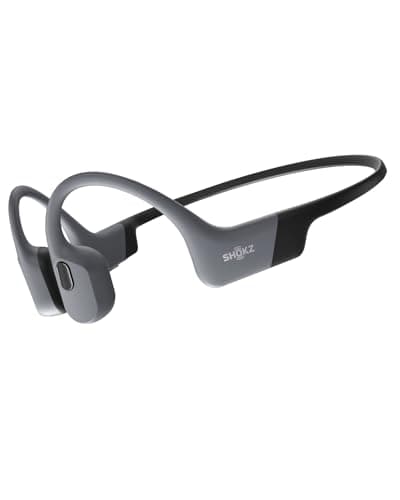 Shokz OpenSwim ProThe rare headphone that actually works underwater, because it stores the music on board rather than relying on Bluetooth, which does not travel through water. | Best for wet weather and winter riding | 8.68.6 out of 10, our editorial score | |
| 4 | 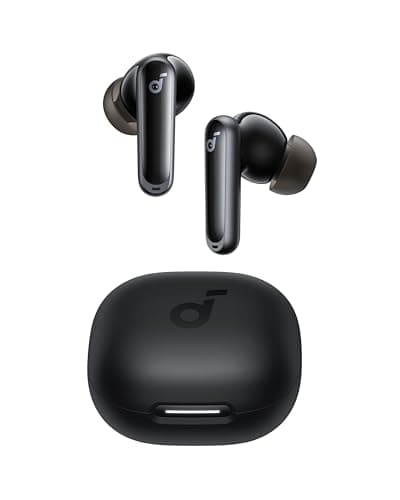 Soundcore P40iA budget earbud rated at 12 hours a charge and 60 with the case, with adaptive canceling and a case that folds out into a phone stand. | Best cheap pair for short rides | 8.08.0 out of 10, our editorial score |
#ad Amazon links are affiliate links. Prices come from Amazon’s own data on the date stamped under the buttons above; where we have no current figure the button reads “Check price on Amazon” instead of guessing. How this is funded.
The picks in full
Every pick, in detail
1. Best overall for cycling
Shokz OpenRun Pro 2
An open-ear headphone that leaves your ear canal empty, so you hear the traffic behind you as well as the playlist. The point of it is the opposite of noise canceling.
Our editorial score: 8.5 / 10
#ad Price as of November 11, 2026. How this is funded
The only design here that leaves the ear canal completely open. Bone conduction plus an 18 x 11 mm air-conduction low-frequency unit means the sound arrives through your cheekbones and the air in front of your ear, not through a plug in it. On a road with traffic that is the whole argument.
30.3 g in total, so there is nothing to shake loose over a pothole, and the wrap-behind-the-head band clears a helmet retention strap instead of competing with it. IP55 covers sweat and splashes, which is a rain shower and not a river crossing.
Up to 12 rated hours, five minutes of charge for 2.5 hours, a full charge in an hour, Bluetooth 5.3 and multipoint. The honest limits: bass is thinner than a sealed earbud at speed, and above roughly 30 km/h wind across the microphones makes calls hard work.
What works on a plane
- Your ear canal stays open, so road and trail awareness is not a compromise
- 30.3 g on a titanium band means it stops registering as something you are wearing
- IP55 shrugs off sweat, which is the failure mode that kills running earbuds
- 12 rated hours covers a marathon block without a mid-week charge
What does not
- Bone conduction gives up bass depth against a sealed earbud, and no firmware fixes physics
- IP55 is splash resistance, not submersion — this is not a swimming headphone
- Open by design, so it is the wrong tool on a plane or in an open-plan office
How it scores against the five travel axes
Published specifications
| Spec | Figure | Source |
|---|---|---|
| Weight | 30.3 g | Shokz OpenRun Pro 2 specifications |
| Battery | Up to 12 hours | Shokz OpenRun Pro 2 specifications |
| Quick charge | 5 minutes for 2.5 hours | Shokz OpenRun Pro 2 specifications |
| Full charge | 1 hour | Shokz OpenRun Pro 2 specifications |
| Bluetooth | 5.3 | Shokz OpenRun Pro 2 specifications |
| Water resistance | IP55 (sweat and splashes, not swimming) | Shokz OpenRun Pro 2 specifications |
| Drivers | Bone conduction plus an 18 x 11 mm air-conduction low-frequency unit | Shokz OpenRun Pro 2 specifications |
| Multipoint | Yes | Shokz OpenRun Pro 2 specifications |
2. Best sealed option, if you ride away from traffic
Beats Powerbeats Pro 2
The ear hook is the whole argument: a sealed earbud that does not migrate out on a long run, with noise canceling for the treadmill and transparency for the road.
Our editorial score: 8.4 / 10
#ad Price as of November 11, 2026. How this is funded
The pick for trail riding, a turbo trainer or a closed circuit — anywhere that hearing a car approach is not the deciding factor. The over-ear hook is the most secure retention system in the registry and survives a rough descent without adjustment.
Up to 8 hours per bud with canceling or transparency on and 36 hours with the case, or up to 10 and 45 in Adaptive EQ. The Apple H2 chip, IPX4 for sweat and splashes, USB-C and Qi wireless charging, and built-in heart-rate sensors that matter more to a cyclist than to anyone else on this site.
It does have a transparency mode, and on a bike that mode should stay on. Two caveats worth stating plainly: a hook and a helmet strap fight for the same few millimetres, so check that before a long ride, and transparency is a microphone feed, not an open ear.
What works on a plane
- Ear hooks solve the one problem that ruins running earbuds, which is drift
- Switchable canceling and transparency, so the same pair works on the treadmill and the road
- Heart-rate sensing on board removes one more strap from the kit
- USB-C and Qi charging, so it uses whatever cable you already carry
What does not
- IPX4 is splash and sweat only — do not take these into a pool
- The hooks make the case noticeably larger than a stem earbud case
- Best features assume an Apple device, so an Android buyer loses part of what they paid for
How it scores against the five travel axes
Published specifications
| Spec | Figure | Source |
|---|---|---|
| Battery, ANC or transparency on | Up to 8 hours per bud, 36 hours with the case | Beats |
| Battery, Adaptive EQ | Up to 10 hours per bud, 45 hours with the case | Beats |
| Water resistance | IPX4 (sweat and splashes) | Beats |
| Chip | Apple H2 | Beats |
| Noise control | Active noise canceling and transparency | Beats |
| Heart rate | Built-in heart-rate sensors | Beats |
| Charging | USB-C and Qi wireless | Beats |
3. Best for wet weather and winter riding
Shokz OpenSwim Pro
The rare headphone that actually works underwater, because it stores the music on board rather than relying on Bluetooth, which does not travel through water.
Our editorial score: 8.6 / 10
#ad Price as of November 11, 2026. How this is funded
IP68 and submersible to 2 m of fresh water, which is a different category of waterproof from the IP55 and IPX4 above. If your commute happens in the rain nine months a year, this is the one that is not being asked to survive something it is not rated for.
The reason it earns a slot beyond the rating is 32 GB of on-board storage, which means you can ride with no phone at all: 6 rated hours in MP3 mode, or 9 hours over Bluetooth 5.4. MP3, FLAC, WAV, AAC, M4A, APE and WMA are supported, and a full charge takes 1.5 hours on a four-pin magnetic cable.
27.3 g, open-ear, same cheekbone-transmission approach as the OpenRun Pro 2. It is built for swimming first, so the sound is the most compromised here — and the magnetic charger is one more proprietary cable to lose.
What works on a plane
- IP68 to 2 m is a real submersion rating, not splash resistance with optimistic marketing
- 32 GB of on-board storage is the only thing that works underwater, and it is generous
- Switches to Bluetooth on land, so it is not a single-purpose purchase
- 27.3 g under a swim cap is light enough to forget about
What does not
- Bluetooth does not work submerged, so lap swimming means loading files first
- A proprietary 4-pin magnetic charging cable is one more thing to lose
- Bone conduction in water is clear but never rich — expect intelligibility, not depth
How it scores against the five travel axes
Published specifications
| Spec | Figure | Source |
|---|---|---|
| Weight | 27.3 g | Shokz OpenSwim Pro specifications |
| Water resistance | IP68, submersible to 2 m of fresh water | Shokz OpenSwim Pro specifications |
| Battery, Bluetooth | 9 hours | Shokz OpenSwim Pro specifications |
| Battery, MP3 mode | 6 hours | Shokz OpenSwim Pro specifications |
| On-board storage | 32 GB | Shokz OpenSwim Pro specifications |
| File formats | MP3, FLAC, WAV, AAC, M4A, APE, WMA | Shokz OpenSwim Pro specifications |
| Bluetooth | 5.4 | Shokz OpenSwim Pro specifications |
| Full charge | 1.5 hours, 4-pin magnetic cable | Shokz OpenSwim Pro specifications |
4. Best cheap pair for short rides
Soundcore P40i
A budget earbud rated at 12 hours a charge and 60 with the case, with adaptive canceling and a case that folds out into a phone stand.
Our editorial score: 8.0 / 10
#ad Price as of November 11, 2026. How this is funded
The budget answer for someone who rides to work twice a week and does not want to spend open-ear money. 12 hours per charge and 60 with the case, which is more total runtime than anything else on this page.
IPX5 is a step above IPX4 — rated against a water jet rather than a splash — so a rain-soaked commute is within scope. 11 mm composite drivers, six microphones with an AI call algorithm, adaptive canceling, and a case that doubles as a phone stand.
Read the trade honestly: this is a sealed in-ear with no hook. On a bike that means canceling must stay off, you must use the transparency setting, and you should treat it as the wrong tool for riding in heavy traffic. For a quiet towpath or a bike lane away from cars it is a lot of product for very little money.
What works on a plane
- 60 rated hours with the case, from an earbud in the budget tier
- IPX5 means sweat and rain are not a worry on a commute
- The fold-out case stand is a genuinely useful thing on a tray table
- Adaptive canceling at a price where fixed canceling is the norm
What does not
- Canceling depth is a long way behind the premium earbuds, especially in the low band
- No LDAC, so Android listeners do not get the better codec
- The stock tip selection is narrow, and the seal is what decides earbud canceling
How it scores against the five travel axes
Published specifications
| Spec | Figure | Source |
|---|---|---|
| Battery, canceling off | 12 hours per charge, 60 hours with the case | Soundcore |
| Battery, canceling on | 10 hours per charge, 50 hours with the case | Soundcore |
| Noise canceling | Adaptive ANC | Soundcore |
| Drivers | 11 mm composite | Soundcore |
| Water resistance | IPX5 | Soundcore |
| Microphones | 6, with an AI call algorithm | Soundcore |
| Case | Doubles as a phone stand | Soundcore |
How we decide
How these picks were chosen
We do not run a test lab and we do not claim to have flown with these units. Every verdict on this page is one of three things: a measurement published by somebody who does own a test rig and is credited by name, a manufacturer specification we quote and then interpret against what a long flight actually demands, or a plainly-labeled editorial judgment. The five axes we score on — cabin-noise reduction, battery on a long-haul, pack size, comfort past hour three, and wired fallback — are the ones that decide a travel purchase, and the weighting is published in full.
Questions
Common questions
What are the best headphones for cycling?
The Shokz OpenRun Pro 2. It is an open-ear bone-conduction design at 30.3 g, rated IP55 and up to 12 hours, and it leaves the ear canal clear so you still hear traffic. The band also clears a helmet retention strap, which hooks and in-ears often do not.
Should you use noise cancelling headphones while cycling?
No. Active canceling is most effective in the low frequencies, which is where engine noise lives, so it specifically removes the warning that a vehicle is approaching. If you only own canceling headphones, ride with canceling off and transparency on.
Are bone conduction headphones good enough for music on a bike?
For podcasts and most music, yes. Bass is thinner than a sealed earbud and road noise competes with it at speed, which is the trade you accept for keeping your ears open. The OpenRun Pro 2 adds an 18 x 11 mm air-conduction low-frequency unit specifically to narrow that gap.
Is it legal to wear headphones while cycling?
It depends entirely on where you ride — rules differ by country, state and city, and some jurisdictions restrict both-ear use. Check your own local regulations before you rely on any pair, and treat an open-ear design as the safer option regardless of what the law allows.
What IP rating do I need for cycling in the rain?
IPX4 is tested against splashing and is the minimum for sweat. IPX5 adds a low-pressure water jet, which covers riding in rain. IP68, as on the OpenSwim Pro, means dust-tight and submersible — more than a commute needs, but the only rating that is not being pushed past its spec in a downpour.
Sources
Where these figures come from
Read next
Related reading
- Beats Powerbeats Pro 2 review
Why a hooked earbud keeps its seal when you are moving.
- Best headphones for running
The same open-ear argument, with sweat and cadence replacing wind and traffic.
- Best headphones for walking
Why canceling is wrong on foot too, and what to use instead.
- Transparency mode vs noise canceling
What a microphone feed can and cannot replace.
- Are bone conduction headphones good for flying?
The same technology in the environment it is worst at.