1. Best sealed earbud that stays put, on a run or in a seat
Beats Powerbeats Pro 2
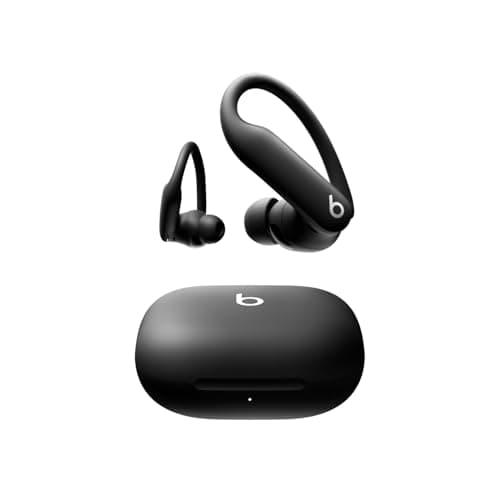
The ear hook is the whole argument: a sealed earbud that does not migrate out on a long run, with noise canceling for the treadmill and transparency for the road.
Our editorial score: 8.4 / 10
#ad Price as of November 11, 2026. How this is funded
The whole product is one decision: a nickel-titanium hook over the ear, so the bud is held by your ear’s anatomy rather than by friction inside the canal. Sealed earbuds migrate — on a run, during a jaw movement, against a seat headrest — and a bud that has shifted a millimeter has lost its seal, which means it has lost most of its canceling as well.
The specification behind it is current Apple hardware rather than a Beats afterthought: the H2 chip, active canceling and transparency, Adaptive EQ, personalized spatial audio with head tracking, three microphones a bud plus a voice accelerometer, heart-rate sensors, and five ear tip sizes from XS to XL. Beats publishes 8 hours a bud with canceling or transparency on and 36 hours with the case, rising to 10 and 45 without.
The cost of the hook is bulk. The case measures 7.5 x 6.6 x 3.4 cm, which is noticeably larger than a stem-earbud case, and IPX4 is a splash rating rather than a serious weather one.
What works on a plane
- Ear hooks solve the one problem that ruins running earbuds, which is drift
- Switchable canceling and transparency, so the same pair works on the treadmill and the road
- Heart-rate sensing on board removes one more strap from the kit
- USB-C and Qi charging, so it uses whatever cable you already carry
What does not
- IPX4 is splash and sweat only — do not take these into a pool
- The hooks make the case noticeably larger than a stem earbud case
- Best features assume an Apple device, so an Android buyer loses part of what they paid for
How it scores against the five travel axes
Published specifications
| Spec | Figure | Source |
|---|---|---|
| Battery, ANC or transparency on | Up to 8 hours per bud, 36 hours with the case | Beats |
| Battery, Adaptive EQ | Up to 10 hours per bud, 45 hours with the case | Beats |
| Water resistance | IPX4 (sweat and splashes) | Beats |
| Chip | Apple H2 | Beats |
| Noise control | Active noise canceling and transparency | Beats |
| Heart rate | Built-in heart-rate sensors | Beats |
| Charging | USB-C and Qi wireless | Beats |
The Beats Powerbeats Pro 2 is the sealed earbud to buy when fit security matters more than pocket space. Beats publishes up to 8 hours a bud with noise canceling or transparency on and 36 hours with the charging case, up to 10 hours a bud and 45 hours without, a 5-minute Fast Fuel charge for 1.5 hours, the Apple H2 chip, Class 1 Bluetooth, IPX4 sweat and water resistance, 8.7 g a bud and 77.7 g with the case, nickel-titanium earhooks, dual-layer drivers, three microphones a bud with a voice accelerometer, heart-rate sensors, five ear tip sizes and USB-C plus Qi wireless charging, at a $249.99 list price. Its weaknesses are case bulk, the splash-only rating, and a feature set that assumes an iPhone.
The short version
Who this is for, and who it is not
Buy it if your earbuds have ever worked their way loose and you have stopped trusting them, if you want one pair that covers a run and a flight, or if you want heart rate without adding a chest strap. It is the pick in best headphones for running and in best headphones for cycling for the same structural reason: a hook does not care how much you are moving.
Do not buy it if the carrying case is the thing you are optimizing. A hooked earbud cannot have a small case, and this one is about the footprint of a chunky sunglasses case rather than something that disappears into a jeans pocket. Do not buy it as your primary long-haul canceling solution either — earbuds versus over-ear for flying explains why an over-ear still wins that specific argument. And do not buy it for swimming, because IPX4 is sweat and splashes.
In short
Key takeaways
- Nickel-titanium earhooks: the bud stays located, which is also what keeps the canceling working.
- 8 rated hours a bud with canceling on, 36 with the case. Strong for a sport earbud.
- Heart-rate sensors on board, which removes a chest strap from the kit.
- IPX4 is splash and sweat only. It is not a swimming or a storm rating.
- The case is large by earbud standards at 7.5 x 6.6 x 3.4 cm, and that is the real price of the hook.
The specification
What Beats publishes
| Specification | Figure |
|---|---|
| Battery a bud, canceling or transparency on | Up to 8 hours |
| Battery with case, canceling or transparency on | Up to 36 hours |
| Battery a bud, Adaptive EQ | Up to 10 hours |
| Battery with case, Adaptive EQ | Up to 45 hours |
| Fast Fuel | 5 minutes for up to 1.5 hours |
| Chip | Apple H2 |
| Bluetooth | Class 1 wireless Bluetooth |
| Water resistance | IPX4, sweat and water |
| Weight | 8.7 g a bud; 77.7 g with the case |
| Earbud dimensions | 4.5 x 4.1 x 2.4 cm |
| Case dimensions | 7.5 x 6.6 x 3.4 cm |
| Earhooks | Nickel-titanium alloy |
| Drivers | Dual-layer |
| Microphones | Three a bud, plus a voice accelerometer |
| Sensors | Heart-rate monitoring, which can be switched off |
| Ear tips | Five sizes, XS to XL, medium pre-installed |
| Charging | USB-C and Qi-compatible wireless |
| List price | $249.99 |
One line in Beats’ own in-the-box list is worth flagging before you order: it covers the earbuds, the five tip sizes, the wireless charging case and the paperwork, and lists the power adapter and USB-C cable as sold separately. At this price that is an irritating omission, even if most buyers already own both.
Criterion one
Cabin noise: good for a sport earbud, short of a travel flagship
Beats publishes active noise canceling and transparency, both driven by the same H2 chip Apple uses in its own earbuds, and does not publish a decibel reduction figure — nor does anyone else in this category, reliably. What can be said is where the design helps and where it does not.
It helps that the hook holds the bud in a fixed position. Canceling in an earbud is built on the seal, and the single largest real-world cause of poor canceling is a bud that has shifted. A design that cannot drift keeps whatever canceling it has, consistently, through a workout or a flight. That is a meaningfully different proposition from a stem earbud that measures well and then slides.
It does not help that this is a sport product first. Against the deepest part of the engine drone band, a dedicated travel earbud with foam tips and a larger acoustic chamber is still ahead — best noise-cancelling earbuds for travel ranks on exactly that, and this is not at the top of it. Transparency mode is the underrated half of the feature set for anyone running on a road; transparency mode versus noise canceling covers how well processed awareness actually substitutes for an open design.
Canceling you keep is worth more than canceling you measure. The hook is what keeps it.
Criterion two
Battery: eight hours a bud with canceling on, which is near the top of the category
Eight rated hours a bud with canceling or transparency running is strong. The premium earbud norm is six, and several flagships publish less. Thirty-six hours with the case covers a week of workouts or a long itinerary without finding a plug, and Fast Fuel at five minutes for an hour and a half covers the pre-run panic case.
For a traveler the number that matters is the per-bud figure, because the case usually ends up in a bag in an overhead bin. Eight hours covers a transatlantic flight with the movie and the sleep attempt; it does not cover a fifteen-hour sector without a trip to the bin. Headphone battery life for long-haul flights works through how to plan around that, and the short answer is to charge the buds in the case during the meal service.
Qi charging on the case is the practical nicety: it drops onto the same pad as a phone, which is one fewer cable in a carry-on — useful given Beats does not include a cable in the box.
Criterion three
Pack size: where the hook gets paid for
Beats publishes a case of 7.5 x 6.6 x 3.4 cm and a combined weight of 77.7 g. That is bigger than any stem-earbud case and it is not close: the hooks have to fold somewhere, and the somewhere is the case. In a jacket pocket it is an obvious lump, and in a small personal item it competes with a phone charger for the same space.
Set against that, 8.7 g a bud is genuinely light on your head, the hooks pack no bulk while you are wearing them, and the whole thing is still a fraction of the volume of an over-ear plus its case. If you are choosing earbuds specifically to save space in a carry-on, this is the wrong earbud; if you are choosing earbuds because you do not want a headband, it is fine.
Criterion four
Comfort past hour three: the hook helps, the seal still decides
An over-ear hook spreads the retention load onto the top of the ear, which means the tip inside the canal does not have to be wedged tight to stay put. In practice that makes a loose-but-sealed fit viable, and a loose-but-sealed fit is the comfortable one. Five tip sizes from XS to XL is a wider range than most manufacturers ship, and it matters more than the spec sheet suggests — best earbuds for small ears covers why the stock medium fails so many people.
The limits are the usual sealed-earbud ones. Several hours of a sealed canal is warmer and more occlusive than an over-ear, glasses arms and hooks compete for the same real estate, and anything hooked over the ear is more intrusive when you are lying against a window on your side. For sleeping on a plane this is the wrong shape entirely; best earbuds for sleeping on a plane exists because that is a different product category.
IPX4 covers sweat and splashing water. It is a gym and light-rain rating, not a swimming or a downpour one, and no earbud with a charging case should be submerged.
Criterion five
Wired fallback: none, as always
There is no cable and no jack, so a seat-back screen needs a Bluetooth transmitter plugged into the aircraft socket unless the aircraft has Bluetooth audio built into the seat. Airplane headphone jack adapters covers the hardware, and Bluetooth headphones and in-flight entertainment covers which fleets have made the problem disappear.
Heart rate and the Apple question
Heart rate, and what an Android buyer gives up
Beats publishes optical heart-rate sensors in each bud, feeding workout apps in real time, and the feature can be switched off. For anyone who trains without a watch, that genuinely removes a device from the kit — and unlike a wrist sensor, an ear sensor is not being shaken by a dumbbell.
The H2 chip is the double-edged part. On an iPhone you get one-touch pairing, automatic device switching, Find My, hands-free Siri, personalized spatial audio with head tracking and firmware that updates itself. On Android the Beats app restores most of the core functionality, but several of those conveniences are not available at all. Paying premium money for a feature set you can only half use is the clearest reason an Android owner should look at the best noise-cancelling earbuds for Android instead.
Alternatives
What else to look at
- Apple AirPods Pro 3 — the same chip and the same ecosystem, deeper canceling and a far smaller case, with no hook to hold it in place.
- Shokz OpenRun Pro 2 — the opposite answer for a runner: nothing in the ear, full awareness of traffic, no canceling at all.
- Sony WF-1000XM6 — if the flight matters more than the run, and the fit problem is not yours.
The verdict
Verdict
This is a sport earbud that travels well rather than a travel earbud that can run. The hook solves a real problem that spec sheets never capture, the battery figures are near the top of the category, and the heart-rate sensing is a genuine subtraction from the amount of kit you carry. The case is big, the water rating is modest, and an Android buyer is paying for things they cannot use.
If your earbuds keep working loose, this is the fix and nothing else on this site addresses it as directly. If they do not, you can buy smaller, quieter or cheaper.
How we decide
How these picks were chosen
We do not run a test lab and we do not claim to have flown with these units. Every verdict on this page is one of three things: a measurement published by somebody who does own a test rig and is credited by name, a manufacturer specification we quote and then interpret against what a long flight actually demands, or a plainly-labeled editorial judgment. The five axes we score on — cabin-noise reduction, battery on a long-haul, pack size, comfort past hour three, and wired fallback — are the ones that decide a travel purchase, and the weighting is published in full.
Questions
Common questions
How long does the Powerbeats Pro 2 battery last?
Beats publishes up to 8 hours a bud with noise canceling or transparency on and up to 36 hours total with the charging case, rising to 10 hours a bud and 45 hours with the case when neither is active. A 5-minute Fast Fuel charge is rated for up to 1.5 hours of playback.
Do the Powerbeats Pro 2 have noise cancelling?
Yes. They carry active noise canceling and transparency mode, both driven by the Apple H2 chip. Beats publishes no decibel reduction figure, and the canceling is good for a sport earbud rather than class-leading against the deep engine drone on a plane.
Are the Powerbeats Pro 2 waterproof?
No. Beats rates them IPX4, which covers sweat and splashing water. That is a gym and light-rain rating rather than a swimming one, and the charging case should never be submerged.
How accurate is the Powerbeats Pro 2 heart rate sensor?
Beats publishes optical heart-rate sensors that feed workout apps in real time and can be switched off, but does not publish an accuracy figure, and we have not measured one. Treat it as a convenience that removes a chest strap from the kit rather than as a medical instrument.
Do the Powerbeats Pro 2 work with Android?
Yes, over standard Bluetooth, with the Beats app restoring most core controls. The H2-specific conveniences — one-touch pairing, automatic switching, Find My, hands-free Siri and personalized spatial audio with head tracking — are iPhone features, so an Android buyer is paying for capability they cannot use.
Is a USB-C cable included with the Powerbeats Pro 2?
Beats’ published in-the-box list covers the earbuds, five ear tip sizes, the wireless charging case and the paperwork, and lists the power adapter and USB-C cable as sold separately. The case also charges on any Qi-compatible pad.
Sources
Where these figures come from
- Beats Powerbeats Pro 2 product and tech-specs pages (up to 45 hours with the case and 10 hours a bud, 36 hours and 8 hours a bud with ANC or transparency on, Fast Fuel 5 minutes for 1.5 hours, Apple H2 chip, Class 1 wireless Bluetooth, IPX4, 8.7 g a bud and 77.7 g total, 4.5 x 4.1 x 2.4 cm earbuds and 7.5 x 6.6 x 3.4 cm case, nickel-titanium earhooks, dual-layer drivers, three microphones a bud plus a voice accelerometer, heart-rate sensors, five ear tip sizes XS to XL with medium pre-installed, USB-C and Qi charging, in-the-box list, $249.99) — read 2026-10-21
- Amazon listing for the Beats Powerbeats Pro 2 (in stock, Jet Black) — checked 2026-10-21
Read next
Related reading
- Best headphones for running
The roundup this product wins, and the open-ear alternative it beat.
- Best headphones for cycling
Where a secure fit and transparency matter at the same time.
- Apple AirPods Pro 3 review
Same chip, smaller case, no hook.
- Best noise-cancelling earbuds for travel
What a dedicated travel earbud does better than a sport one.
- Best earbuds for calls
If the three microphones are the part you are buying.