1. Best for running, walking and anywhere you must hear traffic
Shokz OpenRun Pro 2
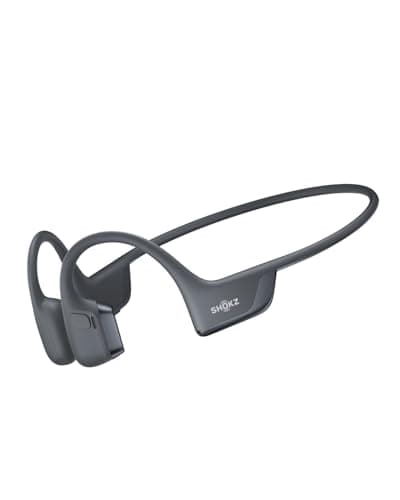
An open-ear headphone that leaves your ear canal empty, so you hear the traffic behind you as well as the playlist. The point of it is the opposite of noise canceling.
Our editorial score: 8.5 / 10
#ad Price as of November 11, 2026. How this is funded
The entire product is one decision: leave the ear canal empty. Nothing is inserted, nothing is sealed, and the sound arrives partly through your cheekbones and partly through a small air-conduction driver aimed at your ear. The result is that you hear the car, the dog, the cyclist and the playlist at the same time.
The supporting specification is strong. Shokz publishes 30.3 g on a full-titanium band, up to 12 rated hours, a one-hour full charge and IP55 — which Shokz defines as protection against low-pressure water splashes and dust, not swimming. Multipoint is listed, so a phone and a watch or laptop stay connected together.
The limits are structural and permanent. There is no isolation at all, so cabin drone and open-plan chatter come through unchanged, and bone conduction gives up bass depth against any sealed earbud. No firmware update changes either.
What works on a plane
- Your ear canal stays open, so road and trail awareness is not a compromise
- 30.3 g on a titanium band means it stops registering as something you are wearing
- IP55 shrugs off sweat, which is the failure mode that kills running earbuds
- 12 rated hours covers a marathon block without a mid-week charge
What does not
- Bone conduction gives up bass depth against a sealed earbud, and no firmware fixes physics
- IP55 is splash resistance, not submersion — this is not a swimming headphone
- Open by design, so it is the wrong tool on a plane or in an open-plan office
How it scores against the five travel axes
Published specifications
| Spec | Figure | Source |
|---|---|---|
| Weight | 30.3 g | Shokz OpenRun Pro 2 specifications |
| Battery | Up to 12 hours | Shokz OpenRun Pro 2 specifications |
| Quick charge | 5 minutes for 2.5 hours | Shokz OpenRun Pro 2 specifications |
| Full charge | 1 hour | Shokz OpenRun Pro 2 specifications |
| Bluetooth | 5.3 | Shokz OpenRun Pro 2 specifications |
| Water resistance | IP55 (sweat and splashes, not swimming) | Shokz OpenRun Pro 2 specifications |
| Drivers | Bone conduction plus an 18 x 11 mm air-conduction low-frequency unit | Shokz OpenRun Pro 2 specifications |
| Multipoint | Yes | Shokz OpenRun Pro 2 specifications |
The Shokz OpenRun Pro 2 is the best open-ear headphone for anyone who has to stay aware of traffic. Shokz publishes 30.3 ± 0.5 g on a full-titanium band, up to 12 hours of battery life, a one-hour full charge, USB-C charging, Bluetooth 5.3, IP55 sweat and splash resistance, multipoint, and DualPitch technology pairing bone conduction with an 18 x 11 mm air-conduction low-frequency driver. It comes in two band sizes, split at a 9.25-inch head measurement. It cancels and isolates nothing, which is the design rather than a fault.
The short version
Who this is for, and who it is not
Buy it if you run or walk on roads and shared paths, if you work somewhere you have to stay reachable, or if sealed earbuds make your ears ache after an hour. On this site it is the pick in best headphones for running, best headphones for walking and best headphones for backpacking, and all three are there for the same reason: awareness is a feature, not a compromise.
Do not buy it as a travel headphone. A cabin is a 50 to 300 Hz drone problem and this is an open design with no seal, so there is nothing for it to work with — the full argument is in are bone-conduction headphones good for flying. Do not buy it if you want bass. And do not buy it for swimming: IP55 is a splash rating, and the product for that job is the OpenSwim Pro at IP68.
The specification
What Shokz publishes
| Specification | Figure |
|---|---|
| Weight | 30.3 ± 0.5 g |
| Battery life | Up to 12 hours |
| Quick charge | 5 minutes for 2.5 hours |
| Full charge time | 1 hour |
| Charging port | USB-C |
| Bluetooth | 5.3 |
| Multipoint | Yes |
| Water resistance | IP55, low-pressure water splashes and dust; not for swimming |
| Sound technology | DualPitch, and PremiumPitch 2.0+ |
| Drivers | Bone conduction plus an 18 x 11 mm air-conduction low-frequency unit |
| Band material | Full titanium, silicone, plastic, nickel-titanium alloy |
| Sizes | Standard for over 9.25" (23.5 cm); Mini for under 9.25" |
| Launched | August 2024 |
| Noise canceling | None, by design |
The row most people miss is the last-but-one. Shokz sells this in two band sizes and tells you how to choose: measure your head and take the Standard above 9.25 inches, the Mini below it. An open-ear headphone holds position by band tension rather than by a seal, so the size is not a comfort preference — it is whether the drivers sit where they are supposed to. Buying the wrong one is the single most common way to be disappointed by this product.
Criterion one
Awareness: the thing it actually does
This site judges headphones on cabin-noise reduction, and this product scores zero on that axis. That is not a failure; it is a different axis. What it delivers instead is unmodified ambient hearing with audio on top, and there is no canceling headphone that can match it because the mechanisms are opposed.
The usual alternative is transparency mode, and it is not the same thing. Transparency picks up the room with external microphones, processes it and replays it into a sealed earcup. It is good, it is latency-limited, and it fails in wind, because moving air hits the microphones it depends on — which is why canceling headphones get worse outdoors and why an open design does not. The comparison between the two approaches is in transparency mode vs noise canceling.
If you are choosing a headphone for a road run, that distinction is the whole purchase. A sealed earbud in transparency mode is a processed approximation of the street; this is the street.
Every other product here is measured by how much of the world it removes. This one is measured by how little.
Criterion two
Sound: better than bone conduction has any right to be, and still not sealed
Shokz publishes a two-part driver arrangement: bone conduction plus an 18 x 11 mm air-conduction low-frequency unit, under the names DualPitch and PremiumPitch 2.0+. Shokz also states that compared with the seventh generation, the eighth generation has less vibration and leakage and better sound.
The air-conduction driver is the honest engineering answer to bone conduction’s oldest problem. Vibrating a skull is a poor way to deliver bass, so Shokz stopped trying to and added a tiny conventional speaker for the low end. It works — this has audible bass in a way that earlier bone-conduction headphones did not.
It still is not a sealed earbud, and physics does not negotiate. With nothing closing your ear canal, low frequencies have an escape path, and road noise competes directly with the music rather than being attenuated first. Two consequences worth knowing before you buy:
- Leakage is real. At higher volumes the person next to you can hear your audio. Shokz says the current generation leaks less than the previous one, which is a relative claim, not an absence.
- Volume creep is the risk. With no isolation, loud surroundings push you to turn it up, and NIOSH sets its recommended exposure limit at 85 A-weighted decibels averaged over an eight-hour day. An open design is safer for your awareness and not automatically safer for your hearing — see do noise-cancelling headphones protect your hearing.
Criterion three
Battery and charging: 12 hours, and a one-hour fill
Up to 12 rated hours, a full charge in one hour and five minutes of charge for 2.5 hours, over USB-C. For the job this product does, those are the right numbers: 12 hours is a week of hour-long runs, and a one-hour full charge means a forgotten charge is a minor inconvenience rather than a missed session.
Where it reads less well is against the over-ears on this site, which run to 24, 40 and even 60 rated hours. That comparison is not very meaningful — a 30 g band has nowhere to put a bigger cell — but it matters if you were hoping to use this as a multi-day travel headphone. On a long trip it is a supplementary pair, and best headphones for backpacking treats it that way.
Criterion four
Fit and durability: titanium, IP55, and two sizes
The band is full titanium with silicone, plastic and nickel-titanium alloy. That is the material choice that makes a wraparound band survive being shoved into a bag and bent by a cycling helmet, and it is why the weight is 30.3 g rather than something heavier with the same stiffness.
IP55 is the durability figure, and Shokz is unusually clear about what it means: protection against low-pressure water splashes and dust. Sweat and rain are covered. Submersion is not, and Shokz says so on the same page by distinguishing this from its IP67 and IP68 products. Sweat is the failure mode that kills running earbuds, so a published, unambiguous rating here is worth more than most spec rows.
The two-size split is covered above and is the thing to get right at purchase. There is no tip to swap and no pad to replace, so the band size is your only fit adjustment.
The cons
What is genuinely wrong with it
- No isolation and no canceling, at all. By design, and it rules the product out for planes, trains and open-plan offices.
- Bass is present rather than good. The air-conduction driver narrows the gap to a sealed earbud; it does not close it.
- It leaks. Less than the previous generation, per Shokz, but audibly at volume. Not a library or quiet-carriage product.
- 12 rated hours. Right for the use case, short against any over-ear.
- IP55 is not waterproof. People buy this for swimming every year and should not.
- Band size is a purchase decision you cannot undo. Measure first; there is no other fit adjustment.
- No wired fallback. Nothing to plug into a seatback screen, which is one more reason it is not a travel headphone.
The alternatives
What else to look at, and why
If you want awareness but also want to swim
The Shokz OpenSwim Pro: IP68 and submersible to 2 m of fresh water, with 32 GB of on-board storage so the phone stays behind. Shorter battery in MP3 mode and a proprietary magnetic charging cable.
If you want a sealed earbud that still runs
The Beats Powerbeats Pro 2 keeps the canal sealed, which buys you bass and canceling and costs you the awareness this product exists to provide.
If the environment is actually loud
An open design is the wrong answer next to machinery, because it protects nothing. What you want there is certified attenuation — the 3M WorkTunes Connect publishes a tested 26 dB NRR and still streams Bluetooth, which is the correct way round for a mower or a chainsaw.
If the real job is calls
Open-ear designs put a microphone a long way from your mouth. Best earbuds for calls ranks the field on published microphone layout instead, which is the right axis for that question.
If you need two devices connected
Multipoint is one of this product’s quieter strengths, and best multipoint Bluetooth headphones puts it against the over-ears and earbuds that also publish the feature.
In short
Key takeaways
- Shokz publishes 30.3 plus or minus 0.5 g on a full-titanium band, with up to 12 rated hours.
- A full charge takes one hour; five minutes of charge gives 2.5 hours, over USB-C.
- IP55 covers low-pressure splashes and dust. It is explicitly not a swimming rating.
- DualPitch pairs bone conduction with an 18 x 11 mm air-conduction driver for the low end.
- Two band sizes, split at a 9.25-inch head measurement — the only fit adjustment you get.
- It isolates and cancels nothing, which makes it the right road headphone and the wrong cabin one.
How we decide
How these picks were chosen
We do not run a test lab and we do not claim to have flown with these units. Every verdict on this page is one of three things: a measurement published by somebody who does own a test rig and is credited by name, a manufacturer specification we quote and then interpret against what a long flight actually demands, or a plainly-labeled editorial judgment. The five axes we score on — cabin-noise reduction, battery on a long-haul, pack size, comfort past hour three, and wired fallback — are the ones that decide a travel purchase, and the weighting is published in full.
Questions
Common questions
Is the Shokz OpenRun Pro 2 worth it?
If you need to hear traffic while you listen, yes — nothing sealed matches it, because the mechanisms are opposed. Shokz publishes 30.3 g, up to 12 rated hours, IP55 and a titanium band. If you want isolation, bass or a plane headphone, it is the wrong purchase at any price.
Does the Shokz OpenRun Pro 2 have noise cancelling?
No, and it is not supposed to. It is an open-ear design that leaves the ear canal empty, so there is no seal for a canceling circuit to work behind. On a plane or in an open-plan office it will not help you.
What size OpenRun Pro 2 should I buy?
Shokz splits the range at a 9.25-inch (23.5 cm) head measurement: Standard above it, Mini below. Because an open-ear headphone holds position by band tension rather than a seal, the size decides whether the drivers sit correctly, so measure before ordering.
Can you swim with the Shokz OpenRun Pro 2?
No. Shokz rates it IP55, which it defines as protection against low-pressure water splashes and dust, and distinguishes on the same page from its IP67 and IP68 products. For swimming the OpenSwim Pro is rated IP68 and submersible to 2 m of fresh water.
How long does the battery last?
Shokz publishes up to 12 hours, a one-hour full charge and five minutes of charging for 2.5 hours, over USB-C. That is short against an over-ear and appropriate for a 30 g band.
Do bone conduction headphones leak sound?
Yes, audibly at higher volumes. Shokz states that the current driver generation has less vibration and leakage than the previous one, which is a relative improvement rather than an absence. It is not the right product for a quiet carriage or a shared office.
Does it have bass?
More than bone conduction alone would give you. Shokz pairs the bone-conduction drivers with an 18 x 11 mm air-conduction low-frequency unit specifically to address this. It is still well short of a sealed earbud, because an open ear canal gives low frequencies an escape path.
Sources
Where these figures come from
- Shokz OpenRun Pro 2 product page, United States (30.3 ± 0.5 g, 12 hours battery life, 1 hour charge time, USB-C charging port, IP55 definition and the IP67/IP68 distinction, full titanium and nickel-titanium alloy materials, DualPitch technology, PremiumPitch 2.0+ and the eighth-generation vibration and leakage statement, Standard and Mini sizing split at 9.25 inches / 23.5 cm, August 2024 launch) — read 2026-10-14
- Shokz OpenRun Pro 2 specifications (Bluetooth 5.3, multipoint, 5 minutes for 2.5 hours quick charge, bone conduction plus 18 x 11 mm air-conduction low-frequency unit)
- Shokz OpenSwim Pro specifications (IP68, submersible to 2 m, 32 GB storage, for the comparison)
- CDC / NIOSH, About noise and hearing loss (85 dBA recommended exposure limit over an eight-hour workday)
Read next
Related reading
- Best headphones for running
The roundup this product wins, and the sealed alternatives it beat.
- Are bone-conduction headphones good for flying?
Why the best road design is the worst cabin design.
- Best headphones for walking
The same awareness argument at a lower heart rate.
- Best headphones for swimming
Where IP55 stops being enough and IP68 starts.
- Transparency mode vs noise canceling
The processed alternative to an open design, and where it fails.