1. Best for mowing, power tools and loud outdoor work
3M WorkTunes Connect
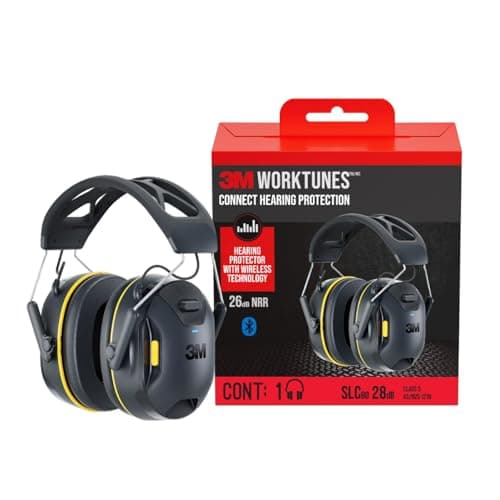
A certified hearing protector that happens to stream Bluetooth, which is the right way round for a petrol mower. Noise canceling headphones protect nothing.
Our editorial score: 8.7 / 10
#ad Price as of November 11, 2026. How this is funded
This is a hearing protector that streams Bluetooth, not a headphone that claims to protect you. The distinction is the entire reason to buy it: the 26 dB Noise Reduction Rating is a certified figure arrived at under a published test standard, which makes it the only reduction number on this site you can compare against anything else.
40+ rated hours from a built-in rechargeable cell over USB-C, an integrated microphone so you can take a call without taking it off, volume controls 3M designed to work with gloves on, and water and sweat resistance. The reduction is passive, so it keeps working when the battery dies — which is the whole safety argument.
It is bulky, warm, and merely adequate as an audio product. All three are correct trades for the job, and all three make it the wrong thing to take on a plane.
What works on a plane
- A published, certified 26 dB NRR rather than an uncertified marketing decibel figure
- 40+ rated hours outlasts any weekend of yard work by a wide margin
- Passive attenuation keeps working if the battery dies, which is the whole safety point
- Built for dust, sweat and being dropped on a driveway
What does not
- Bulky and warm — this is safety equipment, not a travel headphone
- Sound quality is adequate rather than good, which is the correct trade here
- 3M itself warns that real-world fit usually delivers less than the rated NRR
How it scores against the five travel axes
Published specifications
| Spec | Figure | Source |
|---|---|---|
| Noise Reduction Rating | 26 dB NRR | 3M product page |
| Battery | 40+ hours, rechargeable | 3M product page |
| Charging | USB-C | 3M product page |
| Connection | Bluetooth wireless, with integrated microphone for calls | 3M product page |
| Durability | Water and sweat resistant | 3M product page |
| Convenience | Auto shut-off and low-battery indicator | 3M product page |
| 3M's own caution | 3M recommends fit testing; many users receive less reduction than the NRR suggests | 3M product page |
The 3M WorkTunes Connect is the right buy for loud outdoor work, because it is certified hearing protection rather than a headphone making a quietness claim. 3M publishes a 26 dB Noise Reduction Rating, 40+ hours of battery life from a built-in rechargeable cell with a USB-C cord and port, Bluetooth wireless, an integrated microphone for calls, water and sweat resistance, glove-friendly volume controls, soft conformable earcups and a vented headband. 3M also recommends fit testing, because many users receive less reduction than the NRR suggests.
The short version
Who this is for, and who it is not
Buy it if you mow, use a chainsaw, run a leaf blower, work on a jobsite or spend hours behind anything with an engine. In that setting a canceling headphone is not a weaker version of this product — it is the wrong category of product, and the reasons are set out in best noise-cancelling headphones for mowing lawns and do noise-cancelling headphones protect your hearing.
Do not buy it as a travel headphone. It is large, it runs warm, it does not fold into anything, and its passive attenuation is tuned for broadband industrial noise rather than the narrow low-frequency drone of a cabin. For that job start at best noise-cancelling headphones for flights. Do not buy it for an office either, unless you genuinely do not care how it looks — acoustically it would work, which is the awkward finding in do noise-cancelling headphones block voices.
The specification
What 3M publishes
| Specification | Figure |
|---|---|
| Noise Reduction Rating | 26 dB NRR, certified |
| Battery life | 40+ hours, built-in rechargeable |
| Charging | USB-C cord and port |
| Connection | Bluetooth wireless |
| Microphone | Integrated, for calls without removing the headset |
| Volume controls | Ergonomic, usable with gloves on |
| Earcups | Soft and conformable |
| Headband | Vented |
| Durability | Water and sweat resistant |
| Convenience | Auto shut-off and low-battery indicator |
| Design | Lightweight and low-profile, per 3M |
| Weight | Not published by 3M in the specifications we could verify |
| 3M's own caution | 3M recommends fit testing; many users receive less reduction than the NRR suggests |
Criterion one
The 26 dB NRR: why a certified number changes the argument
Every active canceling product on this site is sold on how quiet it makes things, and not one of them publishes a reduction measurement. Bose publishes none. Sony publishes none. Soundcore advertises up to 98 percent and EarFun advertises up to 50 dB, and both are manufacturer marketing rather than tested figures, which is why this site does not repeat them as specifications.
A Noise Reduction Rating is different in kind. It is a single-number rating derived under a published test standard, it appears on the packaging by regulation, and it is directly comparable between products. 26 dB NRR against the ISOtunes LINK 2.0’s ANSI-certified 25 dB NRR is a real comparison. “26 dB NRR” against “up to 98 percent” is not a comparison at all.
For scale: NIOSH sets its recommended exposure limit at 85 A-weighted decibels averaged over an eight-hour workday, and notes that at 85 dBA you likely have to raise your voice to be heard three feet away while at 95 dBA or higher you likely have to shout. NIOSH puts lawn mowers at 85 to 90 dBA and chain saws at 95 dBA and above. A certified 26 dB of attenuation is the difference between a full afternoon of that and a safe one.
A canceling headphone tells you it is quiet. This one tells you by how much, under a test somebody else wrote.
Criterion two
The caution 3M prints itself
3M recommends fit testing and states that many users receive less reduction than the NRR suggests. That belongs near the top of any honest review of this product, because it is the manufacturer volunteering the limit of its own headline number.
The mechanism is the same one that governs every product in this category: attenuation is a seal, and a seal is defeated by anything crossing it. On a protector that means long hair under the cushion, safety-glasses arms, a hat brim, a hood seam, or a cushion that has gone hard with age. Each of those is worth several decibels, and several decibels is a large fraction of 26.
Practically: seat the cups so the cushion lands on bone all the way round with no hair trapped under it, run the glasses arms outside the cushion rather than under it where you can, and replace the cushions when they stop springing back. The general method is in how to improve noise cancelling, and it applies more strongly here than it does to a canceling headphone, because here the seal is not half the system — it is all of it.
Criterion three
Battery: 40+ hours, and it still protects you at zero
40+ rated hours from a built-in rechargeable cell, charged over a USB-C cord and port, with auto shut-off and a low-battery indicator. For weekend yard work that is effectively a season between charges.
The more important point is what happens when it does go flat, and it is the single best argument for buying protection rather than canceling. Attenuation here is passive — cup, cushion and foam — so a dead battery costs you the music and nothing else. An active canceling headphone at zero percent gives you only whatever its earcup passively blocks, which is not a certified figure and is not what you chose it for.
USB-C is also worth a line because it is not universal in this category. Some protectors in this class still run on AAA cells, which has its own advantage on a long day away from power — the ISOtunes LINK 2.0 will take AAAs as a fallback, which the WorkTunes will not.
Criterion four
As an audio product: adequate, which is correct
3M publishes Bluetooth wireless connectivity and an integrated microphone that lets you take a call without removing the headset. It does not publish drivers, frequency response, codecs or a Bluetooth version, and this site is not going to invent them.
What you can infer from the design is honest enough. A hearing protector earcup is built around attenuation, not acoustics, and the driver inside it is small and cheap by the standards of anything in best headphones for music. Expect a podcast, an audiobook or a radio station to sound completely fine, and expect music to sound thin against even the Soundcore Space One.
That is the right trade. You are behind a mower; the alternative is a certified protector with no audio at all. Two details do make the audio genuinely usable rather than tokenistic: volume controls 3M designed to be operated with gloves on, and a microphone good enough to answer the phone with your hands full.
The cons
What is genuinely wrong with it
- Bulky and warm. Safety equipment, not a travel headphone. It does not fold and there is no case.
- Audio is adequate. Fine for spoken word, thin for music, and 3M publishes no driver or codec specification to argue otherwise.
- 3M itself warns real-world fit usually delivers less than the rated NRR. Believe the manufacturer and seat it properly.
- No published weight. 3M calls the design lightweight and low-profile and does not quantify it, so neither do we.
- No AAA fallback. Rechargeable only, unlike the ISOtunes alternative.
- No output limiter. Nothing caps how loud you can play it, which matters because masking machine noise encourages exactly that. The ISOtunes LINK 2.0 publishes an 85 dB cap; this does not.
- Wrong for a cabin. Broadband attenuation is not what a 50 to 300 Hz drone needs, and you would look remarkable in seat 14C.
The alternatives
What else to look at, and why
If you want a volume ceiling
The ISOtunes LINK 2.0: 25 dB NRR, ANSI certified, OSHA and NIOSH compliant, a SafeMax limiter that caps output at 85 dB, up to 50 rated hours or AAA cells, IPX4 and a boom microphone. One decibel less attenuation, considerably more control. It is covered alongside this product in the mowing roundup.
If the noise is a plane rather than a mower
Buy a canceling headphone and do not pretend it protects you. Best noise-cancelling headphones for flights is the right page, and ANC vs passive isolation explains why the two mechanisms cover different parts of the spectrum.
If you need to hear the yard as well
Then you want the opposite product, and you accept no protection: the Shokz OpenRun Pro 2 leaves your ear canal open entirely. That is the right call for a walk and the wrong one next to a chainsaw.
If you just want the quietest thing you can wear
Plain earplugs beat both, at the cost of being unable to listen to anything. Noise-cancelling headphones vs earplugs compares them directly.
In short
Key takeaways
- 26 dB NRR is a certified figure under a published test standard — the only comparable reduction number on this site.
- 40+ rated hours from a built-in rechargeable cell, charged over a USB-C cord and port.
- Attenuation is passive, so a dead battery costs you the music and not the protection.
- 3M recommends fit testing and says many users get less reduction than the NRR suggests.
- Glove-friendly volume controls and an integrated microphone make the audio usable rather than tokenistic.
- No published weight, no output limiter and no AAA fallback — the ISOtunes LINK 2.0 has the last two.
How we decide
How these picks were chosen
We do not run a test lab and we do not claim to have flown with these units. Every verdict on this page is one of three things: a measurement published by somebody who does own a test rig and is credited by name, a manufacturer specification we quote and then interpret against what a long flight actually demands, or a plainly-labeled editorial judgment. The five axes we score on — cabin-noise reduction, battery on a long-haul, pack size, comfort past hour three, and wired fallback — are the ones that decide a travel purchase, and the weighting is published in full.
Questions
Common questions
Is the 3M WorkTunes Connect good for mowing the lawn?
Yes, and it is the right category of product for the job. NIOSH puts lawn mowers at 85 to 90 dBA and sets its recommended exposure limit at 85 dBA averaged over eight hours, and a certified 26 dB NRR is a measured reduction rather than a marketing claim.
What is the NRR of the 3M WorkTunes Connect?
26 dB. That is a Noise Reduction Rating — a single-number figure derived under a published test standard and printed on the packaging by regulation — which is why it can be compared with the ISOtunes LINK 2.0’s ANSI-certified 25 dB NRR, and why it cannot be compared with any canceling headphone’s advertising.
Is a hearing protector better than noise-cancelling headphones?
For loud machinery, yes, and not marginally. Active canceling works best on continuous low-frequency noise and its attenuation is uncertified; a protector attenuates broadband by a tested amount and keeps doing it with a flat battery. For a plane, the answer reverses.
How long does the 3M WorkTunes Connect battery last?
3M publishes 40+ hours from a built-in rechargeable battery, charged with a USB-C cord and port, with auto shut-off and a low-battery indicator. When it runs out, the passive attenuation is unaffected.
Will I actually get 26 dB of reduction?
Probably less, and 3M says so itself: it recommends fit testing and notes that many users receive less reduction than the NRR suggests. Attenuation is a seal, and hair, safety glasses, hats and hardened cushions all cost you decibels.
Can you take calls on the 3M WorkTunes Connect?
Yes. 3M publishes an integrated microphone that lets you take a call without removing the headset, over Bluetooth wireless. It does not publish microphone detail, so treat call quality as adequate rather than good.
How much does it weigh?
3M describes the design as lightweight and low-profile but does not publish a weight in the specifications we could verify, so we do not quote one. Assume it is heavier than any travel headphone here — it is a protector with a sealed cup and a vented headband.
Sources
Where these figures come from
- 3M WorkTunes Connect product page (26 dB NRR, 40+ hours rechargeable, USB-C, Bluetooth with integrated microphone, water and sweat resistance, auto shut-off and low-battery indicator, and 3M's own fit-testing caution)
- Blain's Farm & Fleet retail listing, 3M WorkTunes Connect, Mfr # 90570-DC (confirmed in stock on 2026-10-14; 26 dB NRR, 40+ hours, USB-C cord and port, Bluetooth, integrated microphone for calls without removing the headset, glove-friendly ergonomic volume controls, soft conformable earcups, vented headband, lightweight and low-profile design, water and sweat resistant)
- CDC / NIOSH, About noise and hearing loss (85 dBA recommended exposure limit over an eight-hour workday; lawn mowers 85-90 dBA; chain saws 95+ dBA; raised voice at 85 dBA and shouting at 95 dBA)
- ISOtunes LINK 2.0 product page (25 dB NRR ANSI certified, OSHA and NIOSH compliance, SafeMax 85 dB output cap, up to 50 hours or AAA, IPX4, boom microphone)
Read next
Related reading
- Best noise-cancelling headphones for mowing lawns
The roundup this product wins, and the certified alternative to it.
- Do noise-cancelling headphones protect your hearing?
Why canceling is not protection, with the figures.
- Noise-cancelling headphones vs earplugs
Pure passive attenuation, compared directly.
- Do noise-cancelling headphones work in wind?
Why passive protection is indifferent to the thing that defeats canceling outdoors.
- Shokz OpenRun Pro 2 review
The opposite product: no protection at all, by design.