1. Best wired in-ear for a flight, and the one whose cable is a repair
Sennheiser IE 100 PRO
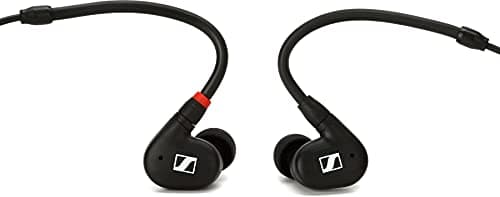
A stage in-ear monitor with a published specification sheet rather than a marketing number: a single 10 mm broadband driver, a detachable cable and a distortion figure Sennheiser is willing to print.
Our editorial score: 8.5 / 10
#ad Price as of November 11, 2026. How this is funded
Sennheiser sells this as a stage monitor, which is why it comes with something almost no consumer earphone does: a specification sheet with numbers on it that a company can be held to. 20 to 18,000 Hz, 20 ohms impedance, 115 dB SPL at 1 kHz and 1 Vrms, and total harmonic distortion below 0.1 percent at 1 kHz and 94 dB. Compare that to the unsourced decibel claims printed on most cancelling earbuds.
The part that matters on a plane is quieter than the numbers. There is no battery. Nothing to charge before a redeye, nothing to go flat over the Atlantic, nothing that loses capacity sitting in a drawer for a year. It plugs into the seat-back screen with no adapter, no transmitter and no pairing, and it will do that identically in ten years.
The cable is detachable, 1.3 m, with a 3.5 mm jack plug. On a wired earphone the cable is the part that fails, because it is the part that gets wound, yanked and bent. A detachable cable turns that from a replacement into a repair, and Sennheiser backs the whole thing with a 2-year warranty.
What works on a plane
- A real specification sheet with distortion and impedance figures, which most earbuds never publish
- No battery at all, so it never runs out and never degrades
- Detachable cable means a frayed cable is a repair rather than a replacement
- Foam and silicone tips in the box, so the seal that does all the isolating is yours to tune
What does not
- Wired, so there is a cable in your lap and no Bluetooth on a plane without an adapter
- No active noise canceling at all — isolation comes entirely from the tip seal
- No microphone on the stock cable, so it is not a call headset
How it scores against the five travel axes
Published specifications
| Spec | Figure | Source |
|---|---|---|
| Frequency response | 20 - 18,000 Hz | Sennheiser |
| Impedance | 20 ohm | Sennheiser |
| Sound pressure level | 115 dB (1 kHz, 1 Vrms) | Sennheiser |
| Distortion | THD < 0.1 % (1 kHz, 94 dB) | Sennheiser |
| Transducer | 10 mm dynamic broadband | Sennheiser |
| Cable | 1.3 m detachable, 3.5 mm jack plug | Sennheiser |
| In the box | Foam and silicone ear adapters, soft pouch, cleaning tool | Sennheiser |
The Sennheiser IE 100 PRO is a wired professional in-ear monitor that works unusually well as a flight earphone. Sennheiser publishes a 20 to 18,000 Hz frequency response, 20 ohms impedance, 115 dB SPL at 1 kHz and 1 Vrms, THD below 0.1 percent, a single 10 mm dynamic broadband transducer, a detachable 1.3 m cable with a 3.5 mm plug, foam and silicone ear adapters, a soft pouch and a cleaning tool in the box, and a 2-year warranty. It has no battery, no Bluetooth and no active noise cancelling of any kind — all of its isolation comes from the seal between the tip and your ear canal.
The short version
Who this is for, and who it is not
Buy it if you fly often and have decided that charging one more device before a trip is a tax you are done paying. Buy it if you want the wired path into a seat-back screen to be genuinely good rather than merely functional. Buy it if you care about what a transducer actually measures, because this is one of the very few products at this price where the manufacturer tells you. It is the in-ear recommendation in best wired earbuds for flights and appears throughout best wired headphones for flights.
Do not buy it expecting quiet to arrive by itself. There is no cancelling circuit here, so the low-frequency engine drone that an active headphone erases is reduced only as much as a good tip seal reduces it — which is real, but is a different and less complete effect. If a quiet cabin is the goal, the honest comparison is in active cancelling vs passive isolation, and the products that actually do it are in best noise-cancelling earbuds for flights.
Also do not buy it as a headset. The stock cable has no microphone, so it is not a call product — best earbuds for calls is the right list for that.
In short
Key takeaways
- Sennheiser publishes a real distortion figure — THD under 0.1% at 1 kHz, 94 dB — which almost no consumer earphone does.
- No battery at all: nothing to charge, nothing to go flat, nothing that degrades on a shelf.
- The 1.3 m cable detaches, so a frayed cable is a repair rather than a new pair of earphones.
- Foam and silicone ear adapters are both in the box, because the tip seal is doing all of the isolating.
- No active noise cancelling and no microphone on the stock cable.
- Sennheiser lists a 2-year warranty and a 20-ohm impedance, so it drives properly from a phone or a seat-back jack.
The specification
What Sennheiser publishes
| Specification | Figure |
|---|---|
| Frequency response | 20 - 18,000 Hz |
| Impedance | 20 Ω |
| Sound pressure level | 115 dB (1 kHz / 1 Vrms) |
| Total harmonic distortion | < 0.1 % (1 kHz, 94 dB) |
| Transducer | 10 mm dynamic broadband |
| Cable | Detachable, 1.3 m, 3.5 mm jack plug |
| In the box | Foam and silicone ear adapters, soft pouch, cleaning tool |
| Warranty | 2 years |
| Active noise cancelling | None |
| Battery | None. It is a passive wired earphone |
One oddity worth flagging rather than tidying away: Sennheiser’s spec sheet lists a weight of 160 g, and does not say what that figure covers. A pair of in-ear monitors does not weigh 160 g, so it is almost certainly the packaged set rather than what goes in your ears. We have not substituted a number of our own, and you should treat any specific in-ear gram figure you see quoted elsewhere as a third-party measurement rather than a manufacturer specification.
On a plane
What it is actually like at 38,000 feet
The seal is the entire product. Sennheiser ships both foam and silicone adapters because they behave differently: foam expands into the canal and blocks noticeably more, silicone seats faster and is easier to take in and out repeatedly. On a long flight the foam tips are the ones to use, and the difference between a good seal and a sloppy one is larger than the difference between two mid-range cancelling earbuds.
What you get from that seal is broad, even reduction across the spectrum — the cabin gets quieter in a way that feels like distance rather than like a filter. What you do not get is the specific trick an active headphone performs on 50 to 300 Hz engine drone, where cancelling removes a band that passive isolation only attenuates. Our explainer on how noise cancelling works on a plane covers why that band is the one that matters, and earbuds vs over-ear for flying covers the form-factor half of the decision.
Every other product on this site is on a clock set by a battery you are not allowed to replace. This one has no clock.
The practical wins are unglamorous and add up. It takes no space — this is the smallest packed thing in our registry by a wide margin. It works on the seat-back screen directly, with none of the Bluetooth-to-IFE friction described in Bluetooth headphones and in-flight entertainment. There is no codec negotiation and therefore no lip-sync delay, which is the whole problem discussed in Bluetooth audio latency on a plane. And at 20 ohms it is an easy load, so a phone dongle or an airline jack drives it to a sensible volume without a separate amplifier.
Against the obvious rivals
What else to consider
- If you want the cabin genuinely quiet, an active cancelling earbud is a different product and a better answer — see the Bose QuietComfort Ultra Earbuds review. You trade the battery back in to get it.
- If you want cheap and wired, the Koss Porta Pro is a third of the price with a limited lifetime warranty, but it is open-backed and on-ear, so it isolates far less and leaks to your neighbor.
- If the seat-back screen is the whole reason you are here, a Bluetooth transmitter is the other route — the AirFly Pro 2 lets a wireless headphone do the same job, with one more object to charge and lose.
- If durability is the deciding factor, the detachable cable and the absent battery put this near the top of the most durable noise-cancelling headphones, with the honest caveat that it is not a cancelling headphone at all.
Verdict
The verdict
The IE 100 PRO is the best argument on this site for buying a product designed for professionals rather than for travelers. It is honest about what it does, it publishes numbers it can be judged on, it has no battery to betray you, and the component most likely to break is the one component you can swap. For a frequent flier who has made peace with a cable, there is very little at this price that is a better long-term purchase.
It is simply not a quiet-cabin product, and we would rather say that plainly than sell it as one. If the thing you want is for the engines to go away, buy something with a battery and accept the clock.
How we decide
How these picks were chosen
We do not run a test lab and we do not claim to have flown with these units. Every verdict on this page is one of three things: a measurement published by somebody who does own a test rig and is credited by name, a manufacturer specification we quote and then interpret against what a long flight actually demands, or a plainly-labeled editorial judgment. The five axes we score on — cabin-noise reduction, battery on a long-haul, pack size, comfort past hour three, and wired fallback — are the ones that decide a travel purchase, and the weighting is published in full.
Questions
Common questions
Does the Sennheiser IE 100 PRO have noise cancelling?
No. It is a passive wired in-ear monitor with no battery and no cancelling circuit. All of its noise reduction comes from the seal between the ear tip and your ear canal, which is real but works differently from active cancelling — it attenuates engine drone rather than erasing it.
Is the Sennheiser IE 100 PRO good for flights?
Yes, with one caveat. It plugs straight into a seat-back screen with no adapter, no pairing and no battery, it packs smaller than anything else we cover, and the foam tips block a useful amount of cabin noise. The caveat is that it does nothing special about low-frequency engine drone, so a cancelling earbud will make the cabin quieter.
Can you replace the Sennheiser IE 100 PRO cable?
Yes. Sennheiser publishes the 1.3 m cable as detachable, which is the main reason this earphone has a long life — on a wired in-ear the cable is almost always the part that fails first, and here that is a repair rather than a replacement.
Does the Sennheiser IE 100 PRO have a microphone?
Not on the stock cable. Sennheiser lists a plain black cable with a 3.5 mm jack plug and no in-line microphone or remote, so it is not a call headset out of the box. If you need to take calls, look at a product built for it instead.
What warranty does the Sennheiser IE 100 PRO come with?
Sennheiser lists a 2-year warranty on the IE 100 PRO product page. That is a manufacturer warranty against defects with its own terms rather than an unconditional replacement promise, and consumables such as ear adapters are not normally covered.
Is the Sennheiser IE 100 PRO hard to drive from a phone?
No. Sennheiser publishes a 20-ohm impedance and 115 dB SPL at 1 kHz and 1 Vrms, which is an easy load. A phone dongle, a laptop jack or an airline seat-back jack will drive it to a sensible listening level without a separate headphone amplifier.
Sources
Where these figures come from
- Sennheiser IE 100 PRO product page (20 - 18,000 Hz frequency response, 20 Ω impedance, 115 dB SPL at 1 kHz / 1 Vrms, THD < 0.1 % at 1 kHz and 94 dB, 10 mm dynamic broadband transducer, detachable 1.3 m cable, foam and silicone ear adapters, soft pouch and cleaning tool in the box, 2-year warranty, 160 g listed without a stated basis) — read 2026-10-28
- Amazon listing for the Sennheiser IE 100 PRO (wired in-ear monitoring headphones, in stock) — checked 2026-10-28
Read next
Related reading
- Best wired earbuds for flights
The list this wins, and what it beat.
- Active cancelling vs passive isolation
Why a tip seal and a cancelling circuit are not the same thing.
- Most durable noise-cancelling headphones
Where a detachable cable and no battery put this product.
- Earbuds vs over-ear for flying
The form-factor half of the same decision.
- Best wired headphones for flights
Every plug-in option we recommend, over-ear included.